
There is no legitimate universal way to bypass ad review. Google’s Circumventing Systems policy treats cloaking as an egregious violation and says an account may be suspended upon detection without prior warning, and Meta applies similar enforcement across business assets. The safer, faster path for a rejected or suspended account is a documented compliance audit followed by a precise appeal, or a managed remediation service if your vertical is high-risk.
TL;DR:
- Google reviews ads within one business day; check status after two full business days, contact support after a week, and avoid unnecessary edits during review.
- Google permits up to three appeals per ad, recommends waiting at least 24 hours between them, and may suspend appeal processing after misuse.
- Before appealing, serve identical pages to reviewers and visitors, compare crawler and browser responses, inspect redirects and logs, and document changes with timestamps and screenshots.
- Disapprovals often stem from restricted products, unsupported health claims, mismatched landing pages, or licensing and trademark issues; correct the underlying cause rather than hiding it.
- A suspension can affect linked campaigns, audience lists, conversion history, and connected business assets, so avoid creating replacement accounts or domains after enforcement.
Table of Contents
- What “Bypass Ad Review” and Ad Cloaking Actually Mean
- How Cloaking and Bypass Techniques Are Implemented
- Why Platforms Prohibit Bypassing Review
- How Ad Review and Appeals Actually Work
- Compliant Recovery Checklist Before You Appeal or Resubmit
- Detection and Audit Checklist: Finding Cloaking on Your Own Site
- Legal and Ethical Considerations of Cloaking
- Common Content Triggers Behind Ad Disapprovals
- Impact on Campaign Performance and ROI
- Best Practices for Maintaining Compliant Ad Systems
- Examples in Sensitive Industries Like CBD and Crypto
- Why We Favor a Compliance-First Approach
- How We Help With Setup, Audits, and Managed Remediation
- FAQ
- Sources
What “Bypass Ad Review” and Ad Cloaking Actually Mean
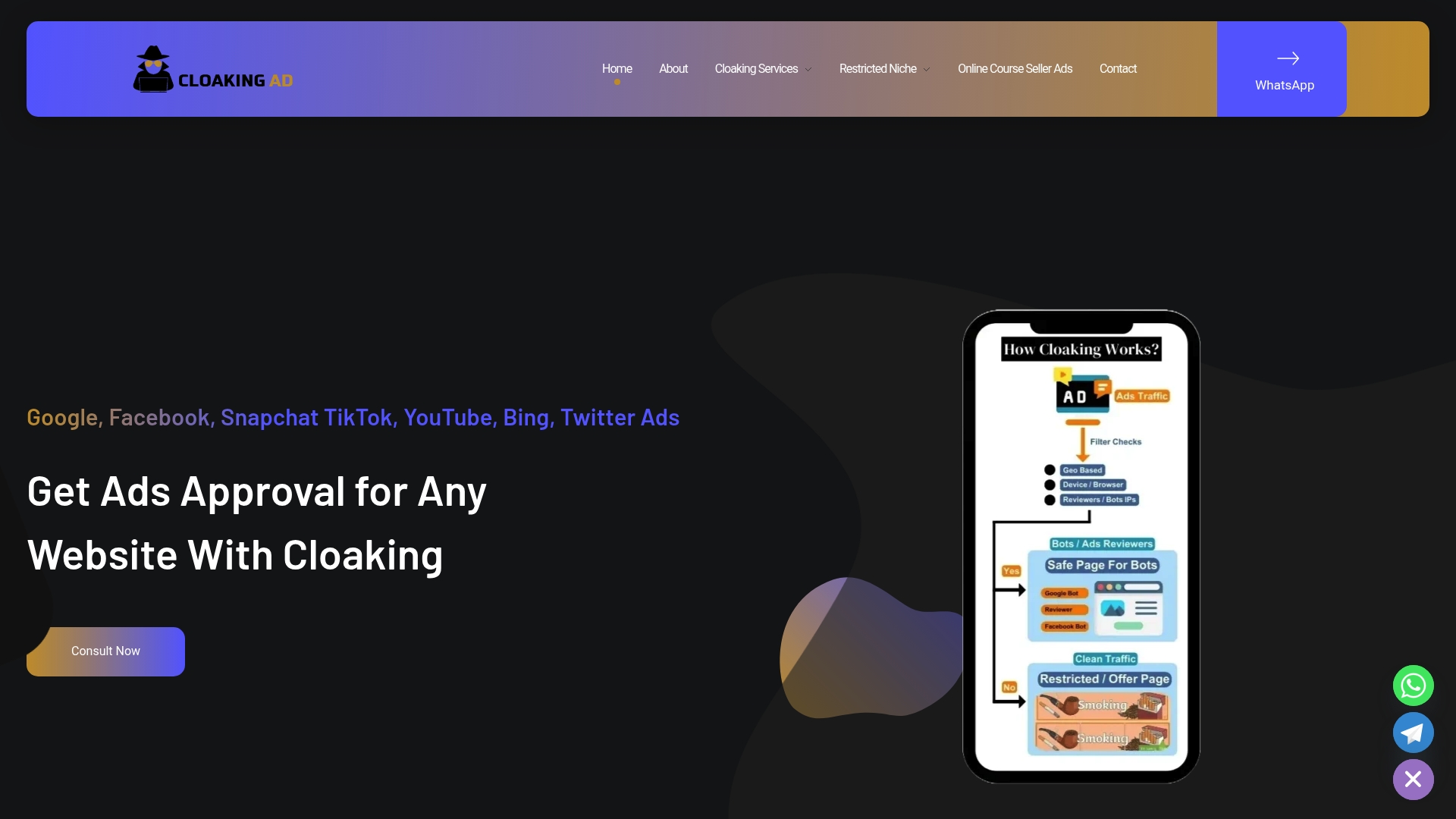
“Bypass ad review” usually describes cloaking: serving one version of a page to a platform’s reviewer or crawler and a different version to regular visitors. The reviewer sees a clean, policy-safe page; real visitors land on the actual offer, which might involve restricted claims, products, or industries.
A few related tactics come up in the same searches:
- Conditional redirects send traffic down different paths based on who or what is requesting the page.
- Multi-hop routing passes a visitor through several intermediate URLs before the final destination loads.
- Safe pages versus money pages describes keeping a compliant page for review and a separate page for conversions.
- Click trackers used for redirection route clicks through a tracking domain that then forwards to content the platform never reviewed.
Personalization looks similar on the surface but is treated differently. Showing a logged-in user their account dashboard, or adjusting currency by region, changes content based on legitimate context and applies the same rules to everyone, including reviewers. Cloaking specifically targets the reviewer or crawler to hide noncompliant content, which is the distinction platforms enforce against.
How Cloaking and Bypass Techniques Are Implemented
The mechanics behind cloaking follow a fairly consistent signal chain, whether the goal is a CBD offer, a crypto exchange, or a replica product site.
- The ad creative links to a final URL, which is the entry point both reviewers and real users hit first.
- Routing logic inspects the incoming request, checking IP address, user agent, geographic location, or client hints to classify who is asking.
- A decision engine serves one of two pages: a safe page for anything flagged as a bot, crawler, or reviewer IP range, or a money page for everyone else.
- Redirects and tracker layers execute the handoff, often through server-side checks rather than visible client-side JavaScript, so the switch is harder to spot by viewing page source alone.
The safe page typically contains generic, policy-compliant content: a blog post, a brand landing page, or an informational splash screen. The money page carries the actual offer, checkout flow, or restricted claims. Switching between them relies on server-side logic that evaluates the request before any content loads, paired with redirect chains and click-tracking layers that obscure the final destination.
Common technical indicators include multi-hop redirects that add unnecessary intermediate domains, header-based logic that treats known crawler user agents differently, pixel or click-tracking parameters that determine routing rather than just measurement, and inauthentic assets built solely to pass review rather than serve real users.
Pro Tip: If a landing page behaves differently depending on referrer headers alone, that is one of the first things a platform’s automated systems check.
Why Platforms Prohibit Bypassing Review
Platforms do not treat cloaking as a minor policy slip. Google’s Circumventing Systems policy classifies it as egregious, meaning accounts may be suspended upon detection, with reinstatement granted only in compelling circumstances. Meta’s enforcement guidance prohibits evading review entirely, including running the same or similar violating ads across multiple business assets, and states that evasion can lead to advertising restrictions.
- Google evaluates signals from the ad itself, the destination site, the account, and third-party data, not just the single URL submitted for review.
- Meta’s rules extend to inauthentic assets, meaning Pages, business accounts, and ad accounts created specifically to get around a prior restriction.
- Because enforcement draws on multiple connected signals, opening a new domain or a fresh ad account after a suspension may create additional enforcement risk rather than provide a clean restart.
This is why a reviewer page that looks clean in isolation does not protect the rest of the account. The policy is built around the relationship between what reviewers see and what the business actually operates, and that relationship is evaluated across the whole account graph, not one URL at a time.
How Ad Review and Appeals Actually Work
Understanding review timing helps explain why advertisers reach for cloaking in the first place, and why it is rarely the right fix. For Google Ads, most reviews finish within one business day. If an ad sits in review past two full business days, checking its status is the first step; contacting Google Ads support makes sense after a full week without resolution.
- Editing an ad while it is under review restarts the review clock, so freeze copy and destination URLs unless you are correcting the actual policy issue.
- Submit new campaigns a few days ahead of a launch date rather than same-day, since review timing is not instant for every ad type.
- Real-time policy reviews now give many ads an instant decision during creation, while more complex issues still route to a standard post-save review.
Most Google Ads clear review within one business day, according to Google’s own help documentation, which is why a well-prepared, compliant submission is usually faster than building and maintaining a cloaking system.
Appeals have hard limits too. Google allows up to three appeals per ad, with at least 24 hours recommended between each to avoid duplicate processing, and misuse of the appeals system can get an account’s appeals suspended entirely.
Compliant Recovery Checklist Before You Appeal or Resubmit
A documented, honest remediation process gives you a far better shot at reinstatement than switching domains or resubmitting unchanged. Work through this before touching the appeal button.
- Publish one stable destination that every visitor and every crawler sees identically, and remove any IP-based, user-agent-based, or geo-based redirect logic tied to reviewer detection.
- Audit every script and third-party tracker on the page, replacing anything that redirects conditionally with certified, transparent tracking vendors.
- Pull server logs and compare crawler responses to real-user responses for the same URL, confirming there is no divergence left over from a prior setup.
- Document every change you make, including timestamps and before-and-after screenshots, since this becomes your evidence package.
- Submit one thorough appeal, choosing Dispute decision or Made changes to comply depending on your situation, and explain precisely what changed and why.
Pro Tip: A single well-documented appeal that names the exact policy and describes the fix is preferable to vague resubmissions, and repeated appeals can get suspended from further processing.
Our own circumventing systems audit guide walks through this same process in more technical detail, including how to preserve evidence that holds up during a Google review.
Avoid resubmitting the same ad repeatedly without changes. Google explicitly warns that misuse of the appeal function can suspend processing of future appeals until you contact support directly, so treat each appeal as a one-shot, well-prepared submission rather than a retry loop.
Detection and Audit Checklist: Finding Cloaking on Your Own Site
Before you submit or resubmit an ad, it is worth checking your own site the way a platform’s systems would. This catches leftover conditional logic from a previous developer, agency, or plugin.
- Fetch the landing page with multiple user agents, including a known crawler string and a standard browser string, and diff the returned HTML.
- Compare rendered screenshots, not just raw HTML, since JavaScript-based redirects can look identical in source but behave differently once rendered.
- Use curl or a headless browser like Puppeteer to request the page from different IP ranges and check for divergent responses or redirect chains.
- Review server logs for header-based routing, looking for rules that key off
User-Agent,X-Forwarded-For, or known data-center IP blocks. - Audit connected assets, including domains, pixels, business manager admins, and payment processors, since cross-asset signals factor into enforcement on both Google and Meta.
Pro Tip: Run the same test from a residential IP and a known cloud-hosting IP range; a mismatch in content or redirect behavior between the two is the clearest sign of conditional routing.
Our device cloaking and client hints guide covers how JA3 fingerprinting and client-hint headers factor into this kind of audit if you want a deeper technical reference.
Legal and Ethical Considerations of Cloaking
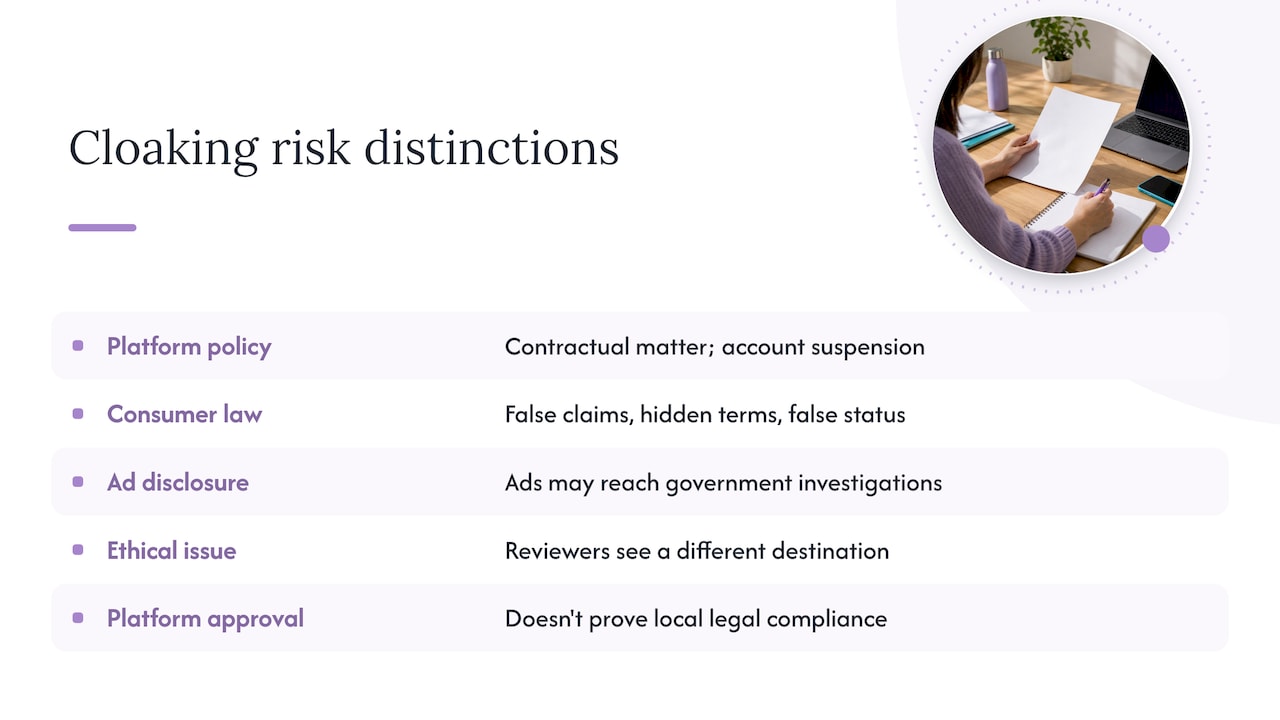
Cloaking sits in a gray zone that depends heavily on what is being hidden and from whom. Platform policy violations are a contractual matter between you and Google or Meta, enforced through account suspension rather than a courtroom, but the underlying advertised content can carry separate legal exposure depending on the product and jurisdiction.
Advertising a product with false claims, concealing material terms from consumers, or misrepresenting a regulated product’s legal status raises consumer-protection concerns independent of any ad platform’s rules. Meta’s advertising standards specifically note that ads are public information and may be disclosed to government entities in connection with lawful investigations, which means a cloaked ad does not disappear from scrutiny just because a platform approved it.
Ethically, the core tension is straightforward: cloaking exists to show reviewers something different from what real customers see. Even when the underlying product itself is entirely legal, such as CBD or a crypto exchange, the act of concealing the real destination from a reviewer is itself what both Google and Meta define as the violation, separate from whatever the product is.
Our legal and risk framing guide goes deeper into where platform bans and regulatory scrutiny can overlap for restricted verticals, which is worth reading before building anything.
The practical takeaway: treat cloaking as a platform-enforcement risk first and a potential legal question second, and never assume platform approval is evidence that the underlying claims are compliant with consumer-protection law in your market.
Common Content Triggers Behind Ad Disapprovals
Most disapprovals trace back to a short list of recurring triggers, and recognizing them helps you fix the actual issue instead of reaching for cloaking as a workaround.
Restricted product categories can lead to ad rejections: CBD and hemp derivatives, kratom, pharmaceuticals and prescription drugs, crypto and forex trading, and vape or smoking products all carry platform-specific restrictions that go beyond normal content review. Health and efficacy claims trigger separate scrutiny, especially language implying a cure, guaranteed results, or medical treatment without the required certification.
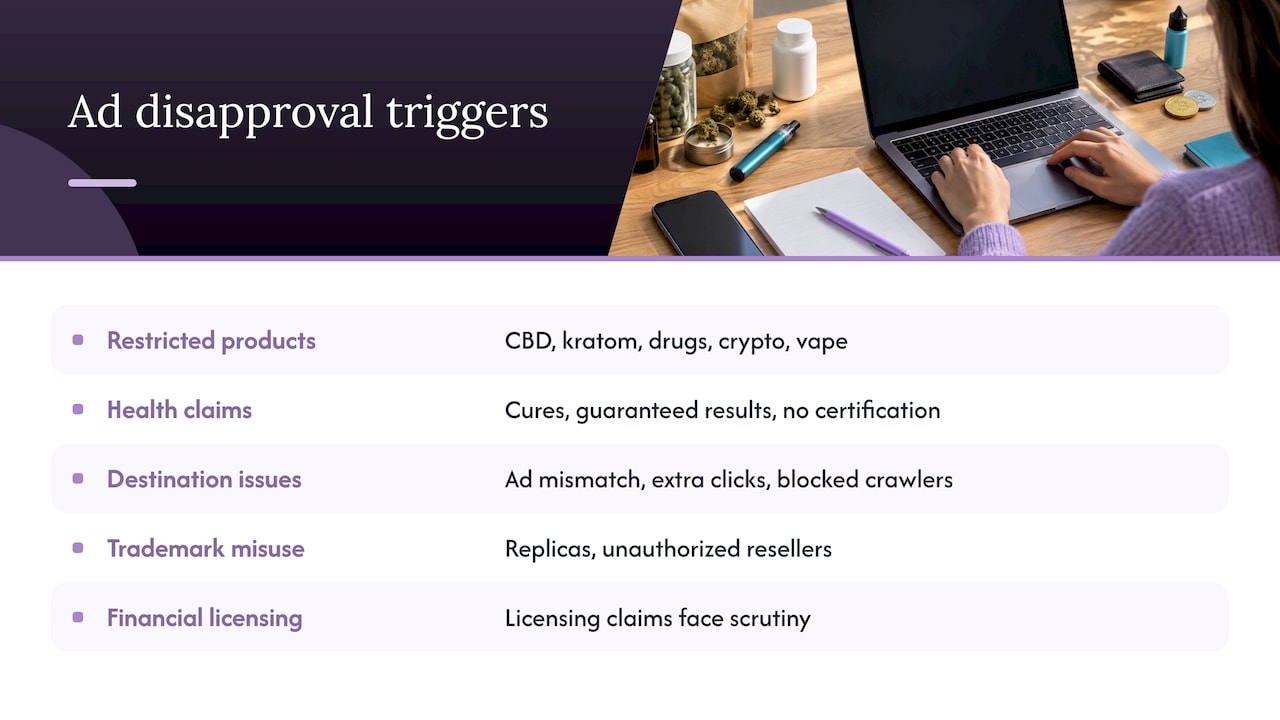
Misleading destination experiences are another common cause: a landing page that does not match the ad’s claims, a checkout flow that differs from what the ad promised, or a page that requires extra clicks to reach the advertised offer. Google’s cloaking examples specifically list intrusive interstitials that block crawlers and sending users to a different site than what was reviewed, even within the same domain.
Trademark and brand issues may arise for replica products and unauthorized resellers. Review platform policies on the use of protected brand names and logos. Financial promotions may face additional scrutiny around licensing claims. Check the applicable Google and Meta requirements for the product and market before submitting ads.
Each of these triggers has a compliant fix, whether that is adding required certifications, adjusting claim language, or matching the landing page to the ad exactly. Cloaking treats the symptom by hiding the trigger from the reviewer rather than resolving why the trigger exists.
Impact on Campaign Performance and ROI
Cloaking setups introduce performance costs that rarely show up in the pitch but show up fast in the numbers. Server-side routing logic adds latency to page loads, since every visitor request has to pass through a decision layer before content renders, and that extra hop can measurably slow time-to-first-byte on the money page.
Tracking accuracy also degrades. When a cloaking system serves different content to crawlers and bots than to real users, conversion pixels and analytics tags installed on the money page may fire inconsistently depending on how the routing layer handles script loading, which muddies attribution data advertisers rely on to optimize spend.
The bigger ROI risk is account-level, not page-level. A suspended ad account does not just lose the flagged campaign, it loses every active campaign tied to that account, along with historical performance data, audience remarketing lists, and conversion tracking history built up over time. Rebuilding that from a fresh account means starting optimization from zero, which typically costs more in wasted spend during the learning phase than the original disapproval would have cost to simply fix.
Cross-account enforcement compounds this further. Because Meta’s enforcement guidance and Google’s policy both evaluate signals across connected business assets, a suspension can cascade into linked ad accounts, business manager profiles, or payment methods, multiplying the ROI hit well beyond the single campaign that triggered it.
Best Practices for Maintaining Compliant Ad Systems
For advertisers who do work with cloaking systems in regulated or high-risk verticals, a few operational habits separate stable, long-running setups from ones that collapse quickly.
Maintaining a single source of truth for the actual offer matters most: the real landing page content, pricing, and claims should stay consistent regardless of who requests them, with routing logic reserved strictly for legitimate purposes like geo-based currency display rather than reviewer detection. Regular log audits catch configuration drift before a platform does, since server rules and tracking scripts get modified by multiple team members over time and small changes accumulate into detectable inconsistencies.
Keeping connected business assets clean reduces cross-account exposure: separate payment methods, distinct domains where appropriate, and administrator access limited to people who actually need it. Documentation of every system change, including who made it and why, turns a future appeal from guesswork into a factual record.
Working with a specialist who monitors platform policy updates continuously matters more than it sounds, since both Google and Meta update enforcement language and real-time review systems on an ongoing basis, and a setup that was compliant with last year’s enforcement patterns can fall out of step without anyone noticing until a suspension hits. Our Facebook ad cloaking compliance guide covers the specific fixes that matter heading into 2026 for Meta-specific enforcement patterns.
Examples in Sensitive Industries Like CBD and Crypto
CBD, kratom, and crypto advertisers may face platform scrutiny, while relevant laws and platform policies can vary by jurisdiction.
In the CBD and hemp space, a compliant approach is to use an accurate landing page and avoid hiding product claims from reviewers. Check applicable laws and platform policies before using regional routing. Our CBD and kratom ads approval guide walks through how this is structured for hemp-derived product advertisers specifically.
Crypto and forex advertisers may need to meet financial-promotion requirements in addition to standard ad review. Check the relevant platform requirements for the product and market. A stable setup here usually means working through the platform’s certification process first, then using routing only to manage regional licensing differences rather than to avoid the certification step altogether. Our crypto advertising approval service covers how this certification layer interacts with campaign setup for exchanges and trading platforms.
What separates a durable setup from one headed for suspension in both verticals is the same principle: routing logic handles legitimate regional or regulatory variation, while the actual offer, pricing, and claims stay identical for every visitor, including the platform’s own review systems.
Why We Favor a Compliance-First Approach
Deliberately bypassing review might get a campaign live, but it undermines the account’s long-term stability and risks further restrictions on the account. A compliance-first remediation process addresses policy issues and can support more stable campaigns. We recommend a documented technical audit before filing any appeal, every time.
— Umar
How We Help With Setup, Audits, and Managed Remediation
Resolving ad issues in CBD, crypto, kratom, peptides, replica brands, or other restricted verticals may take more than fixing one flagged ad. We build the technical setup and handle ongoing account management for restricted verticals.
- A consultation call walks through your current account history, flagged policies, and connected assets before we recommend a fix.
- Our cloaking system setup service, priced at $1,599 one-off, covers the server configuration, safe-page build, and real-time reviewer detection for your specific vertical.
- Our done-for-you managed engagement, priced at $3,599 one-off, adds ongoing account management.
If you have been through repeated disapprovals or a suspension already, start with a consultation call to get a clear read on what happened and what a fix actually requires.
FAQ
Is there a legitimate way to bypass Google or Meta ad review?
No. Both platforms treat deliberate evasion as a policy violation, and Google’s Circumventing Systems policy can suspend an account on detection with reinstatement only in compelling circumstances. A practical path is to fix the underlying compliance issue and submit a documented appeal.
How long does Google Ads review actually take?
Most ads clear review within one business day, according to Google’s help documentation. If review drags past two full business days, check the ad’s status, and contact Google Ads support if it passes a full week.
How many times can I appeal a disapproved Google ad?
Google allows up to three appeals per ad, recommending at least 24 hours between appeals, and misuse of the appeal system can get an account’s appeals suspended entirely. One well-documented appeal is far more effective than repeated attempts.
What counts as cloaking under Google’s policy?
Google’s examples include intrusive interstitials that block crawlers, showing different content to Google than to users, and redirecting to a different site than the one reviewed, even within the same domain. Click trackers used to redirect to prohibited content also qualify.
When should I hire a specialist instead of fixing this myself?
Repeated complex rejections, enforcement that spreads across linked business assets, or operating in a regulated vertical like CBD, crypto, or pharma are strong signals to bring in a specialist. Setup services like our cloaking system configuration handle the technical audit and ongoing management that a one-time manual fix usually cannot sustain.
Sources
- Circumventing systems – Advertising Policies Help
- Google launches Real-Time Policy Reviews for faster ad approvals