
Google does not allow ads for counterfeit goods, and replica-brand products that copy a trademark are usually disapproved. The narrow compliant paths are an authorized reseller, clearly described compatible products, or honest own-brand positioning. Most replica advertisers still hit rejections, which is why high-risk cases often need documented remediation or managed help to go live.
TL;DR:
- Google reviews ads, landing pages, metadata, and external reports together, so display prices, seller identity, sourcing, return policies, and contact details clearly.
- Before launch, replace brand assets, describe products by their materials and dimensions, remove unauthorized marks from metadata, and retain invoices or authorization letters.
- Appeals rarely succeed without evidence that Google made an error; fix the landing page first, submit sourcing documents, and stop repeated appeals after denial.
- Cloaking does not change a product’s legal status, and poorly configured routing can trigger account termination; seek local legal advice before expanding across markets.
- Check account status daily, log each reason code and response, retest routing after edits, and exclude reviewer traffic from conversion reporting.
Table of Contents
- What do Google’s counterfeit and trademark policies require?
- How do Google and right-holders detect replica ads?
- What should your pre-launch checklist include?
- How does Google’s review and appeals process work?
- When should you consider a cloaking or managed ad-approval service?
- What are cloaking techniques and how do they apply to replica ads?
- What ethical and legal considerations apply?
- What do case studies of cloaked replica campaigns show?
- How do you monitor and adjust a campaign after approval?
- How do you measure and optimize performance when using cloaking?
- Our take: start with the page, not the trick
- How we help advertisers get replica-brand Google Ads approved
- FAQ
What do Google’s counterfeit and trademark policies require?
Google’s counterfeit policy prohibits selling or promoting counterfeit goods, which it defines as products bearing a trademark identical or substantially indistinguishable from another’s trademark. The rule covers both the ad and the website or app it leads to, so a clean ad does not rescue a problematic landing page.
Trademarks are treated separately. Google’s trademark policy says a mark can be restricted when it is used confusingly or by a direct competitor, and a complaint from the trademark owner can lead to restrictions based on the ad and the landing page.
Landing pages that avoid trademark flags tend to share a few traits:
- A real purchase flow with visible pricing, not a catalog that points to a chat app
- Clear statements of who is selling the product and where it comes from
- Product descriptions that name what the item is, not whose brand it imitates
- Return policy and contact details a reviewer can find in seconds
- No logos, brand names or lookalike packaging in the hero image
The practical takeaway: if the product itself carries someone else’s mark, no copywriting fixes it. The policy is built around the product, not the wording.
How do Google and right-holders detect replica ads?
Google does not rely on one signal. Its counterfeit goods help page reflects an enforcement model that reads ad creatives, landing pages, metadata and third-party reports together. A technically compliant ad can still be flagged because the destination site or product descriptions look suspicious in aggregate.
Replica campaigns usually get caught through a handful of patterns:
- Logo or image similarity between your creative and the brand owner’s assets
- Keywords or phrases that imply authenticity, such as “original” or “genuine”
- Landing pages with no reseller disclosure or unclear sourcing
- Pricing far below what the authentic product sells for
- Complaints filed by the brand owner
Detection is also proactive. WIPO documentation notes that platforms and right-holders use automated tools that scan brand names, logos, keywords and pricing indicators to block suspected infringing content before it goes live.
Enforcement is layered: even a clean ad can be flagged when the destination site’s product descriptions and metadata raise automated review signals, so audit the whole funnel, not just the ad text.
What should your pre-launch checklist include?
Work through these steps in order. The earlier ones remove the most risk.
- Use your own brand assets. Replace brand logos and the original maker’s product photos with neutral shots of your actual item, on a plain background.
- Rewrite product copy descriptively. Say what the product is, its materials and its dimensions. Terms like “replica” and “1:1” are high risk, and anything implying authenticity invites a flag.
- Make seller status explicit. State on the landing page who you are, what you sell and where you ship from. Show price, return policy and a working contact method.
- Strip trademarks from metadata. Check page titles, alt text, URLs and structured data for brand names you do not have rights to.
- Store your sourcing paperwork. Keep supplier invoices, authorization letters or proof of sourcing in one folder. You will rarely get to use them, but when an appeal is possible, they are the only thing that matters.
- Segment high-risk campaigns. Keep risky product lines in a separate, clean ad account with its own documentation and audit trail, so one disapproval does not take down everything.
- Run a policy audit before submitting. Our audit walks through the account hygiene checks that prevent avoidable suspensions.
Pro Tip: Preview your ads with Google’s Anonymous Ad Preview Tool and read your landing page as a stranger would, in a private window with no cookies, before you ever click submit.
How does Google’s review and appeals process work?
Expect little flexibility. Practitioner experience, reflected in Google’s counterfeit guidance, is that appeals on counterfeit violations are highly restricted. Reinstatements are rare and generally require strong documentation showing Google made an enforcement error, not just that you misunderstood the rule.
What tends to carry weight in an appeal:
- Proof of authorization from the brand owner, if you have it
- Supplier invoices showing legitimate sourcing
- Side-by-side evidence that your product and mark differ clearly from the brand owner’s
- A landing page already fixed before you appeal, not after
If the appeal is denied, stop and document everything: dates, reason codes, the exact wording of the decision. Firing off repeated appeals rarely helps and can make an account look worse. Our guide on how to secure, document and appeal after a suspension covers what to preserve. At that point, managed remediation is usually a better use of your time than another round of the same appeal.
When should you consider a cloaking or managed ad-approval service?
Bring in outside help when the problems stop being fixable by editing a page. The usual signs:
- Repeated disapprovals after you have already cleaned up the landing page
- Account suspensions or payment profile problems
- Campaigns running across several platforms with different rules
- No sourcing documentation to support an appeal
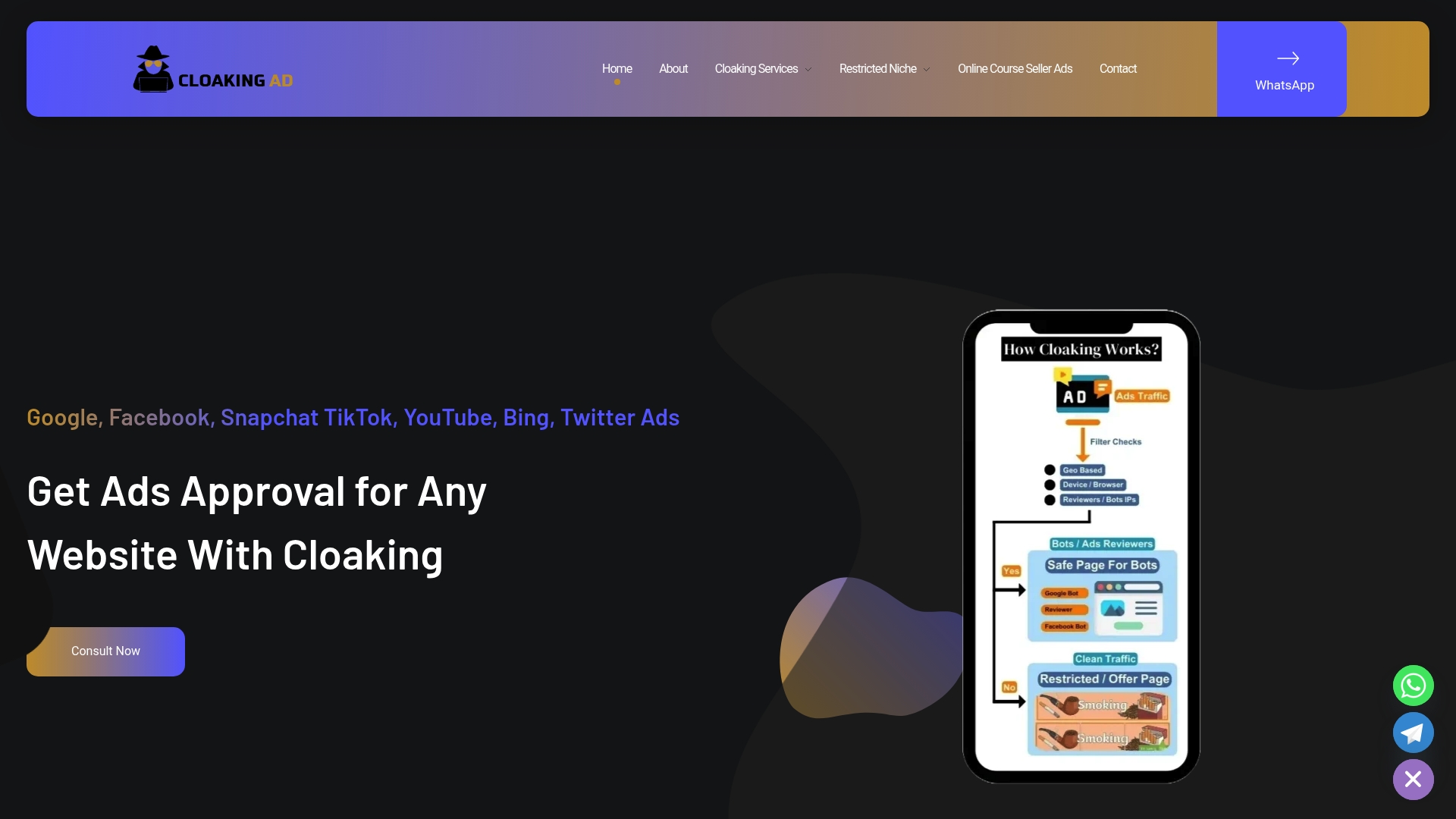
Specialists typically offer safe landing pages, reviewer detection, server-side routing, cloaking setup and ongoing account management. When vetting one, ask for documented case results, a written scope, and a staged remediation plan with checkpoints rather than a promise of guaranteed approval.
Pro Tip: Ask any provider to explain, in plain terms, what happens to your account if a campaign is flagged. Their answer tells you how seriously they treat risk.
What are cloaking techniques and how do they apply to replica ads?
Cloaking means showing different content to different visitors based on signals such as IP address, device characteristics or request headers. In an approval context, the idea is that a reviewer or crawler sees a compliant page while real visitors reach the full offer page.
The common building blocks are straightforward. Reviewer and bot detection identifies traffic from ad platform review systems. Server-side routing decides which page to serve. A safe landing page presents policy-compliant content. Device and network fingerprinting, covered in our piece on device cloaking for ads, refines who gets routed where.
We should be plain about the stakes. Google’s rules apply to the ad and the destination, and its enforcement reads multiple signals together, so any setup that is poorly configured can be detected and can end an account. Our service pages on Google Ads cloaking and replica cloaking ads describe how we configure routing and reviewer detection for these accounts. Whatever you choose, the quality of the safe page and the precision of the detection logic decide whether a setup holds or collapses.
What ethical and legal considerations apply?
Cloaking does not change the legal status of the product. A counterfeit or trademark-infringing item stays that way whether a reviewer sees it or not, and the brand owner can still pursue claims against the seller, not only against the ad.
Courts are also paying closer attention to advertising. WIPO’s webinar for judges summarizes recent cases in which courts worldwide reassess how trademark use in online advertising and algorithmic placement bear on consumer confusion. One WIPO-indexed Brazilian case treated using a rival’s brand as a keyword to trigger sponsored links as potentially fraudulent diversion of clientele, with compensation and injunctions possible.
Three practical considerations follow:
- Laws differ by country, so a product that is lawful in one market may be infringing in another
- Misleading customers about authenticity is a separate risk from the trademark question
- Platform terms are contractual, and violating them can cost you accounts regardless of any court outcome
Our own legal risk overview covers platform bans and regulatory scrutiny in more detail. Get advice from a lawyer in your selling market before you scale.
What do case studies of cloaked replica campaigns show?
We will not invent figures or client stories. What we can describe is the pattern that separates campaigns that survive from those that do not.
Campaigns that last tend to share the same fundamentals. The landing page the reviewer sees is a genuine, complete store with real policies and no mimicry of a brand. The routing logic is tested before spend begins, not after. Accounts are kept separate by risk level, so a single flag does not take down a whole business. Documentation exists before it is needed.
Campaigns that fail tend to share the opposite traits: a thin safe page, brand terms left in metadata, one account carrying everything, and no plan for the first disapproval. If you want evidence from a specific setup, ask a provider for documented results from comparable accounts, and ask what happened to those accounts over time, not only at launch. Our replica service page outlines the engagement options, and a consultation call is the right place to ask for relevant references.
How do you monitor and adjust a campaign after approval?
Approval is a snapshot, not a permanent status. Google re-evaluates ads and landing pages continuously, and complaints from brand owners can arrive at any time.
A steady monitoring routine includes:
- Checking the status of ads and accounts daily, and keeping an eye on Google’s status dashboard to rule out platform-side issues
- Re-reading your landing page and metadata after every edit, as new copy can reintroduce brand terms
- Logging every disapproval with its reason code, date and the change you made in response
- Rotating creatives before fatigue forces rushed edits
- Testing the safe page and the routing logic on a schedule, since detection patterns shift
Track approval rate and reason codes as leading indicators. A rising share of disapprovals tied to the same code points to a structural problem, not bad luck. Where your campaigns also run on Google-owned properties like video, our notes on YouTube policy fixes cover the extra checks worth adding.
How do you measure and optimize performance when using cloaking?
Cloaking can show different content to different visitors, and that complicates measurement. Your analytics must track the visitor who actually converts, not the reviewer who sees the safe page.
Set up measurement around the real funnel. Tag the offer page, not the safe page, for conversions. Exclude reviewer and bot traffic from your reporting so it does not drag down your conversion rate. Compare click-to-landing-page loads against recorded sessions to spot routing failures, since a gap there means visitors are being dropped or misrouted.
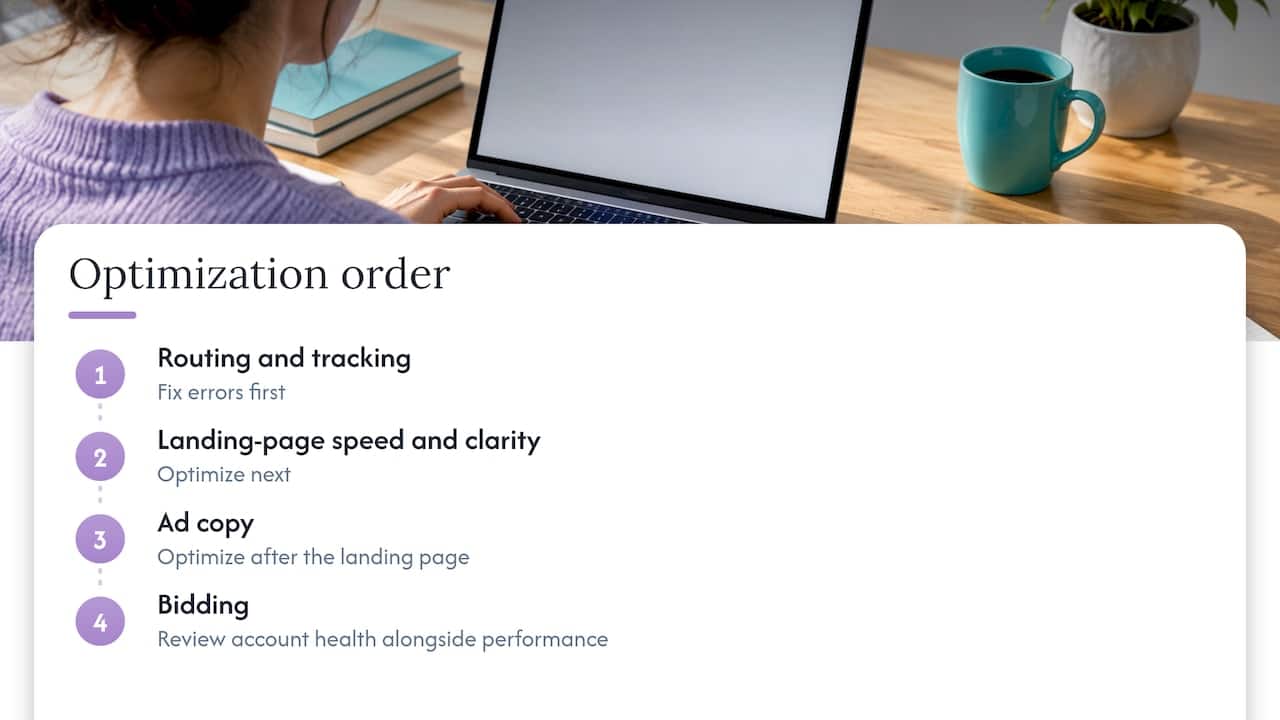
Then optimize in the usual order: fix routing and tracking errors first, then landing page speed and clarity, then ad copy, then bidding. Optimizing bids on corrupted data wastes budget quickly. Review account health alongside performance, because a profitable campaign in a fragile account is a short-lived one. For related approaches in other restricted verticals, see our guide on audits versus cloaking.
Our take: start with the page, not the trick
My view is simple: most replica advertisers reach for clever routing before they have fixed the thing reviewers actually read. Start with transparency and landing page remediation. Clean up the imagery, copy and metadata first, and only then test creative changes.
Track approval rates and reason codes closely after launch. Those numbers tell you when you have a fixable problem and when you have a structural one. Escalate to a specialist when the business risk from downtime is bigger than the cost of managed help, or when your account stability has stopped being something you can repair alone.
What I would not do is treat any technique as a license to ignore the legal side. The product’s status stays the same no matter who sees which page.
— Umar
How we help advertisers get replica-brand Google Ads approved
If repeated disapprovals are costing you more than a specialist would, we can take it on. Our team offers a consultation call, a cloaking system setup and a done-for-you approval and account management engagement. Setup is $1,599 one-off, and the done-for-you engagement is $3,599 one-off. Current pricing details are on our website.
You can expect a scoped remediation plan, safe landing page strategy, reviewer detection and ongoing support. Book a consultation through our main site, or look at the replica ads service page first.
FAQ
Does Google allow ads for replica products?
No, not when the product bears someone else’s trademark. Google prohibits promoting counterfeit goods, defined as items with a trademark identical or substantially indistinguishable from another’s, and applies the rule to both the ad and the destination site.
Can you use a brand name in your ad text?
Sometimes, but it is risky. Google’s trademark policy allows restrictions when a mark is used confusingly or by a direct competitor, and a trademark owner’s complaint can trigger them. Reseller disclosure and descriptive use help, but they are no guarantee.
How hard is it to win a counterfeit appeal?
Very hard. Reinstatement generally requires strong documentation showing Google erred, such as proof of authorization or supplier invoices, and the counterfeit guidance reflects a tightly restricted appeal process.
Why did my compliant-looking ad still get flagged?
Google reads ad creatives, landing pages, metadata and third-party reports together. A clean ad can still be flagged if the destination site’s descriptions or images raise signals, so check the whole funnel.