
Bing Ads cloaking means showing Microsoft’s ad reviewers one page and real visitors another. On Microsoft Advertising (the platform formerly called Bing Ads) it is the riskiest move you can make. Microsoft classes cloaking as an egregious policy violation, and that class carries an immediate, permanent account suspension. This guide covers what the policy says, which niches cloaking cannot rescue, who is liable when it goes wrong, and what we would do first if your ads keep getting rejected.
TL;DR
- Microsoft Advertising treats cloaking as an egregious violation. The usual penalty is a permanent ban with no warning, and these bans are generally not appealable.
- CBD and marijuana ads are prohibited on Microsoft’s network. Cloaking does not make them legal, and anti-evasion systems scan both the ad and the destination.
- You stay responsible for what your affiliates and vendors run in your name, including to the FTC.
- Most Bing rejections are editorial and fixable. Reading the reason code is the right first step, before any technical workaround.
- If your niche is restricted, talk to someone who works in it daily before you touch your only ad account.
Table of Contents
- What “cloaking” means on Microsoft Advertising
- How Microsoft handles the violation
- Why cloaking cannot rescue prohibited niches
- Editorial rejections versus egregious bans
- Who is liable when something goes wrong
- Our perspective
- A compliance-first workflow for restricted offers
- Where we can help
- FAQ
- Sources
What “cloaking” means on Microsoft Advertising
In plain terms, cloaking is a setup that detects who is requesting a page and serves different content depending on the answer. A reviewer, a crawler or a bot sees a clean, compliant page. A person who clicked your ad sees the real offer. The signals used to decide who gets what usually include IP ranges, device fingerprints, geography and request headers.
Platforms do not care how clever the detection is. They care about the outcome: the destination a reviewer approved is not the destination a customer reaches. That mismatch is what the policy calls circumventing systems. Google’s policy on circumventing systems says the same thing in its own words: advertisers may not try to trick or get around ad review processes with their ads, content or destinations. Microsoft’s wording differs, but the principle is identical.
It helps to separate cloaking from things that look similar but are not:
- Geo-targeted landing pages. Showing a French visitor a French page, with the ad and the page telling the same story, is ordinary localization.
- Branded tracking redirects. A redirect that passes through your own domain for tracking can be legitimate when the ad, the display URL and the final URL agree. A guide to affiliate link cloaking makes the same distinction between a transparent redirect and one that hides the real destination.
- Dynamic content. Personalizing a headline by keyword is fine. Swapping the product category between reviewer and visitor is not.
The test is simple: if a reviewer from Microsoft followed the same path as your customer, would they approve what they saw? If the honest answer is no, you are in cloaking territory, whatever the technology is called.
How Microsoft handles the violation
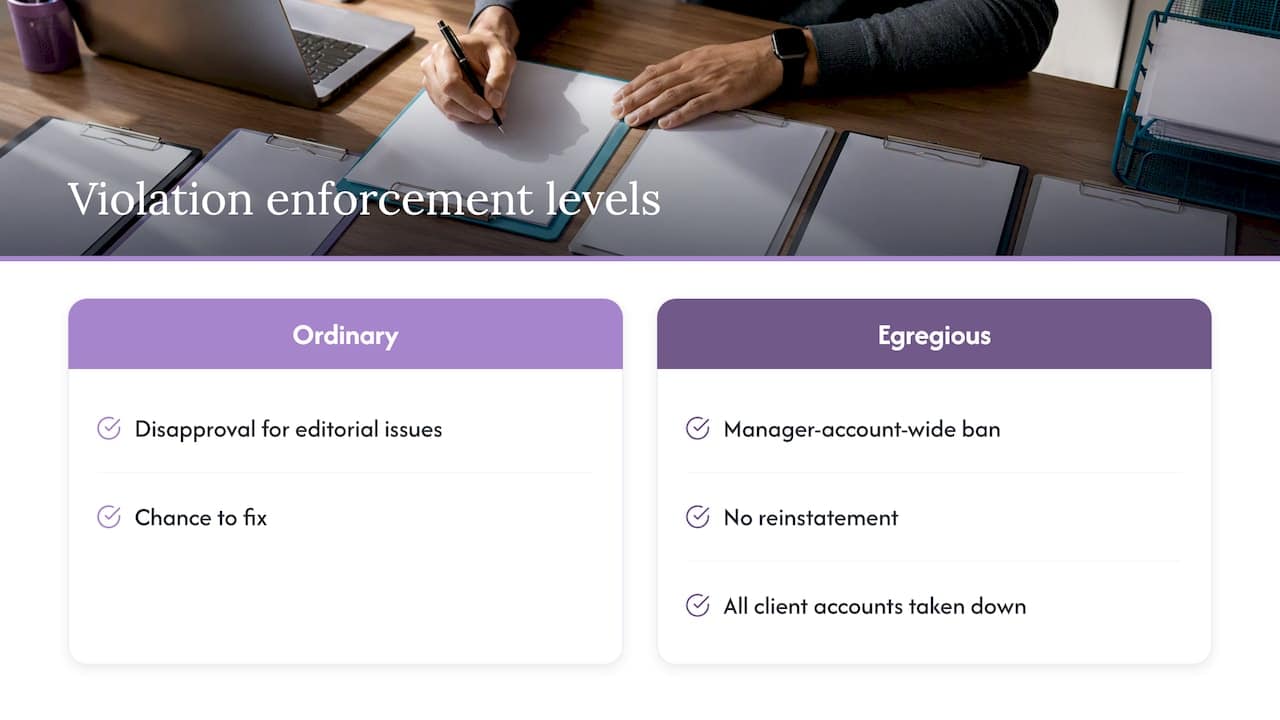
Microsoft sorts violations by severity. Most are ordinary editorial problems: a punctuation issue, a claim that needs support, a landing page that is slow or broken. Those get a disapproval and a chance to fix.
Egregious violations sit in a separate class. According to Microsoft’s own Q&A answer on the topic, they are treated as so severe that they lead to a complete ban across the affected manager account, with no reinstatement. The same page lists related offenses such as hiding the identity of the advertiser or payer and facilitating illegal products or practices. Cloaking sits alongside them.
Two consequences follow that many advertisers overlook.
The ban reaches beyond one campaign. A manager account suspension takes down every client account underneath it. An agency running twenty accounts can lose all of them for one landing page.
Trust does not come back. Policy commentators note that a circumventing-systems flag means the platform no longer believes your intent. According to one explainer on circumventing systems rejections, automated systems then watch your other business assets more closely, which makes recovery exceptionally rare. Opening a new account with the same business, domain or payment details tends to be read as the same behavior again.
Microsoft also changed how it communicates consequences. Its 2023 network policy update set out different account-level impacts depending on the violation, from ad and landing page disapprovals to broader account actions. The direction of travel is toward clearer, tougher enforcement, not looser rules.
Why cloaking cannot rescue prohibited niches
The most common reason advertisers search for Bing Ads cloaking is a niche Microsoft simply does not want. CBD is the textbook case.
Microsoft’s policies fall into three tiers: prohibited content, restricted content that needs certification or meets conditions, and editorial rules about style. A Microsoft Q&A thread on hemp products places CBD and marijuana in the prohibited tier. The advertiser in that thread said the products were fully legal, and that did not change the answer. Legal in your state is a different question from allowed on Microsoft’s network.
A 2026 overview of Microsoft Ads policies describes the same three-tier structure and notes that prohibited content is off-limits without exception. That tells you what a cloaked CBD campaign on Bing is: a prohibited product, plus a deception violation, on top of it. You would be stacking two reasons for a ban.
Here is how the main restricted verticals look in practice on Microsoft Advertising:
| Niche | Typical Microsoft status | Realistic path |
|---|---|---|
| CBD, hemp, marijuana | Prohibited | Use platforms and channels where a compliant route exists; do not rely on Bing |
| Pharma and prescription products | Restricted, certification needed | Complete the required certification, then run compliant creative |
| Crypto | Restricted, conditions apply | Meet the licensing and regional requirements before launching |
| Supplements and peptides | Editorial and claim-based review | Keep claims defensible and the landing page consistent with the ad |
| Forex | Restricted, conditions apply | Hold the relevant financial authorization for each target country |
Treat the table as a planning aid, not a ruling. Microsoft updates its policy pages, and the status for your country and product is the one on the live policy page the day you launch. Check it, and keep a dated screenshot.
We cover the other side of this in more detail in our guides on CBD, hemp, kratom and vape ad approval and crypto ad licensing, where platform rules differ from Microsoft’s.
Editorial rejections versus egregious bans
Before deciding anything drastic, find out which kind of problem you have. They behave very differently.
Editorial disapprovals are the everyday kind. Microsoft now reviews individual assets, such as headlines, descriptions and images, rather than only whole ads. Disapprovals come with reason codes, and Microsoft publishes a list of editorial reason codes so you can see exactly which rule an asset tripped. If an issue is marked appealable, you can appeal it, and through the API the limit is 2,000 appeals per account every 24 hours, with a ceiling of 10,000 pending appeals.
Egregious violations are different. Cloaking falls here, and the appeal route described above is aimed at editorial rejections. Violations of the egregious kind are generally not appealable.

That gap matters for planning. If your problem is an editorial code, you have a fast, cheap fix and a formal appeal path. If your ads are being rejected because the landing page does not match what you promise, the answer is almost always to make the page match, not to hide it. Our walkthrough on reading Bing reason codes and using the API to fix policy issues goes through the codes step by step.
Who is liable when something goes wrong
Outsourcing does not outsource responsibility. Industry analysis of affiliate enforcement notes that brands are held co-liable for violations their partners commit, even when the brand did not build the cloaking itself. The same source says the FTC consistently holds brands responsible for deceptive claims made by affiliates. It is an industry write-up rather than a regulator’s ruling, so treat it as a trend to plan around, and ask a lawyer about your exposure.
Three practical points follow:
- Put a no-cloaking clause in affiliate agreements. Make it a contractual breach, with the right to terminate.
- Check your live pages the way a customer does. The same source recommends viewing landing pages from the locations and devices your campaigns target and following the whole redirect chain, not just the first URL.
- Watch for reviewer-versus-user differences. A page that changes by location or device without a clear reason is a red flag for the platform and for you.
Our article on ad cloaking risks, platform bans and FTC scrutiny lays out the legal side for restricted ads in more depth.
Our perspective
We build ad-approval systems for high-risk verticals: CBD, crypto, forex, supplements, peptides, pharma and more. So we see the same pattern from the inside. Advertisers arrive with a rejection and a deadline, and they ask for the technical fix before anyone has read the reason code.
On Microsoft Advertising, we think that order is backwards. Microsoft is a smaller platform than Google or Meta, the reviews are granular, and its policy page is blunt about egregious violations. The downside of a mistake there is not a slap on the wrist. It is a permanent ban on the manager account. Our view is that the technology has a place in a larger plan, but the plan starts with three questions:
- Is the product allowed on this platform at all, in this country?
- If it is, what exactly is the reviewer rejecting, and is it fixable on the page and in the creative?
- If it is not, which platform is the right one for this offer?
Often the honest answer to the first question is that Bing is the wrong channel for the product. For a prohibited product, no setup changes that, and we would rather say so than sell a configuration that gets your account banned. For restricted niches where a compliant route exists, the work is audit, documentation and clean landing pages. That is why we run the consultation first and the technical build second. It protects your accounts, and it protects ours too.
— Umar
A compliance-first workflow for restricted offers
If you are selling in a sensitive vertical and want Microsoft traffic, this is the order we would follow.
- Confirm the category. Read the current Microsoft policy page for your product and country. Write down whether it is prohibited, restricted or editorial, and save the date.
- Pull the reason codes. For every disapproval, note the code and the asset. The reason code list tells you what the platform actually objected to.
- Audit the landing page. Does it show the same offer to every visitor? Does it carry the disclosures, the contact details and the claims support the policy expects? Our seven-step audit for circumventing systems suspensions is a good checklist.
- Review your claims. Medical and health claims are a frequent rejection cause across platforms. See our guide to the medical claims policy.
- Fix, then appeal. Where the issue is appealable, correct the asset first, then appeal through the interface or the API.
- Prepare for the worst case. Keep records of what you submitted, so that if an account is ever suspended you can document it and appeal with evidence.
- Diversify. Do not rely on one ad account or one platform. A restricted offer should have more than one acquisition channel.
This is slower than a quick technical trick. It is also the version that leaves you with an account still open in six months.
Where we can help
CloakingAd works with advertisers in restricted and high-risk categories across Google, Facebook, TikTok, Bing, YouTube, Twitter, Snapchat and other platforms. Our engagements come in three forms: a consultation call, a cloaking and server setup, and a fully managed Done-For-You service that includes ongoing account management. Start with the consultation. We will look at your product, your target platform and your rejection history, and tell you plainly what is realistic, including when a channel is the wrong one. You can book it from our main page, or see what each tier includes on our services page.
FAQ
Does Microsoft Advertising allow cloaking?
No. Microsoft lists cloaking among egregious violations, which lead to a permanent ban across the affected manager account. These cases are generally not appealable, so there is no second chance to explain.
Can I run CBD ads on Bing if I cloak the landing page?
Not safely. CBD and marijuana fall under prohibited content on Microsoft’s network, and cloaking would add a deception violation on top of a prohibited product. Look at platforms and channels that have a compliant route for your product instead.
Can I appeal a Bing Ads disapproval?
Yes, for editorial disapprovals marked appealable. Microsoft’s appeals guide describes an API limit of 2,000 appeals per account per 24 hours. Egregious violations such as cloaking are generally outside that route.
Is my brand responsible if an affiliate cloaks my offer?
In practice, yes. Industry analysis says platforms and the FTC hold brands accountable for partner violations. Add a clear prohibition to affiliate contracts and check live pages regularly, and ask a lawyer about your own exposure.
What should I do first if my Bing ads keep getting rejected?
Read the reason code on each rejected asset and compare it with the policy page. Most rejections are editorial and can be fixed on the page or in the ad copy. If the product itself is prohibited, the fix is a different channel.
Sources
- Violation of Egregious Policy, Microsoft Q&A
- Can I advertise hemp products on Bing, Microsoft Q&A
- Editorial review appeals, Microsoft Advertising API
- Editorial reason codes, Microsoft Advertising API
- Updates to our network policies, Microsoft Advertising
- Circumventing systems, Google Advertising Policies Help
- Microsoft Ads Policies, Approval and Disapproval 2026
- Ad Rejected for Circumventing Systems? What It Means
- Affiliate Cloaking: Brand Liability for Partner Ads 2026
- How to Cloak Affiliate Links: Step-by-Step