
TikTok cloaking means showing its ad reviewers one landing page while sending real users somewhere else, and TikTok treats it as a clear policy violation with escalating account penalties. The platform’s crawlers and human reviewers actively hunt for the mismatch, and getting caught risks a suspended or permanently banned ad account. The fix isn’t a smarter cloak. It’s auditing your creative-to-lander match, cleaning up your redirect chain, and switching to transparent, compliant routing before you ever submit.
TL;DR:
- TikTok actively detects cloaking through repeated landing page re-crawls, redirect chain analysis, and checking for content mismatches during review updates.
- Using multiple redirects beyond two hops or submitting pages with broken mobile rendering increases the risk of ad rejection and account suspension.
- The safest approach involves routing through a single domain, personalizing content server-side without changing the offer’s substance, and maintaining thorough logging of routing decisions.
- Technical issues such as slow loads, intrusive popups, and non-compliant policy pages are common causes of landing page rejections; testing inside TikTok’s app on throttled mobile data can prevent these.
- Outright cloaking vendors that serve different content to reviewers than to users pose legal, regulatory, and long-term account risks, with recent enforcement focusing on user journey misleading rather than simple content differences.
Table of Contents
- What TikTok Cloaking Actually Means in Practice
- How TikTok Detects Cloaking and What Happens Next
- Why Advertisers Still Try It, and What It Actually Costs
- Compliant Routing That Still Gets Restricted Offers Approved
- The Pre-Submit Checks That Catch Most Rejections
- Vetting a Cloaking Vendor: Seven Questions and What Pricing Should Look Like
- A Real Rejection Loop and How It Got Fixed
- Your Pre-Launch Checklist Before You Submit Anything
- How Detection Methods Evolved and Where They’re Headed
- What Cloaking Actually Does to Your Metrics and ROI
- Compliant Campaigns vs. Cloaked Campaigns: What the Contrast Looks Like
- Publisher Perspective: When Managed Help Actually Makes Sense
- Get Your Restricted-Niche Ads Approved Without the Risk
- Sources
- FAQ
What TikTok Cloaking Actually Means in Practice
Technically, cloaking works through branching logic: a script checks incoming traffic by IP range, user agent, or referrer header, then routes suspected reviewers to a clean, compliant page while sending real visitors to the actual offer. Marketers lean on this for video sales letters, affiliate funnels, and restricted categories like supplements or crypto where the honest page would get flagged instantly.
That’s different from legitimate personalization. Showing a French-language version of a page to French IP addresses, or a mobile-optimized layout to phone users, on the same canonical domain, is normal targeting every major platform allows. Cloaking crosses the line when the substance of the offer changes based on who’s looking. Platforms define this exact behavior as showing reviewers a fundamentally different page than real users see, and that distinction is the entire basis for enforcement.
How TikTok Detects Cloaking and What Happens Next
TikTok’s review pipeline crawls your landing page using its in-app browser, then periodically re-crawls live campaigns to catch pages that change after approval. That re-check is where most cloaked setups die. A page that looked clean at submission but serves different content a week later gets flagged on the next pass.
Detection triggers a predictable escalation: a temporary hold on the ad or account, a narrow appeals window to explain the discrepancy, and, on repeat or severe violations, permanent suspension. Specific signals that draw deeper scrutiny include a mismatch between the ad’s claims and the landing page’s actual content, redirect chains that hop through multiple domains, and broken rendering inside TikTok’s own in-app browser. Recent enforcement updates specifically target advertorial-style pre-landers, countdown timers, and destination mismatches, which means tactics that slid through in prior years now get caught faster.
Why Advertisers Still Try It, and What It Actually Costs
The appeal is obvious: a restricted offer gets approved fast, and the campaign starts generating revenue immediately. That short-term win is exactly what makes the long-term cost easy to underestimate.
Once TikTok flags a cloaked account, the damage rarely stops at one rejected ad. Advertisers report losing entire pixel-trained audiences, having other campaigns on the same business account restricted, and in some cases losing access to the ad manager entirely. If the underlying offer involves misleading health claims or an unlicensed financial product, cloaking adds a second layer of exposure: regulatory and legal risk that has nothing to do with TikTok’s terms of service at all. A banned account you can appeal. A false-advertising complaint or a state regulator’s inquiry is a different problem entirely.
Compliant Routing That Still Gets Restricted Offers Approved
The safer version of “branching” keeps everyone on one canonical domain and personalizes server-side, based on legitimate signals like geography or device, without changing what the offer actually claims. Reviewers and real users land on the same page; the content adjusts, the substance doesn’t.
Before submission, run your ad claims against your landing page line by line. If the ad says “clinically studied,” the page needs to back that up or drop the claim. Required policy pages, privacy policy, terms of service, a working contact page, need to be live and reachable on first load, not buried behind a click-through.
- Route through a single domain and personalize with server-side logic, not separate destination URLs.
- Use direct tracking links, or resolve any tracker to its final domain before submitting.
- Run TikTok’s built-in split testing instead of hand-rolled A/B redirects.
- Log every routing decision, timestamp, rule triggered, and outcome, so you have a record if TikTok asks questions.
A compliance-first routing layer with per-request audit logs is now considered an acceptable middle ground between raw exposure and deceptive cloaking, and it’s the version that actually survives an appeal.
Pro Tip: Keep a dated screenshot or log entry every time you change a landing page mid-campaign. If TikTok’s re-crawl flags a discrepancy, that record is often the difference between a quick appeal win and a permanent ban.
The Pre-Submit Checks That Catch Most Rejections
Most rejections trace back to a handful of fixable technical issues, not some elaborate detection algorithm. Run these before you spend a dollar on media:
- Count your redirect hops. Two or more is common; each added hop increases the odds a crawler flags the chain as cloaking behavior, even though TikTok hasn’t published a hard numeric limit.
- Open your ad’s landing page inside TikTok’s actual in-app browser, on a mid-tier Android device, over throttled 4G, not your office Wi-Fi on a laptop.
- Confirm your privacy policy, terms, and contact page all render on first view with no extra clicks required.
- Remove intrusive popups, auto-playing countdown timers, or interstitials that block the page before the user sees real content.
- Save a log of the test: device, connection speed, load time, and screenshot, in case you need it for an appeal later.
Slow loads and broken mobile navigation are consistently among the leading causes of landing-page rejections TikTok’s system flags, well ahead of anything resembling sophisticated fraud detection.
Vetting a Cloaking Vendor: Seven Questions and What Pricing Should Look Like
Hiring outside help isn’t a violation by itself. What matters is whether that vendor’s system serves materially different content to reviewers than to users, or simply filters bad traffic while keeping the offer consistent. Ask any vendor these seven questions before signing anything:
- What bot and data-center IP ranges do you filter, and can you show me the list?
- Do you provide per-request logs I can access, not just a summary dashboard?
- Is my account isolated, or does it share infrastructure and reputation with other clients?
- How often do you update detection rules as platforms change enforcement?
- What’s your documented process if my account gets flagged or suspended?
- Who owns the domains, scripts, and creative assets if I leave?
- What are the exit terms if I want to cancel the engagement?
Pricing generally falls into three models: a flat SaaS subscription, a setup fee plus usage costs, or a full retainer. Advertisers spending under roughly $10,000 a day often do better on SaaS tools paired with an in-house operator than on an expensive retainer built for high-complexity accounts. Treat any vendor promising “guaranteed approval” or refusing to share logs as a red flag, not a selling point.
Pro Tip: Ask a prospective vendor for one anonymized audit log sample before you commit. If they can’t produce one, they probably aren’t tracking what they claim to be tracking.
A Real Rejection Loop and How It Got Fixed
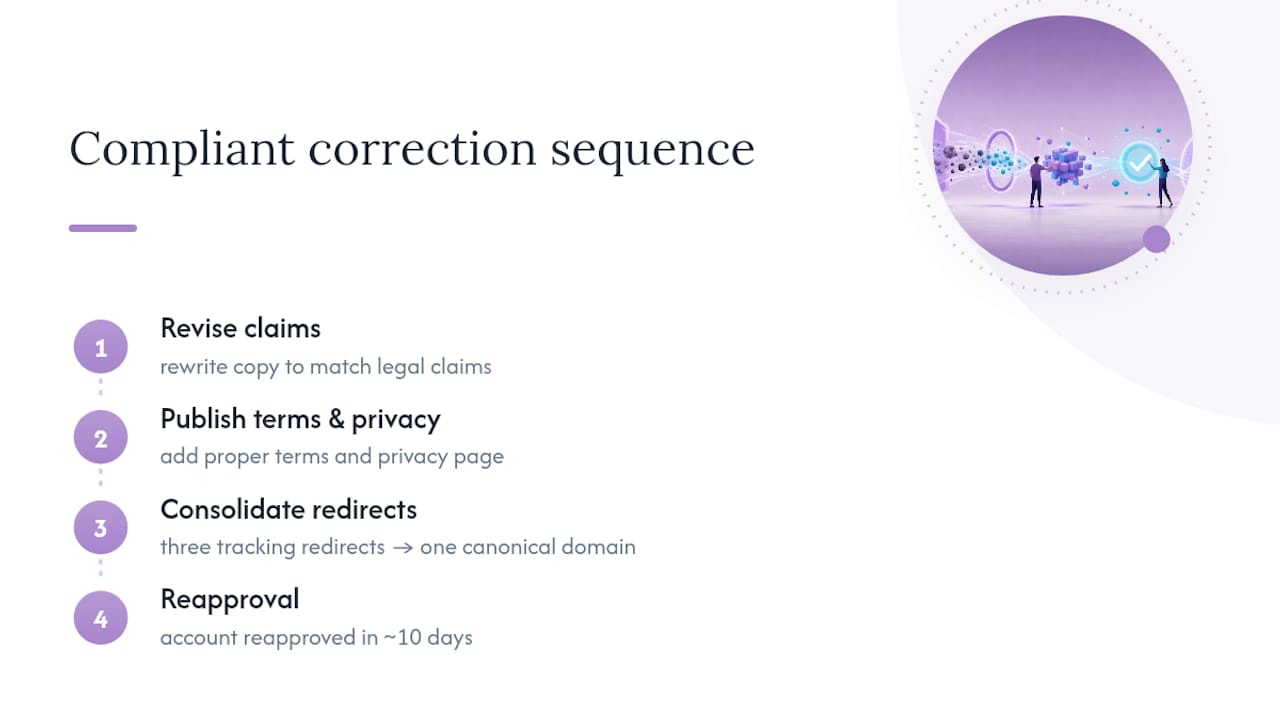
A supplement advertiser had a video ad rejected for an unsubstantiated health claim. Instead of fixing the claim, the team tried cloaking the landing page to hide it from reviewers. Within two weeks, TikTok’s re-crawl caught the mismatch and placed the entire ad account under review.
The fix that actually worked: rewriting the ad copy to match what the product could legally claim, publishing a proper terms and privacy page, and consolidating three tracking redirects into one canonical domain. Reapproval took about ten days. The lesson holds across verticals: the claim was the problem, not the review process.
Your Pre-Launch Checklist Before You Submit Anything
Run through this order every time, and most rejections never happen in the first place:
- Test your landing page inside TikTok’s in-app browser on throttled mobile data.
- Count redirect hops and cut anything beyond a single, direct tracking link.
- Confirm privacy, terms, and contact pages load without extra clicks.
- Match every ad claim word-for-word against what your landing page actually substantiates.
- Confirm your vendor (if any) provides per-request logs and doesn’t share your reputation pool with other accounts.
- Document your routing logic and keep a dated audit trail for at least 90 days.
Buyer reports across the industry suggest redirect chains of two to four hops are frequently flagged as a cloaking signal, even without a published hard limit from TikTok itself. Treat two hops as your practical ceiling, not four.
How Detection Methods Evolved and Where They’re Headed
Early cloaking setups relied on simple IP blacklists, block a known reviewer range, and the ad sailed through. That worked because platforms hadn’t yet built infrastructure to correlate traffic patterns across accounts. It didn’t last.
By the early 2020s, ad platforms started cross-referencing device fingerprints, browser rendering behavior, and known vendor IP ranges instead of relying on static blacklists. Cloaking vendors responded with rotating proxies and device farms designed to mimic real user behavior. That arms race continues, but the balance has shifted decisively toward detection. Platforms now correlate crawler fingerprints against known vendor infrastructure, which shortens the useful life of any cloaked setup in major markets, often to weeks rather than months.
The 2026 policy updates accelerated this further by targeting the presentation layer, not just the routing layer. Advertorial-style pages designed to look like independent editorial content, countdown timers implying false urgency, and pre-landers that soften a claim before the real pitch, all now draw scrutiny even without a technical cloak involved. TikTok’s enforcement logic has moved from “did you serve different content” to “does this entire user journey mislead someone,” which is a much harder standard to game.
For advertisers, that shift matters more than any single technical workaround. A redirect trick that worked in 2023 gets caught in days now, not months. The advertisers still running stable campaigns in regulated verticals are the ones who stopped trying to outrun detection and started building pages that would survive scrutiny regardless of who’s looking at them, reviewer or customer.
What Cloaking Actually Does to Your Metrics and ROI
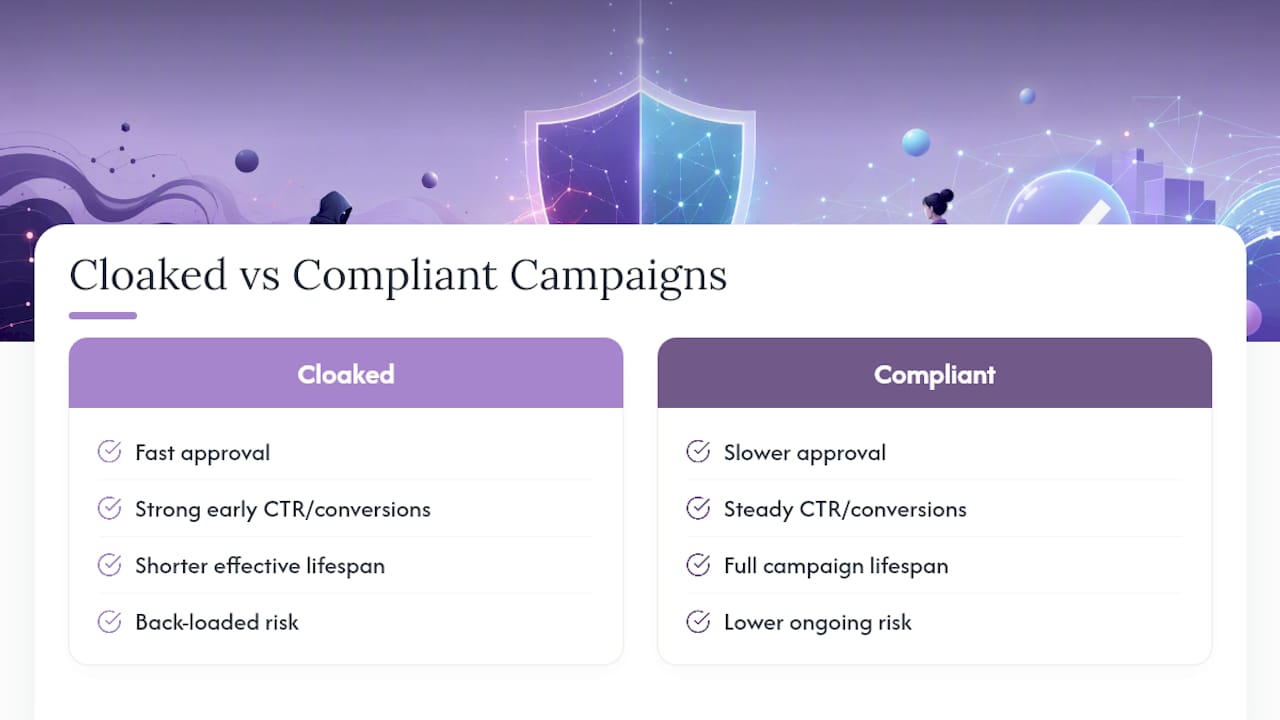
Cloaked campaigns often show strong performance right up until the moment they don’t. Approval comes fast, early click-through and conversion numbers look clean, and the account scales. Then a re-crawl catches the mismatch, and the campaign doesn’t just get paused, it often gets shut down mid-flight, along with whatever pixel data and retargeting audience you’d built.
That’s the real ROI problem: cloaking front-loads performance and back-loads risk. A campaign that runs cloaked for six weeks and gets banned has a shorter effective lifespan than a compliant campaign that runs for six months at a slightly lower conversion rate. Total ad spend efficiency almost always favors the compliant route once you account for the sunk cost of rebuilding an account, a pixel, and an audience from zero.
There’s a secondary cost that rarely gets discussed: appeal time. A flagged account can sit in review limbo for days or weeks with zero ad delivery, which means zero revenue from that channel while competitors keep running. Advertisers who’ve been through a suspension consistently describe the appeals process as slower and less predictable than simply fixing the landing page upfront would have been.
The performance data cloaking produces is also somewhat fake. If your reviewer-facing page differs from your user-facing page, your approval metrics tell you nothing real about whether your actual offer, the one customers see, is landing well with TikTok’s algorithm or its audience. You’re optimizing a page nobody but a bot ever sees.
Compliant Campaigns vs. Cloaked Campaigns: What the Contrast Looks Like
Picture two advertisers running the same CBD topical product on TikTok. Advertiser A builds a cloaked funnel: reviewers see a generic skincare page, real users see health claims about pain relief and anxiety reduction. It gets approved in a day. Three weeks later, a re-crawl catches the discrepancy, and the whole ad account, including two other unrelated campaigns, goes under restriction.
Advertiser B takes the slower route: rewrites the claims to match what’s actually substantiated (“may support relaxation” instead of “eliminates anxiety”), publishes a real terms and privacy page, and consolidates tracking onto one domain. Initial approval takes three submission cycles and about a week longer than Advertiser A’s instant approval. But the campaign is still running months later, with a stable pixel and a retargeting audience that’s actually usable.
The pattern holds across verticals beyond CBD, restricted supplement categories, crypto offers, and affiliate funnels all show the same split: whichever advertiser treats the landing page as the actual product, rather than a hurdle to get past reviewers, ends up with a longer campaign life and cleaner data. The compliant version isn’t slower because compliance is inherently costly. It’s slower because writing a claim you can actually defend takes more work than writing one you can’t.
Publisher Perspective: When Managed Help Actually Makes Sense
Cloaking Ads works with advertisers in regulated verticals, CBD, crypto, forex, supplements, and similar categories, building compliant routing systems rather than reviewer-deception schemes. A managed engagement makes sense once you’re running multiple campaigns across platforms and can’t afford to rebuild logs and audit trails from scratch every time policy shifts. If you’re running one small account, in-house fixes and a documented checklist will usually get you further than any vendor contract. Whichever route you take, insist on documentation you can produce during an appeal, not just a dashboard that looks reassuring.
— Umar
Get Your Restricted-Niche Ads Approved Without the Risk
If you’re running campaigns in CBD, crypto, forex, peptides, or another high-friction category, you already know the rejection cycle eats time you don’t have. Cloaking Ads exists specifically for that gap: custom setup and ongoing account management built for advertisers who can’t just “write a cleaner claim” because the entire product category triggers automatic review.
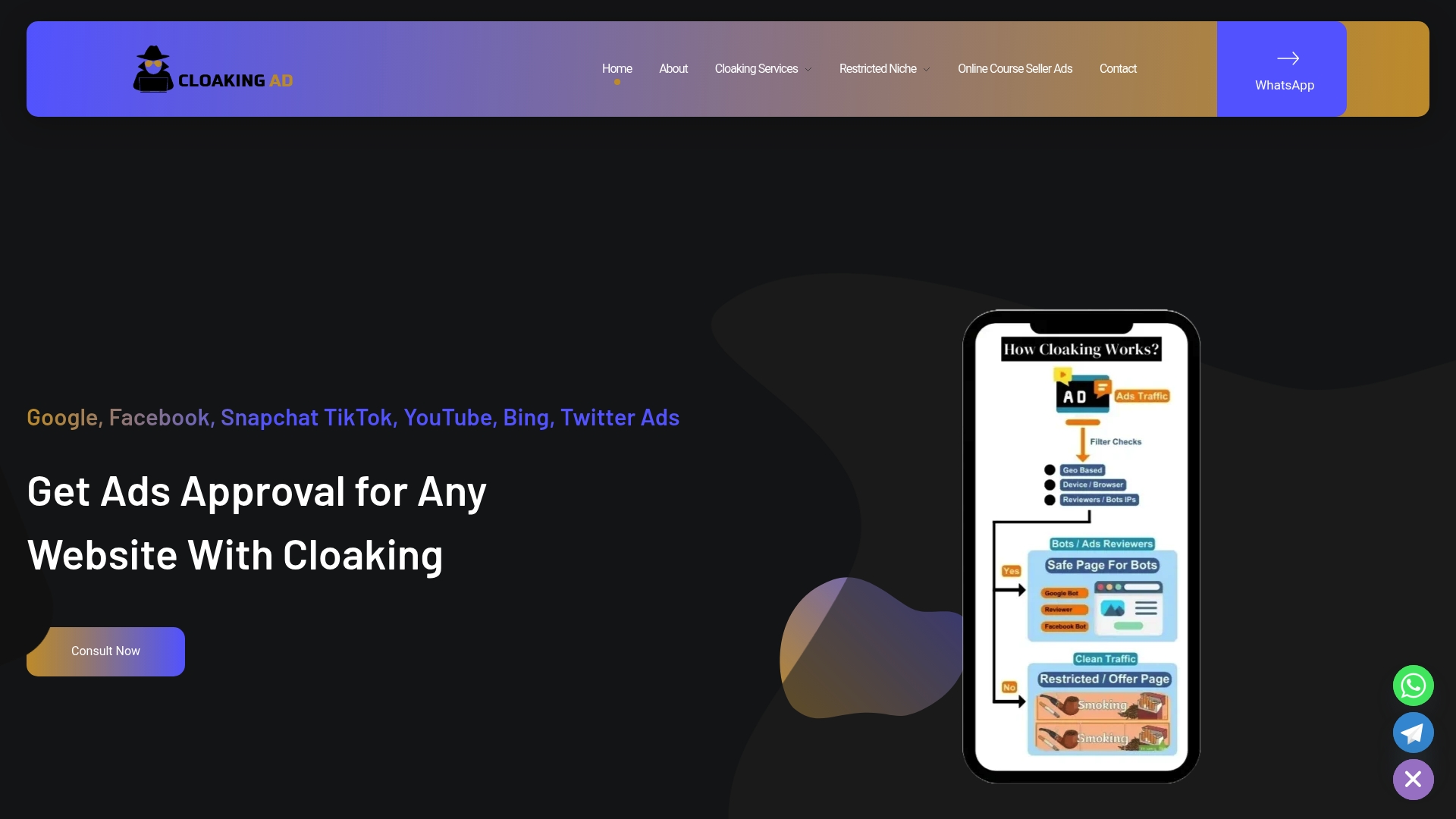
A first engagement typically starts with an audit of your current landing pages and redirect chain, followed by a documented routing plan and a remediation timeline if your account already has flags against it. For advertisers who want the infrastructure without a full management contract, the cloaking system setup runs as a $1,599 one-off engagement. For teams that want ongoing hands-on management across platforms, the done-for-you service is a $3,599 one-off engagement covering setup and continued optimization. If you’re not sure which fits, book a consultation call and walk through your current setup before you spend another dollar on rejected campaigns.
Sources
- Cloaking TikTok Ads: What It Is and What It Is Not | Daily Intel Service
- Cloaking for TikTok and Facebook Ads: 2026 Compliance Guide | DeepClick
- TikTok’s New Affiliate Ad Rules Are Reshaping How Media Buyers Run Advertorials in 2026 – Affiliate Times
FAQ
What Is the 3 Second Rule on TikTok?
The “3 second rule” refers to TikTok’s algorithm counting a video view once a viewer watches for at least three seconds, which affects reported view counts and ad delivery metrics. It’s not a cloaking-related rule; it’s a measurement threshold that shapes how your ad performance data gets reported back to you.
Can TikTok Access Everything on Your Phone?
TikTok’s app permissions work like any other app: it can only access what you explicitly grant, camera, microphone, contacts, and so on, through your device’s permission settings. It does not have blanket access to your entire phone by default, though privacy advocates recommend reviewing granted permissions periodically.
Is the New TikTok 2026 Update Safe to Advertise Under?
Yes, but the 2026 enforcement updates specifically tightened rules around advertorial pre-landers, countdown timers, and redirect chains, so campaigns that relied on those tactics face higher rejection risk now than in prior years. Advertisers running compliant, claim-substantiated landing pages on a single domain aren’t materially affected.
How Much Does It Cost to Run TikTok Ads?
TikTok ad spend varies widely by campaign goals and bidding, and TikTok doesn’t publish a fixed cost-per-thousand-views figure that applies universally. For advertisers in restricted categories who also need approval infrastructure, Cloaking Ads offers a cloaking system setup at $1,599 one-off, separate from your TikTok ad spend itself.
Is Hiring a Cloaking Vendor Against TikTok’s Rules?
Hiring a vendor isn’t automatically a violation. What matters is whether the vendor’s system serves materially different content to reviewers than to real users, versus simply filtering bot and fraud traffic while keeping the offer consistent for everyone.