
Yes, supplement ads can get approved, but only when every claim is classified correctly before you submit. Start by sorting each claim into disease, structure/function, or nutrient-content categories, then strip or substantiate anything that implies you’re treating, curing, or preventing a medical condition, since FDA and FTC rules govern what platforms will allow. Google and Meta both review your landing page as closely as your ad copy, so fix the destination first. A managed option exists for brands that keep failing this process despite clean claims.
TL;DR:
- Claims suggesting treatment, cure, or prevention of a disease must be removed or rewritten as structure/function statements to avoid disapproval.
- Landing pages need to match ad claims exactly, avoid medical imagery, and not imply diagnoses or medical consultations to pass review.
- Substantiating every claim with clear evidence and organizing documentation by product and claim speeds approval and simplifies appeals.
- Rejections often stem from location mismatches, unverified ingredients, or medical visuals, which can be fixed by thorough review and proper documentation.
- For persistent issues or restricted categories, hiring a specialized service like Cloaking Ads can help bypass automated restrictions while maintaining compliance.
Table of Contents
- What Do Google and Meta Actually Check for Supplement Ads Approval?
- Health Claims vs. Structure/Function Claims: What’s the Difference?
- What Should You Prepare Before Submitting Supplement Ads?
- Why Do Supplement Ads Get Disapproved (and How Do You Fix It)?
- How Do You Appeal a Rejected Supplement Ad?
- How Do You Keep Supplement Ads Approved Long-Term?
- When Should You Bring in a Managed Approval Service Like Cloaking Ads?
- Umar’s Take: What Actually Moves the Approval Needle
- Get Supplement Ad Approvals Without the Rejection Loop
- Where to Read the Actual Policy Text
- Sources
- FAQ
What Do Google and Meta Actually Check for Supplement Ads Approval?
Google’s automated systems and human reviewers look for the same handful of triggers every time: disease claims, pharmaceutical-sounding ingredients, and landing pages that read like a doctor’s office instead of a store. Google’s Unapproved pharmaceuticals and supplements policy lists specific categories and example products the platform won’t run, and it flags that some healthcare advertisers need certification before any ad goes live. Separately, Google’s Healthcare & medicines policy governs destinations and targeting, which means an otherwise clean ad can still get rejected if the landing page falls outside approved formats or locations.
Meta runs a similar filter but with heavier weight on imagery and targeting signals. Before-and-after photos, exaggerated weight-loss visuals, and hyper-specific health-condition targeting (arthritis, diabetes, anxiety) tend to trip automated review even when the copy itself looks tame. Both platforms treat testimonials as claims, not personal opinion, so a customer quote saying a product “cured” their fatigue carries the same risk as writing that claim yourself.
Here’s the practical checklist to run before you launch anything:
- Does any word imply treating, curing, preventing, or diagnosing a disease? Remove it.
- Does the ad mention a condition (diabetes, depression, cancer) by name? Rewrite around structure/function language instead.
- Does the creative include exaggerated before/after imagery or medical-looking visuals (lab coats, syringes, stethoscopes)?
- Does targeting rely on inferred health conditions rather than general interest categories?
- Does the landing page match the ad’s tone and claims exactly?
Pro Tip: Run your ad copy and landing page through the same checklist together, not separately. Reviewers evaluate them as one unit, and a compliant ad linked to a non-compliant page fails just as often as the reverse.
Google’s own guidance notes that some advertisers need certification and that certain products are restricted to specific locations. That single detail explains a huge share of the “randomly rejected” complaints marketers post in forums. It’s rarely random. It’s usually a location or certification mismatch nobody checked upfront.
Health Claims vs. Structure/Function Claims: What’s the Difference?
This distinction decides more approval outcomes than any other single factor, so getting it wrong is the fastest way to a permanent policy strike. A health claim states or implies a product treats, cures, prevents, or diagnoses a disease. “Reduces the risk of osteoporosis” is a health claim. A structure/function claim describes how an ingredient supports normal body function, without referencing a disease: “supports bone density” or “helps maintain healthy joints.” A nutrient-content claim simply states the amount of a nutrient, like “high in vitamin D” or “excellent source of magnesium.”
Structure/function claims come with a legal obligation most marketers skip: FDA requires notification within 30 days of first marketing the claim, plus the standard disclaimer stating the product isn’t intended to diagnose, treat, cure, or prevent any disease. That disclaimer is the part nearly everyone misreads. Slapping it on a bottle or a landing page doesn’t mean FDA reviewed or endorsed anything. It’s a legal notice, not a stamp of approval, and platforms know the difference even when advertisers don’t.
The FTC layer runs parallel to FDA’s. Advertisers need competent and reliable scientific evidence substantiating a claim before publishing it, not after a customer complains. This applies to every claim format: headline copy, a testimonial, an influencer post, even a comparison chart. The FTC doesn’t pre-approve anything, which surprises marketers used to platform review cycles, but it will investigate after the fact and treat unsubstantiated claims as deceptive advertising regardless of intent.
A quick reference for classification:
- Disease/health claim: “Treats anxiety,” “cures insomnia,” “prevents heart disease” — avoid entirely unless you have drug-level regulatory clearance.
- Structure/function claim: “Supports calm mood,” “promotes restful sleep,” “supports cardiovascular health” — allowed with notification and disclaimer.
- Nutrient-content claim: “Good source of omega-3,” “contains 500mg of magnesium” — allowed when accurate and verifiable.
Pro Tip: Keep a simple spreadsheet mapping every claim on your site and in your ads to its category. When a reviewer or an appeals team asks for justification, you want that answer in seconds, not days.
Remember that there’s no single global “approved supplement” status. A claim that’s fine for a U.S. audience might require different substantiation, or be outright banned, in another country. If you run ads internationally, check each destination market’s rules separately rather than assuming FDA compliance travels with you.
What Should You Prepare Before Submitting Supplement Ads?
Preparation determines your approval odds more than any last-minute copy tweak. Build this in order:
- Ingredient audit. Confirm every ingredient is legal in each target market and cross-check it against Google’s prohibited and restricted lists before you write a single headline.
- Documentation library. Collect Certificates of Analysis (CoAs), GMP manufacturing certificates, and any third-party lab reports, and keep them organized by product and batch.
- Claim-to-evidence matrix. Tie every marketing claim to a specific study, lab result, or certificate. A defensible evidence package typically includes ingredient-level CoAs, study citations matched to the exact claim and dosage used, GMP certificates, and a simple two-page matrix reviewers can scan quickly.
- Landing page review. Verify ingredients are visibly listed, refund and shipping policies are clear, contact information is real and findable, and imagery avoids medical settings or implied diagnoses.
- Ad creative pass. Strip medical terminology, avoid targeting based on inferred health conditions, and confirm the ad’s headline matches the landing page’s actual claims word for word.
The file-naming part matters more than people expect. Name evidence files by product SKU and claim number (for example, SKU4021_claim03_sleepstudy.pdf) so an appeals reviewer, or your own team six months later, can trace any specific claim back to its source in under a minute.
| Asset | What It Should Contain | Why Reviewers Ask for It |
|---|---|---|
| Certificate of Analysis | Verified ingredient identity and potency per batch | Confirms formulation matches label claims |
| GMP certificate | Manufacturing facility compliance documentation | Establishes production legitimacy |
| Claim-evidence matrix | Each claim mapped to its supporting study or test | Speeds up appeals and audits |
| Landing page disclosure | Ingredients, refund policy, contact details | Meets platform transparency requirements |
On the landing page itself, three details cause more rejections than anything else: missing contact information, refund policy buried or absent, and imagery that implies a medical treatment rather than a wellness product. None of these require a lawyer to fix. They require someone on your team to actually read the page the way a reviewer would.
Why Do Supplement Ads Get Disapproved (and How Do You Fix It)?
Most disapprovals fall into four repeatable patterns, and each has a specific fix rather than a vague “clean up the copy” instruction.
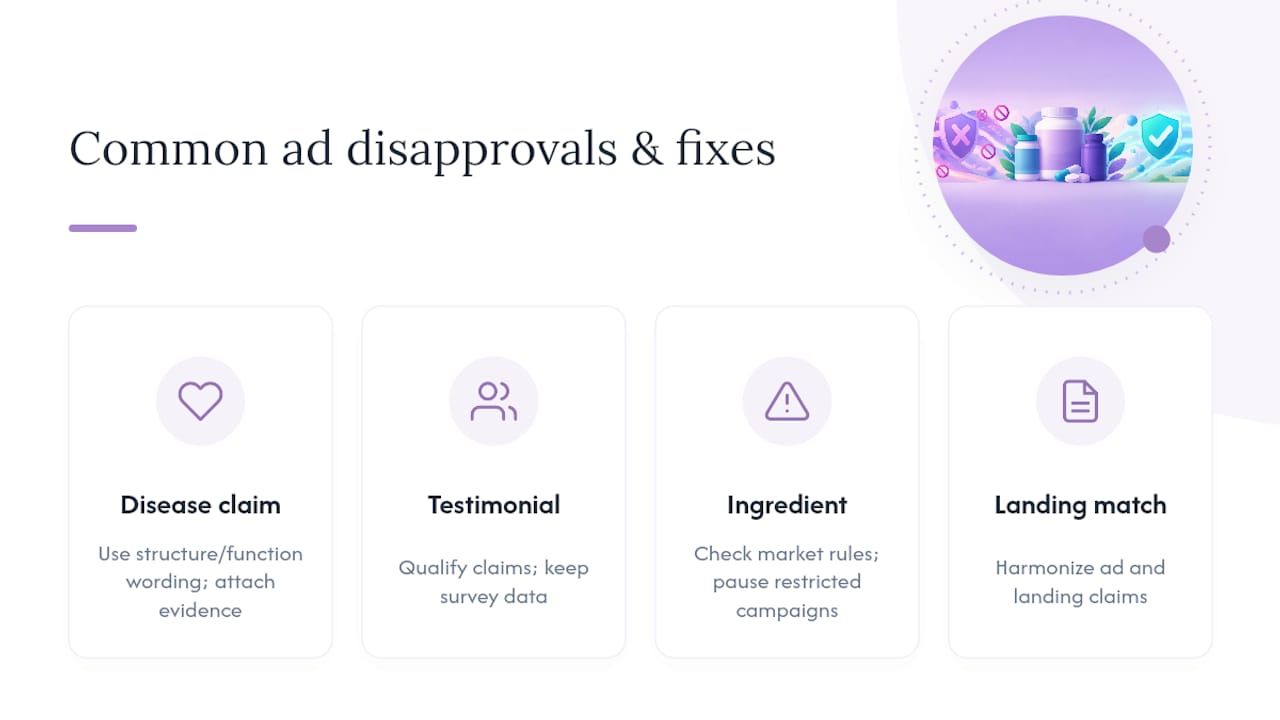
Disease claim slipped into copy. “Helps fight inflammation-related disease” reads as a health claim even if you didn’t intend it that way. Fix: rewrite to structure/function language (“supports a healthy inflammatory response”) and attach the evidence backing that specific wording, or remove the line entirely if you can’t substantiate it.
Testimonial implying guaranteed results. A customer quote saying “This cured my chronic pain in a week” creates the exact liability a careful ad avoids. The FTC treats testimonials the same as claims you’d write yourself, and moving a risky promise into a customer’s mouth doesn’t remove that liability. Fix: replace it with a qualified statement (“many customers report feeling more comfortable within days”) and keep the original survey data on file in case a platform or regulator asks.
Banned or restricted ingredient discovered. Sometimes a formulation includes an ingredient that’s legal in one market and flagged in another. Fix: verify the formulation against each target market’s rules, pull the product from campaigns in restricted regions immediately, and reformulate if the ingredient is central to your positioning.
Ad and landing page don’t match. Your ad says “supports joint comfort” but the landing page headline says “eliminate arthritis pain.” That mismatch alone can trigger disapproval even though the ad copy itself passed. Fix: harmonize both pieces to the same claim category, and remove any funnel step that implies prescription facilitation or medical consultation you’re not licensed to provide.
Pro Tip: Before resubmitting, read your ad and landing page back to back out loud. If the tone shifts from “supports wellness” to “solves your disease,” a reviewer will catch it even if you don’t.
None of these fixes require guesswork. They require pulling the specific claim, matching it against its category, and either substantiating it properly or cutting it.
How Do You Appeal a Rejected Supplement Ad?
Appeals succeed far more often when they’re documented rather than argumentative. Here’s the sequence that works:
- Read the actual disapproval reason, not just the policy name. Google and Meta both cite a specific policy category, and that category tells you exactly which fix applies.
- Make the fix first, then appeal. Submitting an appeal without changing anything rarely works twice.
- Attach your evidence file when the platform allows supporting documentation. Include the claim-evidence matrix and any relevant CoA or study citation directly tied to the rejected claim.
- Document every change you made between the rejected version and the resubmission, so a human reviewer can see the difference at a glance.
- Expect a review window, typically a few business days, and avoid resubmitting the exact same creative repeatedly while waiting, since repeated identical submissions can flag an account for manual review.
For categories Google treats as regulated healthcare advertising, certification becomes necessary rather than optional. Google’s healthcare certification process applies to advertisers in specific categories and comes with location restrictions, meaning certification in one country doesn’t automatically clear you to advertise in another. Typical documentary evidence includes business licensing, proof of legal operation in the target market, and sometimes a compliance officer’s attestation.
At some point, DIY appeals stop being the efficient path. If you’ve fixed the obvious issues and you’re still getting rejected, or if you’re trying to scale the same campaign across Google, Meta, and TikTok simultaneously, that’s usually the signal to bring in legal counsel, pursue a third-party accreditation, or work with a Meta-specific compliance service built around this exact workflow.
How Do You Keep Supplement Ads Approved Long-Term?
Approval is not a one-time event. Platforms re-review active campaigns, update policies without much warning, and can flag an account retroactively if a formulation or claim changes after launch. A basic maintenance routine prevents most of that risk:
- Run a monthly audit of live ad copy against your current claim-evidence matrix, not just at launch.
- Keep an internal change log tracking every formulation update, new claim added, or landing page edit, with dates.
- Refresh CoAs and lab reports on a set schedule rather than waiting until a reviewer asks for them.
- Stick to conservative creative templates for sensitive audiences and avoid chasing trending ad formats that lean on exaggerated visuals.
- Subscribe to official policy update feeds from Google and Meta so formulation or claim changes never catch your team off guard.
- Preserve every appeal record and disapproval notice for at least a year. Patterns in rejection reasons often reveal a systemic issue worth fixing at the product level.
Accounts with a clean history of quick, well-documented fixes tend to get faster reviews over time. Accounts that repeatedly submit the same flagged claim tend to get flagged faster and reviewed more harshly, sometimes across the entire account rather than just the one ad.
When Should You Bring in a Managed Approval Service Like Cloaking Ads?
Some brands do everything right, classify claims correctly, clean up testimonials, build a full evidence file, and still get caught in repeated rejections because the vertical itself carries extra scrutiny. Peptides, CBD, kratom, and certain pill-form supplements fall into this bucket regardless of how compliant the copy is. That’s the specific gap Cloaking Ads is built to close.
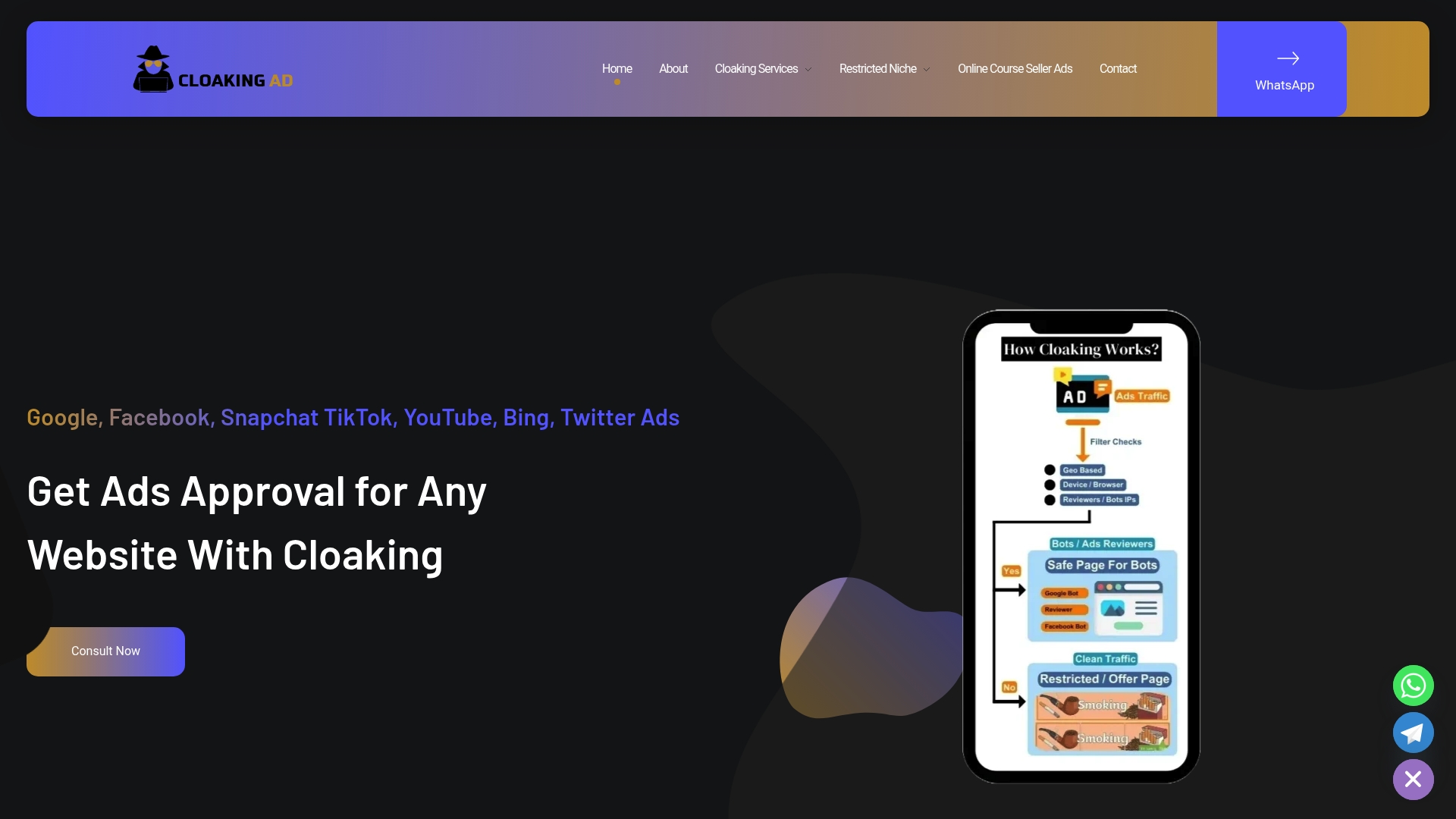
Cloaking Ads specializes in ad approvals for businesses operating in restricted niches, including CBD, kratom, peptides, and other supplement categories that platforms scrutinize heavily. Rather than relying only on rewritten copy, the service sets up cloaking mechanisms designed to bypass overly aggressive automated screening while keeping the underlying campaign compliant and the account stable.
Consider a managed approach when any of these apply:
- You’ve fixed every claim and landing-page issue the checklist above covers, and you’re still getting rejected.
- You need the same campaign running across Google, Meta, and TikTok simultaneously without rebuilding creative for each platform’s quirks.
- Your internal team doesn’t have the bandwidth to monitor policy changes, maintain evidence files, and handle appeals on a rolling basis.
This isn’t a replacement for compliance work. It’s what you reach for after compliance work has already been done and the niche itself remains the obstacle.
Umar’s Take: What Actually Moves the Approval Needle
Most guides treat claim classification and landing-page cleanup as separate problems. They aren’t. Fix the claims first, then rebuild the landing page to match, and you’ll clear the majority of rejections before you ever touch an appeal form.
Where marketers waste time is chasing clever creative angles instead of boring, transparent ones. A plain page with visible ingredients, a real refund policy, and cautious language outperforms a flashy funnel every time a reviewer looks closely. Save the aggressive creative for categories that don’t carry this much scrutiny.
Bring in outside help only after remediation and appeals have genuinely failed, or when scaling across platforms outpaces what your team can manage alone. That’s a resourcing decision, not a compliance shortcut.
— Umar
Get Supplement Ad Approvals Without the Rejection Loop
Cloaking Ads gives supplement brands a faster path than the standard cycle of submit, get rejected, rewrite, resubmit, and hope. Instead of guessing which claim tripped the filter this time, you get a setup built specifically around bypassing overly aggressive automated review while keeping your campaign genuinely compliant underneath.
The Done-For-You engagement runs $3,599 one-off and covers full campaign management, ongoing account monitoring, and the cloaking infrastructure needed to keep ads live across Google, Meta, and TikTok. If you want to handle campaign management in-house but need the technical foundation built correctly, the Setup Cloaking System package runs $1,599 one-off and covers server configuration and safe landing pages tailored to your niche.
Before your first call, gather your product spec sheet, current lab reports and CoAs, existing ad copy, and any disapproval notices you’ve already received. That documentation lets the team diagnose the real blocker in one conversation instead of three. Book a consultation call to walk through your specific rejection history and figure out which package fits your scale.
Where to Read the Actual Policy Text
Platform summaries and marketing guides simplify things, sometimes too much. When you need the exact legal or policy language, go straight to the source:
- FDA’s dietary supplement questions and answers for general labeling and safety obligations.
- FDA’s structure/function claim notification requirements for the 30-day filing rule and disclaimer language.
- FTC’s health products compliance guidance for substantiation standards.
- Google’s unapproved pharmaceuticals and supplements policy for prohibited categories and examples.
- Google’s healthcare and medicines policy for certification and destination requirements.
This article is general information, not a substitute for advice from a qualified doctor. Consult a qualified healthcare professional about your own circumstances before acting on anything here.
Sources
- It’s not “FDA‑approved.” What that means for dietary supplements | FDA
- Notifications: structure/function and related claims for dietary supplement labeling | FDA
- Health products compliance guidance | Federal Trade Commission
- Unapproved pharmaceuticals and supplements – Advertising Policies Help
- Healthcare and medicines – Advertising Policies Help
FAQ
Do I need FDA approval to sell supplements?
No. The FDA generally doesn’t require premarket approval to sell or distribute a dietary supplement in the U.S. You’re still responsible for using legal ingredients, labeling accurately, and making only truthful, substantiated claims.
What are red flags to watch out for in supplement advertising?
The biggest ones are disease claims disguised as benefits, testimonials promising guaranteed results, and landing pages that look more like a medical clinic than a product page. Mismatched messaging between your ad and your landing page is another common trigger for disapproval on both Google and Meta.
How do I advertise a supplement without getting rejected?
Classify every claim as disease, structure/function, or nutrient-content before writing copy, then build an evidence file tying each claim to a specific study or certificate. Make sure your landing page matches your ad’s tone exactly, and consider a service like Cloaking Ads if repeated rejections continue despite clean copy.
How do I know if a supplement claim is approved?
There’s no formal “approval” for individual claims. Structure/function claims require notifying FDA within 30 days of first use and carrying the required disclaimer, while disease claims aren’t allowed on supplements at all without drug-level clearance.