
Yes, pharma and restricted-health ads get approved regularly, but only when the creative, landing page, and account signals all tell reviewers the same honest story. Platforms ban deceptive cloaking outright, so approval hinges on transparency, not tricks. Before you submit anything else this week, run a destination pre-audit: check every redirect hop, confirm your policy pages load, and test how the page renders on mobile.
TL;DR:
- Clearing redirect chains and collapsing URL hops significantly reduces the risk of cloaking detection and improves approval chances.
- Ensuring policy pages are live on the verified domain and match the claims in the creative prevents common destination-based rejections.
- Making sure landing pages load quickly on mobile, do not break or redirect differently, is essential for passing platform automated reviews.
- Submitting detailed evidence like screenshots, logs, and clear remediation steps speeds up appeals and increases the likelihood of account reinstatement.
- Compliance with platform-specific certification, targeting rules, and disclaimers is necessary because legal approval does not guarantee platform approval.
Table of Contents
- What Does “Pharma Ads Approval” Actually Require?
- Why Do Most Pharma Ads Get Rejected in the First Place?
- What Should You Test Before Submitting a Pharma Ad?
- How Do You Protect an Ad Account Once You’re Approved?
- How Do FDA and EMA Rules Shape What You Can Advertise?
- What Content Gets Pharma Ads Rejected Beyond Technical Issues?
- How Long Does Pharma Ad Approval Actually Take?
- What Do Compliant and Non-Compliant Pharma Ads Look Like?
- When Should You Handle Approval Yourself vs. Bring in a Specialist?
- Get Your Pharma Ads Approved Without the Guesswork
- Sources
- FAQ
What Does “Pharma Ads Approval” Actually Require?
Getting a pharma or pharma-adjacent ad approved means passing two separate checks: the creative review and the destination review. Most advertisers obsess over the first and ignore the second, which is backwards, because destination mismatches cause the majority of rejections in restricted categories.
Google, Meta, and TikTok each define cloaking the same way at a functional level: showing reviewers one thing while showing real users something else. Google’s policy on evasive or deceptive practices treats this as system circumvention, and it carries some of the harshest penalties in the entire policy library, up to and including account suspension without warning.
Reviewers don’t rely on a single pass. Automated crawlers hit your landing page first, often from data-center IP ranges with recognizable browser fingerprints. If your page detects that fingerprint and serves a “safe” version while showing something riskier to real visitors, that’s the exact pattern enforcement systems hunt for. Manual audits follow for accounts flagged by pattern-matching, and platforms also run post-approval sampling, meaning your ad gets re-crawled after launch. A campaign that passed review on Monday can get flagged on Thursday if the destination changed in between.
Here’s the part advertisers miss: routing itself isn’t the violation. Serving a French version to French visitors and an English version to everyone else is legitimate localization. Redirecting mobile users to a mobile-optimized layout is fine too. The violation is intent to hide a material difference, like a page that shows generic wellness content to a reviewer and a specific drug claim to a paid visitor.
A few patterns reliably trigger scrutiny:
- Content that changes based on referrer, user agent, or IP range in a way that hides the real offer
- Multiple redirect hops between the ad’s display URL and the final landing page
- Landing pages that render fine on desktop but break, stall, or redirect differently on mobile carriers
Enforcement stat: Platforms treat destination-mismatch behavior as a top-tier violation category, and suspensions frequently arrive without a warning period, according to Google’s own ad network abuse policy.
Why Do Most Pharma Ads Get Rejected in the First Place?
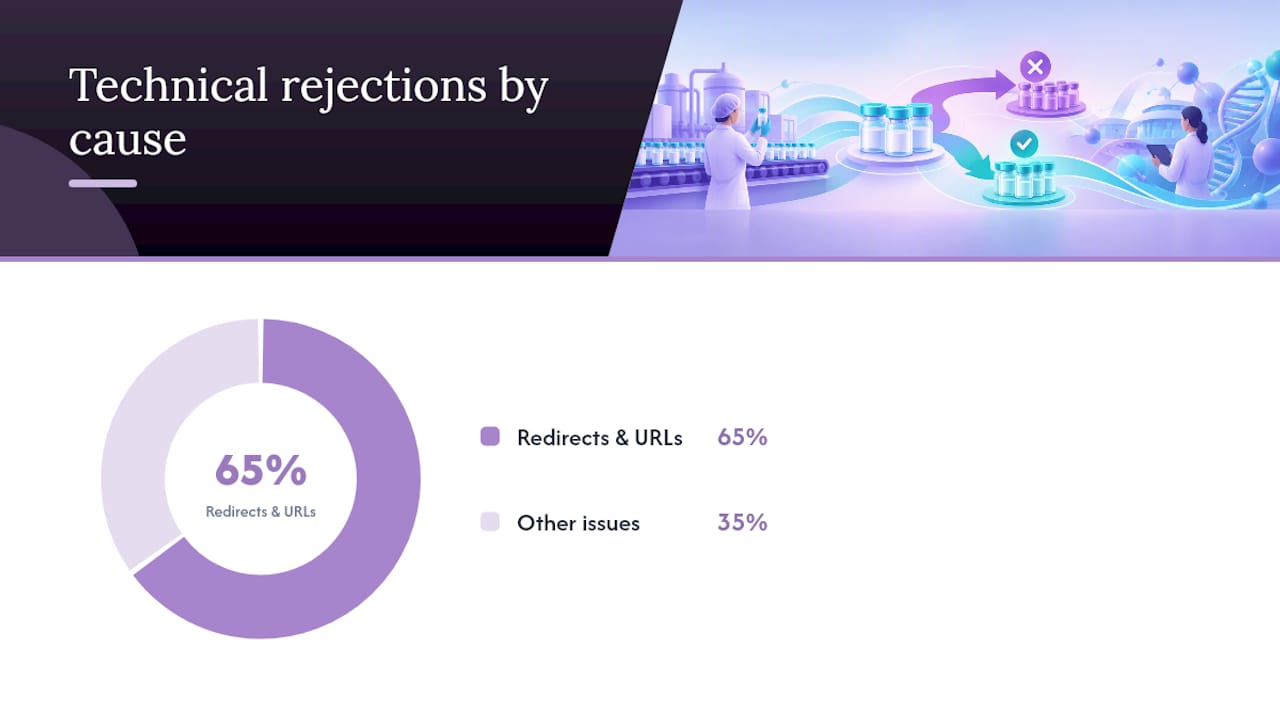
Technical, destination-based issues cause the bulk of rejections, and they’re also the fastest to fix. Industry practice suggests that simply cleaning up URL hygiene, collapsing redirects and matching the display URL to the final destination, resolves roughly 65% of technical rejections tied to crawler detection.
Fix these in order of impact:
- Kill redirect chains and shorteners. Every hop between your ad’s display URL and the actual landing page looks like an evasion attempt to a crawler. Collapse multistep redirects to a single hop, and drop third-party link shorteners entirely. They’re a red flag even when you’re using them innocently for tracking.
- Add the pages reviewers expect to find. A live privacy policy, terms of service, and a working contact page, all on the verified domain, are baseline requirements. Missing pages or broken mobile rendering are two of the most common reasons TikTok holds a landing page for review, according to guidance from Daily Intel Service.
- Match the claim in your creative to the claim on your lander. If your ad copy mentions a specific compound, dosage, or condition, your landing page needs to say the same thing in the same terms. Divergence between ad and destination is one of the clearest cloaking signals a reviewer can find.
Pro Tip: Screen-record your landing page loading on a throttled 4G connection before you submit. Reviewers and their crawlers don’t always get fiber-speed connections, and a page that stalls for three seconds on a real network can behave differently than the version you tested on office Wi-Fi.
One more thing worth flagging even though reviewers rarely look here directly: tracking payloads and server-to-server data feeds can leak sensitive medical or personal fields to ad platforms without anyone noticing during a routine content review. That’s not a rejection reason today, but it’s a compliance liability that catches up with accounts later.
What Should You Test Before Submitting a Pharma Ad?
Run this checklist before every submission, not just your first one. Resubmitting the same broken destination is the single biggest waste of review cycles in restricted verticals.
- Open the landing page in TikTok’s in-app browser, not Safari or Chrome, since in-app rendering is what the platform’s own review process simulates according to TikTok’s landing page guidance. Test on a mid-range Android device over cellular data, not office Wi-Fi.
- Time-to-interactive matters. If a visitor has to wait more than a couple of seconds for the page to become usable, that delay alone can read as suspicious behavior to automated review systems.
- Count your redirects. Anything beyond a single hop between ad and destination should get collapsed. Remove bridge pages and shorteners completely.
- Confirm your policy pages are live on the same verified domain as your landing page, and that the domain itself is verified inside Meta Business Manager or your Google Ads account.
- Save your evidence before you submit anything. Screenshots of the working page, server logs showing the redirect fix, and timestamped before/after comparisons are exactly what platforms ask for when you request a manual review or file an appeal.
| Pre-submission check | Why it matters | Fix time |
|---|---|---|
| In-app browser rendering | Matches how the reviewer’s crawler actually sees the page | Same day |
| Redirect hop count | Multiple hops read as evasion signals | 1 to 2 days |
| Live policy pages | Missing pages are a common automatic hold | Same day |
| Domain verification | Required for account-level trust signals | 1 to 3 days |
Domain verification inside your ad platform’s business account is a step advertisers underestimate. A guide to Meta’s approval and license process walks through exactly what verification requires and how it interacts with appeals.
How Do You Protect an Ad Account Once You’re Approved?
Approval is a starting point, not a finish line. Post-approval sampling means platforms can and do re-crawl live campaigns, so the version of your page that got approved needs to stay the version that’s live.
Keep these boundaries firm:
- Isolate your infrastructure. Separate Business Manager accounts, separate pixels, and separate payment methods per client or per offer limit how far an enforcement action spreads. Shared assets are the most common reason a single flagged campaign takes down an entire portfolio, a pattern Daily Intel Service has documented repeatedly in Meta account bans.
- Don’t swap the funnel after approval. Changing the offer, price, or content on an approved landing page is one of the fastest routes to a suspension, since it creates exactly the destination mismatch enforcement systems are built to catch.
- Audit your tracking payloads. Server-to-server data feeds can carry sensitive medical or personal fields into ad-platform systems without triggering a content review at all, which makes this a blind spot most teams never check.
Pro Tip: Treat every approved landing page like a signed contract with the platform. If you need to test a new offer, launch a fresh campaign with a fresh domain rather than editing the page underneath a live ad.
How Do FDA and EMA Rules Shape What You Can Advertise?
Regulatory bodies and ad platforms enforce different layers of the same problem, and both matter. In the United States, prescription drug advertising falls under the authority of the Food and Drug Administration, which requires balanced presentation of risks alongside benefits. In the European Union, the European Medicines Agency and national regulators generally prohibit direct-to-consumer advertising of prescription medicines entirely, a sharp contrast to the US framework.
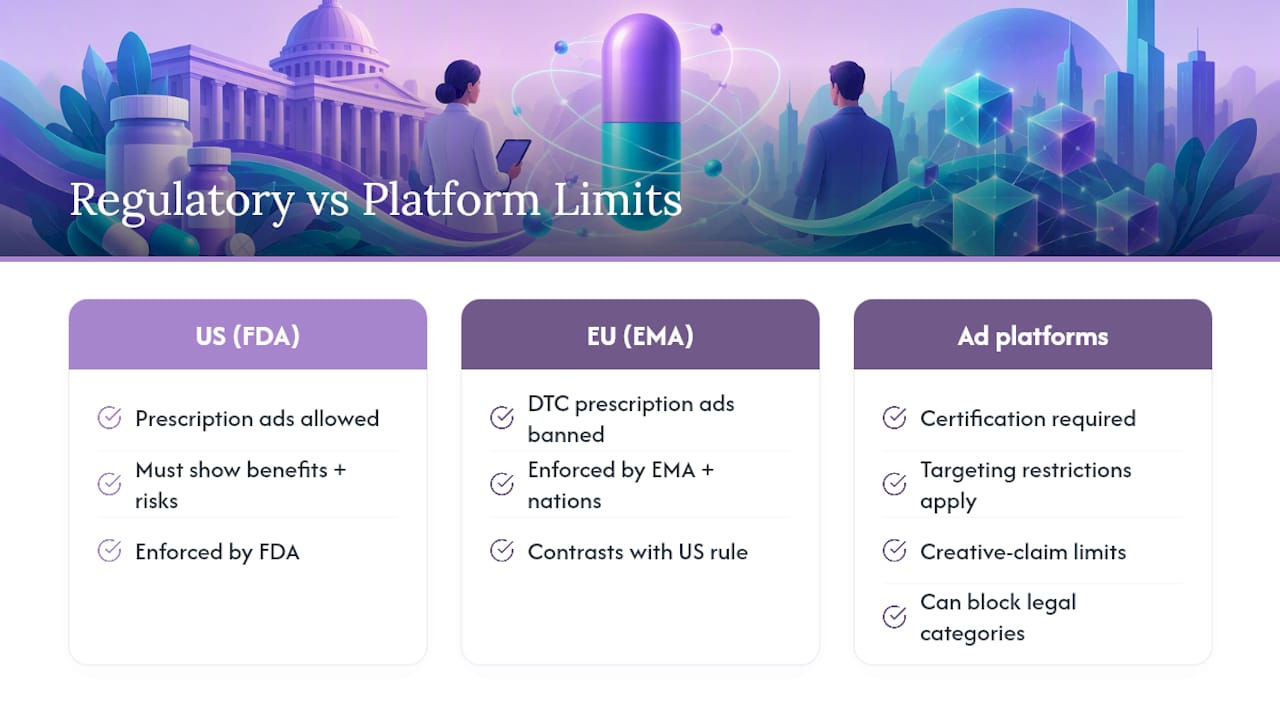
Ad platforms layer their own restrictions on top of whatever the law already requires. Google and Meta both require pharmaceutical advertisers to complete certification processes before running certain categories of health ads, and both platforms restrict targeting and creative claims well beyond the legal minimum. That means an ad that’s technically legal in your jurisdiction can still get rejected for violating platform-specific creative rules.
This is where a lot of confusion creeps in. Advertisers assume that if their product is legally sold, their ad should be approved. Platforms don’t operate that way. TikTok, Google, and Meta all reserve the right to restrict entire categories, supplements, prescription drugs, and pharma-adjacent products like peptides, regardless of local legal status. Big pharma brands have started building real presence on platforms like TikTok, but only by working within entity eligibility rules, country-specific authorization, and creative-level compliance, not around them, according to reporting from Endpoints News. The lesson holds for smaller advertisers too: compliance with the platform gate is a separate hurdle from legal compliance, and you need to clear both.
What Content Gets Pharma Ads Rejected Beyond Technical Issues?
Fix your redirects and your policy pages, and you’ll still get rejected if your claims cross a line. Content-based disapprovals are a different animal than destination issues, and they’re often less forgiving on appeal.
Unsubstantiated efficacy claims top the list. Phrases like “cures,” “guaranteed results,” or specific percentage improvements without clinical backing get flagged almost automatically by both human reviewers and keyword-matching systems.
Before-and-after imagery for medical or pharmaceutical products draws heavy scrutiny, particularly when it implies a guaranteed outcome. Weight-loss drugs, skin treatments, and hormone therapies are the categories where this shows up most.
Fear-based or exploitative framing around a health condition, imagery or copy designed to manufacture anxiety about a diagnosis to sell a solution, violates most platforms’ health and wellness content policies outright.
Missing required disclaimers for prescription or controlled substances is a straightforward miss. If your product category requires a safety disclaimer, its absence is often enough to trigger rejection on its own, separate from any technical issue with your landing page.
Targeting mismatches matter too. Advertising a prescription-only product to a general audience, without the account certifications platforms require for that category, gets flagged even when the creative itself is clean.
The pattern across all five: reviewers are looking for exaggeration, omission, or manipulation, not just technical policy violations. A landing page can pass every destination check and still get an ad disapproved if the copy oversells what the product does.
How Long Does Pharma Ad Approval Actually Take?
Initial review timelines vary by platform, but the process itself follows a predictable shape. Submit your ad, and an automated system typically screens it within hours. If it clears that pass, a manual reviewer may still take a second look, particularly for accounts new to a restricted category or campaigns using health-related keywords.
Rejection at this stage isn’t final. You can resubmit after fixing the flagged issue, but resubmitting the exact same landing page with no changes rarely produces a different outcome, since the same automated triggers fire again. The advertisers who get approved fastest are the ones who treat the first rejection as diagnostic information rather than an obstacle to route around.
For account-level suspensions tied to circumventing-systems violations, the timeline stretches considerably. Google’s appeals guidance recommends submitting detailed remediation steps and evidence rather than a generic appeal request, and reviewers weigh specificity heavily. A vague appeal claiming “this was a mistake” gets far less traction than one documenting exactly which redirect was removed, which policy page was added, and when.
Manual appeals succeed more often when advertisers attach before-and-after screenshots, logs showing the technical change, and a clear explanation of what caused the original flag, a pattern confirmed by appeal case studies from Barham Marketing. Expect appeal review to take longer than initial ad review, often several business days, and build that lag into your campaign timeline rather than treating an appeal as a same-day fix.
What Do Compliant and Non-Compliant Pharma Ads Look Like?
A compliant ad for a supplement or peptide product describes what the product is and links to a landing page that matches that description exactly, complete with a working privacy policy, clear ingredient or composition information, and no unsubstantiated health claims. The display URL matches the final URL with zero redirect hops in between. If the ad mentions a specific benefit, the landing page explains the basis for that claim rather than just repeating it louder.
A non-compliant version of the same ad might use a generic wellness image and neutral copy to pass the initial creative review, then route through two or three redirects to a landing page that makes aggressive, unqualified claims the ad itself never showed a reviewer. That gap, between what the reviewer saw and what the real visitor sees, is the textbook cloaking pattern every major platform is built to catch.
Another common non-compliant pattern: a landing page that works perfectly during manual testing but breaks or redirects differently when accessed from a data-center IP versus a residential one. That’s not always intentional cloaking. Sometimes it’s a caching or CDN misconfiguration. But platforms don’t distinguish between malicious cloaking and accidental technical inconsistency when their enforcement systems fire. The CloakingAd resource on pharma and pills ads walks through more category-specific examples of where advertisers in this space commonly go wrong.
When Should You Handle Approval Yourself vs. Bring in a Specialist?
Simple fixes, cleaning up a redirect chain, adding a missing privacy page, fixing mobile rendering, are worth doing yourself. If you’re running a small campaign with a straightforward offer, the checklist above will get most advertisers approved without outside help.
Where it gets harder is complex funnels: multi-step VSL pages, recurring billing mechanics, or an account that’s already been suspended once for circumventing-systems violations. Account recovery in particular is not a place to learn by trial and error, since a poorly documented appeal can burn your one shot at reinstatement.
A managed provider should give you clear documentation at every step: an asset map showing what’s isolated from what, a written remediation plan before anything changes, and ongoing monitoring after approval so post-approval sampling doesn’t catch you off guard. That transparency is what separates a real compliance partner from someone selling a shortcut. The breakdown of how cloaking improves pharma approval rates covers what that process looks like in practice.
— Umar
Get Your Pharma Ads Approved Without the Guesswork
Cloaking Ads specializes in exactly the problem this article just walked through: getting complex, high-risk campaigns like pharma, peptides, and health supplements approved and kept live, not just approved once and flagged three weeks later. The difference between DIY fixes and a managed engagement is speed and documentation. Cloaking Ads offers a rapid turnaround on setup and supports managed engagements with a commitment to approval, designed around asset isolation and platform-specific compliance patterns.
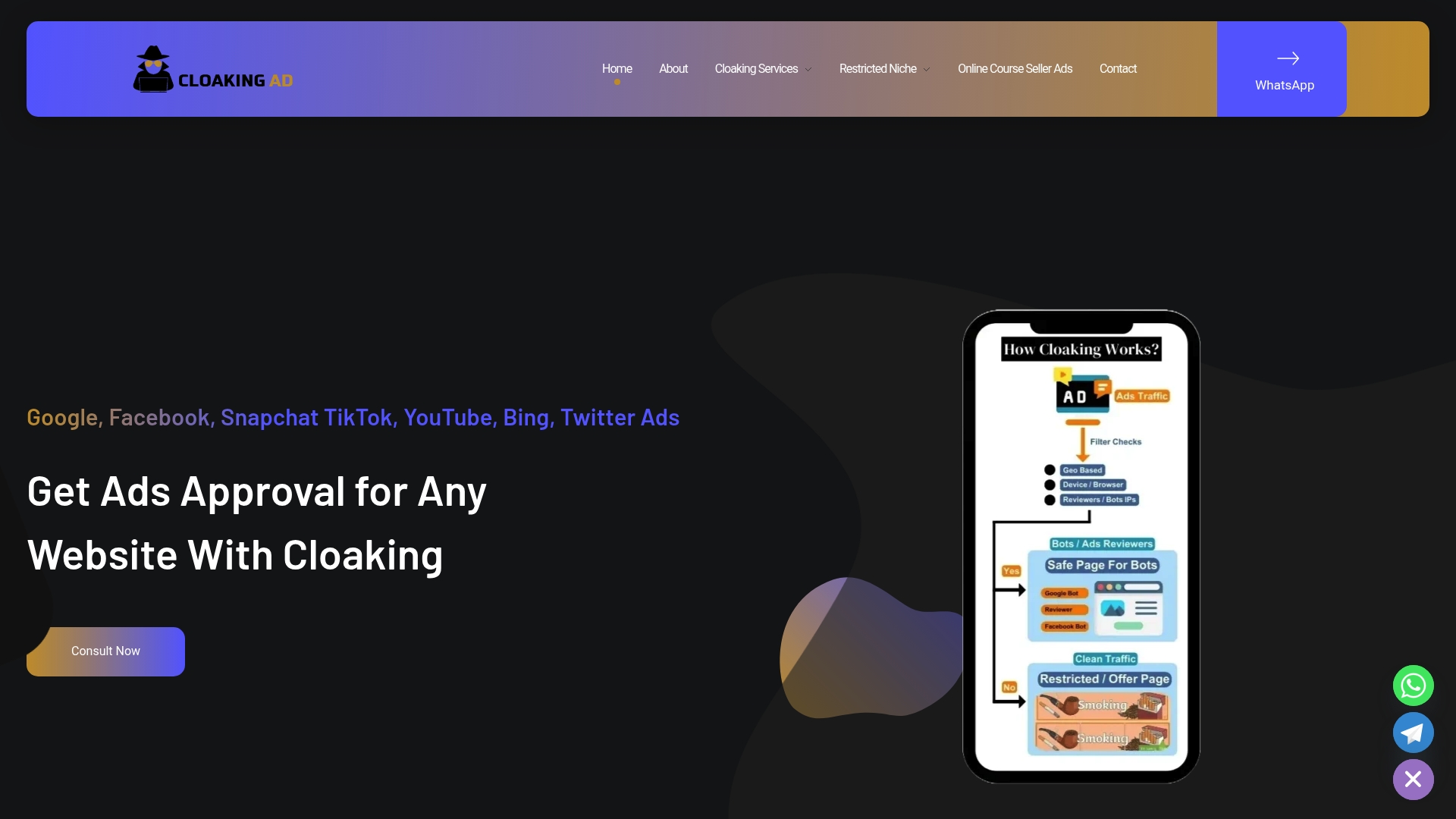
If you want a second set of eyes on your current setup, a CONSULTATION CALL is the lowest-friction starting point, priced on request through Cloaking Ads. For advertisers ready to move, the SETUP CLOAKING SYSTEM service runs $1,599 one-off and covers server configuration, safe landing pages, and reviewer detection built for restricted verticals, detailed on the services page. Advertisers who want the whole thing handled end to end can go with the Done-For-You package at $3,599 one-off. Onboarding typically starts with the same pre-audit steps covered here: redirect collapse, domain verification, and a review of your current tracking setup, before any cloaking infrastructure goes live. Book a consultation to get that audit started this week.
Sources
- Google Ads policy: Evasive or deceptive practices / Abusing the ad network
- Google Ads: Account suspension and appeals guidance
- TikTok Ads Landing Page Rejections: Causes and Fixes | Daily Intel Service
- How to Appeal Facebook Circumventing Systems Ads | 2026 Guide
FAQ
Is Pharma Advertising Allowed on Google and Meta?
Yes, but only within strict category rules and certification requirements that go beyond general legal compliance. Both platforms require pharmaceutical advertisers to meet platform-specific eligibility standards, and enforcement for evasive destination behavior, as defined in Google’s ad network policy, can result in account suspension.
What Triggers a Cloaking Detection on a Landing Page?
A mismatch between what a reviewer’s crawler sees and what a real visitor sees, whether from redirect chains, IP-based content swaps, or device-specific differences that hide a material offer detail. Cleaning up URL hygiene alone resolves the majority of these technical triggers.
How Long Does an Appeal for a Suspended Pharma Ad Account Take?
Appeal review generally takes longer than initial ad review, often several business days, and success depends heavily on documentation quality. Platforms want specific remediation evidence, screenshots, logs, and timestamps, not a general explanation, according to Google’s appeals guidance.
Does Cloaking Ads Guarantee Pharma Ad Approval?
Cloaking Ads states that managed engagements come with a guaranteed approval commitment, paired with ongoing account monitoring after launch. Pricing starts at a mid-thousand-dollar range one-off for cloaking system setup, with fully managed done-for-you packages at a higher mid-thousand-dollar range one-off, both listed on Cloaking Ads’ services page.
Can I Fix Pharma Ad Rejections Without Hiring a Service?
For straightforward issues, missing policy pages, broken redirects, or mobile rendering problems, yes, a self-run pre-audit and the fixes covered in this guide often resolve the rejection. Complex funnels, recurring billing setups, or recovering a suspended account are where a managed provider’s documentation and asset isolation become worth the cost.