

IP-based cloaking serves different content to crawlers and ad reviewers than it shows real visitors, identified by IP address. Search engines and ad platforms treat deliberate versions of this as a policy violation, with consequences ranging from index removal to account suspension. If you run server-side IP rules on your site or campaigns, the practical next step is to audit your setup against the checklist below before a platform flags it for you.
TL;DR:
- IP based localization is generally acceptable when language, regional pricing, or bandwidth changes leave the product and core content unchanged; concealment crosses the line.
- Platforms verify crawler IP ranges with reverse DNS, then compare behavior, fingerprints, and external snapshots; spoofed addresses alone do not evade layered review.
- Compare crawler responses with normal browser sessions, inspect headers, and test changes in staging; CDN rules and stale A/B tests can create accidental mismatches.
- Google Ads may disapprove ads before suspending accounts for repeated or severe violations, and appeals require documented fixes rather than assurances.
- A dynamic IP address can qualify as personal data when linked to an identifiable person, so document a lawful basis and limit retention where required.
Table of Contents
- What counts as IP-based cloaking versus ordinary IP delivery?
- How is IP-based cloaking actually built, and what traces does it leave?
- How do search engines and ad platforms detect it?
- What do platform policies say and how is cloaking enforced?
- What are the privacy and legal implications of using IP as a signal?
- What should webmasters do to stay compliant?
- What our work in restricted ad verticals shows about accidental cloaking
- Why most cloaking advice misses the real risk
- Get hands-on help auditing or building a compliant setup
- FAQ
- Sources
What counts as IP-based cloaking versus ordinary IP delivery?
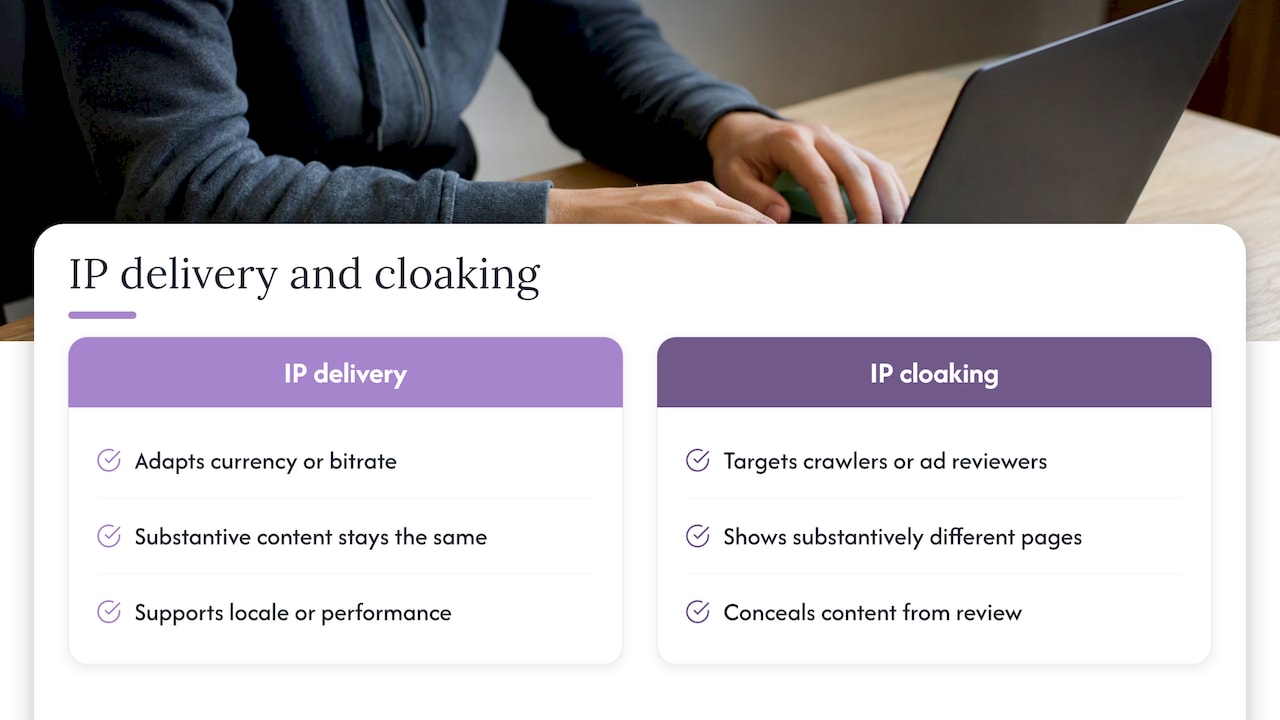
IP-based cloaking means your server checks a visitor’s IP address and uses that check to decide whether to show search engine crawlers or ad reviewers a different page than the one a normal visitor sees. The intent is concealment: hide content that would get the page rejected or penalized if the reviewer saw it directly.
That is distinct from IP delivery, a far more common and generally benign practice. A retail site might detect a visitor’s IP to suggest a local currency, or a video platform might use it to pick a lower-bitrate stream for a slow connection. Cloaking’s Wikipedia entry draws this line clearly: cloaking delivers different content to spiders versus users, while IP delivery can be legitimate when both audiences ultimately see substantively the same content, just adapted for locale or performance.
The test is not whether IP is used as a signal. Both practices do that. The test is whether the content shown to a crawler or reviewer differs in substance from what a real visitor sees, and whether that gap exists specifically to pass a review the true content would fail.
How is IP-based cloaking actually built, and what traces does it leave?
Most implementations combine a few layers rather than relying on IP alone, since static IP lists go stale quickly.
- IP allow or block lists: server rules match the visitor’s IP against known crawler or reviewer ranges and branch the response accordingly.
- ASN and reverse DNS checks: lookups confirm whether an IP belongs to a known network operator, such as a search engine’s data center.
- Geolocation databases: third-party IP-to-location services decide what version of a page to render.
- Header inspection: User-Agent, Accept-Language, and referrer values are checked alongside IP to corroborate or override it.
- Behavioral signatures: differences in request cadence, missing robots.txt fetches, or assets served only to certain visitors can all betray a cloaking setup.
- Device and browser fingerprinting: TLS fingerprints (JA3) and client hints are increasingly layered on top of IP checks for more precise targeting, a pattern detailed in our device cloaking resource.
Not every mismatch is intentional. Misconfigured CDN edge rules or leftover A/B testing logic can accidentally produce the same fingerprint as deliberate cloaking.
Pro Tip: Pull your server logs for a known crawler IP range and diff the response body against a normal user session; a byte-level difference is your first clue.
How do search engines and ad platforms detect it?
Detection rarely relies on a single signal. Platforms verify whether a request actually originates from their published crawler ranges using reverse DNS, then layer behavioral heuristics on top.
- Range verification: confirming an IP genuinely belongs to the crawler it claims to be, not a spoofed address.
- Behavioral heuristics: timing patterns, navigation sequences, and whether robots.txt was fetched before the page.
- Cross-correlation: comparing a site’s served content against external datasets, cached snapshots, or third-party crawls to catch mismatches.
- Fingerprint confidence: combining client hints and TLS fingerprints with IP data sharply raises detection precision, since a spoofed IP alone no longer passes review.
- Manual review flags: content that triggers automated suspicion gets escalated to human reviewers, who compare what they see against what the crawler received.
Academic research on cloaking and fingerprinting maps this layered approach in detail, showing that network, browser, and contextual cues together close most of the gaps that IP checks alone leave open. Outcomes for confirmed cloaking range from index removal and manual search penalties to outright ad account suspension.
What do platform policies say and how is cloaking enforced?
Google Ads’ Circumventing Systems policy explicitly names cloaking as a violation, defined as showing Google one version of a page or ad destination while showing users something different. The policy also covers related tactics, such as click trackers that redirect users to content the platform never reviewed.
- Policy scope: cloaking is grouped with other circumvention tactics like disguised destination URLs and redirect chains built to dodge review.
- Acceptable variation: showing different language, regional pricing, or bandwidth-adapted assets is fine as long as the underlying product or service stays the same.
- Enforcement path: detected violations typically trigger ad disapproval first, escalating to account suspension for repeated or severe cases.
- Appeal process: platforms generally require you to document the fix before resubmitting, not just promise compliance.
Search engine webmaster guidelines mirror this logic for organic listings: the dividing line is always whether the reviewer and the visitor see the same core content.
What are the privacy and legal implications of using IP as a signal?
Treating IP addresses as a purely technical detail can be a mistake in some jurisdictions. The Court of Justice of the European Union held, in Case C‑582/14, that a dynamic IP address can qualify as personal data when it can be linked to an identifiable person using other available information.
- Jurisdictional variability: some data protection authorities interpret IP addresses broadly as personal data by default, while others require additional identifying context.
- Minimization: logging IPs indefinitely for cloaking logic, rather than for a defined, limited purpose, increases exposure under data protection law.
- Lawful basis and disclosure: processing IPs for targeting or filtering may need a documented legal basis and a mention in your privacy notice.
- Consult counsel: this is not legal advice, and jurisdictional rules differ enough that a qualified lawyer should review any cloaking or IP-logging setup before launch.
What should webmasters do to stay compliant?
An audit-first approach catches most problems before a platform does.
- Compare responses: request your pages using known crawler IP ranges and diff them against a standard browser session.
- Use staging and test accounts: validate behavior away from production traffic before rolling changes out live.
- Inspect headers: check User-Agent, Accept-Language, and referrer handling alongside IP logic to confirm nothing diverges unintentionally.
- Run headless-browser comparisons: automate the diff process so accidental drift from CDN rules or A/B tests gets caught early.
- Prefer safer alternatives: Accept-Language negotiation, progressive enhancement, and server-side rendering achieve most legitimate localization goals without IP-based branching; our circumventing systems audit guide walks through a fuller seven-step version of this process.
- Remediate if flagged: remove any deceptive redirect or content branch, document exactly what changed, and follow the platform’s specific appeal guidance rather than resubmitting blind.
Pro Tip: Keep a dated changelog of every server-side content rule; it turns a platform appeal from guesswork into a five-minute conversation.
What our work in restricted ad verticals shows about accidental cloaking
Handling ad approvals across CBD, crypto, pharma, and other restricted categories means we see accidental cloaking constantly: a misconfigured CDN rule or leftover test branch that triggers the same red flags as a deliberate setup. Our device cloaking and risk checklist covers how fingerprinting layers on top of IP checks, and our consultation work focuses on catching that gap before a platform does, through setup review, monitoring, and safe landing-page patterns built for high-risk categories.
Why most cloaking advice misses the real risk
Most guidance on this topic still reads like a history lesson: what cloaking was, how search engines used to catch it, why it is bad. That framing undersells the actual operational risk, which is that today’s detection stacks combine IP checks with fingerprinting and behavioral analysis, so a static IP list that worked two years ago is now a liability, not a safeguard.
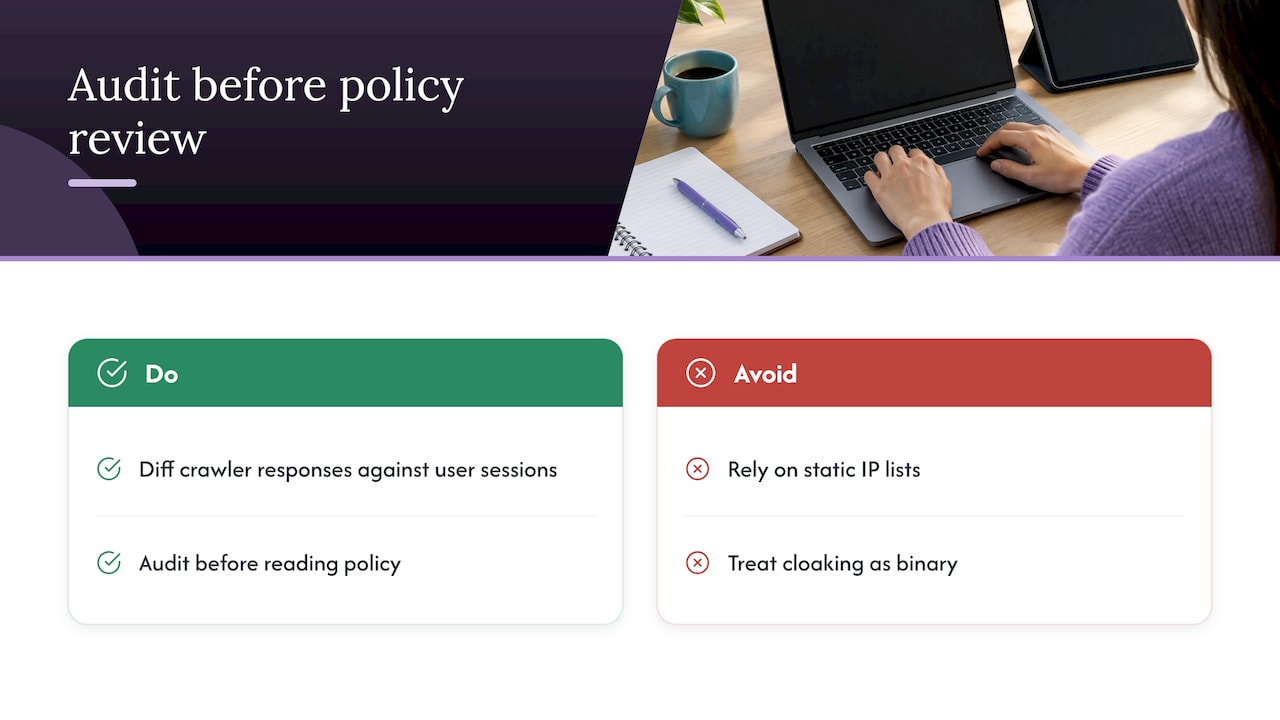
The conventional advice to “just avoid cloaking” also skips the harder, more common problem: accidental cloaking from CDN edge rules, A/B tests, or stale geolocation logic that nobody intended as deceptive but that trips the same detection signals. Readers who treat this as a binary, either you cloak or you do not, miss that most flagged sites fall into that gray middle.
If you take one thing from this, prioritize the audit over the policy reading. Diff your crawler-facing responses against real user sessions first. The legal and policy context matters, but it only becomes relevant once you know whether your setup actually produces a mismatch worth worrying about.
— Umar
Get hands-on help auditing or building a compliant setup
If you operate in a restricted vertical like CBD, crypto, forex, pharma, peptides, or similar, we offer consultation calls and services for cloaking system setup and account monitoring. Current prices are available on the pricing page.
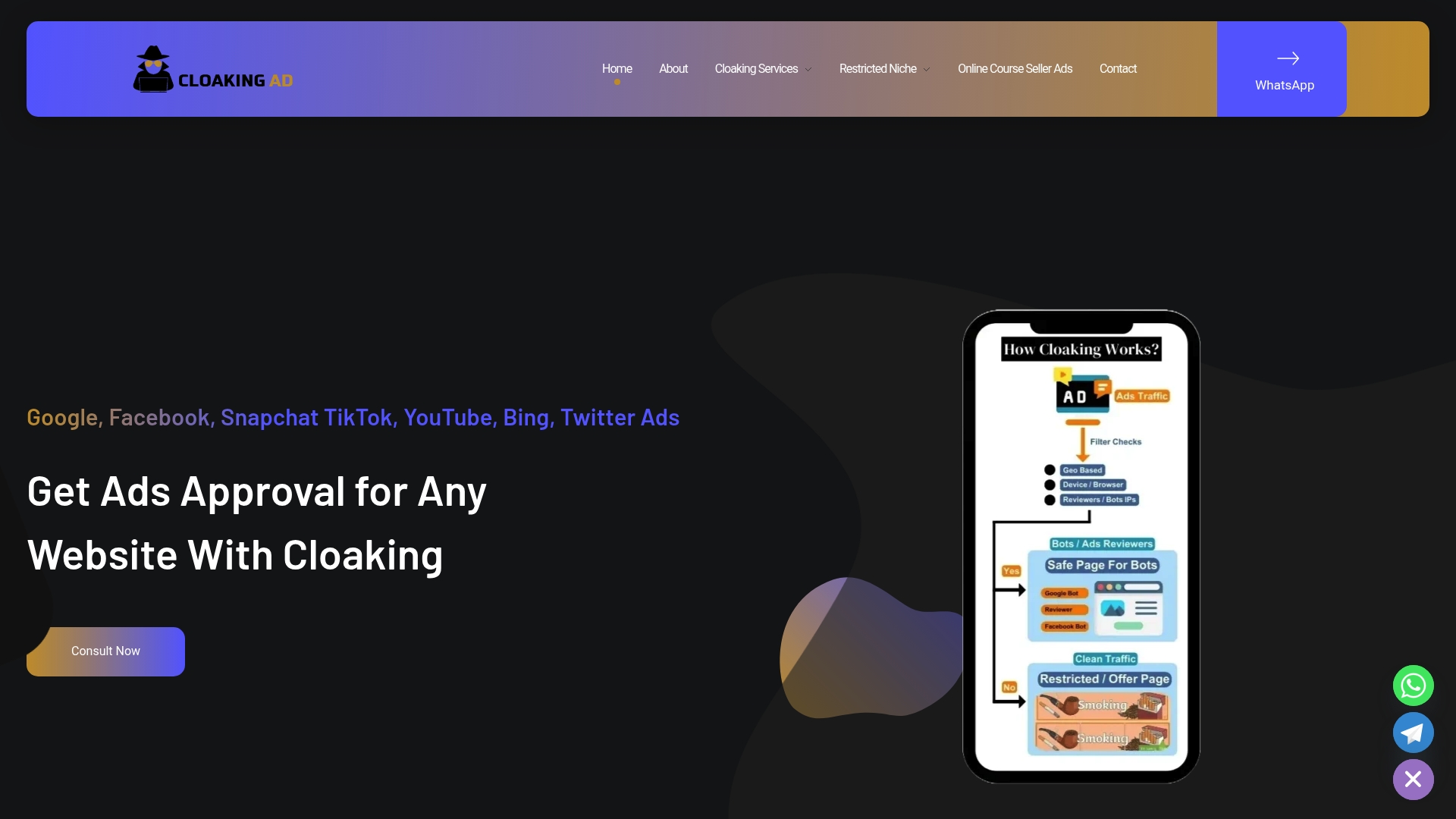
Reach out through our main booking page to start with an audit of your current setup and a clear remediation plan before a platform flags it for you.
FAQ
Are IP grabbers illegal?
IP grabbers themselves are generally legal tools for collecting visible network information, but how the collected data gets used can trigger privacy obligations. Using one to deceive, harass, or target an individual without consent can cross into illegal territory depending on jurisdiction and intent.
How do I cloak my IP address?
Individuals typically mask their own IP using a VPN, proxy server, or the Tor network, which routes traffic through intermediary servers before it reaches a destination site. This is distinct from website-side IP cloaking, where a site operator serves different content based on a visitor’s detected IP.
Can IP spoofing be detected?
Yes, IP spoofing can often be detected through reverse DNS verification, cross-referencing known legitimate address ranges, and behavioral analysis that flags inconsistencies between claimed and actual network origin. Combining these checks with device fingerprinting, as outlined in Cloaking’s Wikipedia overview, raises detection confidence further.
Is IP spoofing legal?
Legality depends heavily on intent and jurisdiction: spoofing used for testing, research, or privacy within your own systems is generally treated differently than spoofing used to commit fraud or evade security controls. Because IP addresses can qualify as personal data in some regions, as established by the CJEU’s Case C‑582/14, misuse can also carry data protection consequences beyond fraud statutes.