
Yes, rolling spot forex and related speculative financial products can run on Google Ads, but only in approved locations where the advertiser holds a valid local license, the product complies with local law, and the advertiser has completed Google’s certification for that specific market. Binary options and several other product types remain banned outright, and misleading claims will get an ad pulled no matter how compliant the account otherwise looks.
TL;DR:
- Submit a separate Google certification application for every target country, with current local registration and proof that the advertised product falls within your license scope.
- Keep the advertiser, license, product scope, and disclosures consistent across certification and landing pages, with the risk warning beside the primary call to action.
- Regulated firms remain responsible for affiliate ads, so provide approved claims and disclosures and review partner creative before and after publication.
- EU and UK campaigns must reflect retail leverage caps and prominently show standardized loss disclosures, rather than advertising a broker’s higher global limits.
- Check Google’s policy pages weekly, regulator notices monthly, and audit landing pages and ad creative quarterly; keep dated copies of every approved version.
Table of Contents
- What Google’s Complex Speculative Financial Products Policy Actually Covers
- Which Markets Allow Forex and CFD Ads, and Which Regulator Applies
- How to Apply for Google’s Financial Products Certification
- Ad Copy and Landing Page Rules You Cannot Skip
- Where Regulator Rules Override or Shape Google’s Policy
- Keeping Your Account Compliant After Approval
- How Agencies Prepare Forex Advertisers for Certification
- What I’d Prioritize as an Advertiser Right Now
- Getting Hands-On Help With Forex Ad Approvals
- FAQ
- Sources
What Google’s Complex Speculative Financial Products Policy Actually Covers
Google groups rolling spot forex, contracts for difference (CFDs), and spread betting under its Complex speculative financial products policy, a category distinct from general financial services advertising. The policy exists because these products carry a structurally high loss rate for retail traders, and regulators in most major markets already treat them as higher-risk instruments requiring extra disclosure.
In plain terms, Google’s rule has three moving parts. First, the advertiser needs an active license from the financial regulator in the market being targeted, not a license from a different country that happens to cover similar products. Second, the product itself, including leverage ratios and account structures, has to comply with that market’s local law, which means a leverage cap allowed in one country can make the same ad non-compliant in another. Third, Google requires the advertiser to go through its own certification process for each location targeted, separate from any licensing already held with a regulator.
“Licensed provider” means the entity running the ad, or the entity it is promoting, holds a current and verifiable registration with the named financial authority for that jurisdiction, not a historical license or one pending renewal. “Eligible location” refers to the country or region Google has designated as open for this ad category. Google does not allow blanket global campaigns for these products; eligibility is assessed location by location, and an advertiser certified in one country cannot assume that certification extends elsewhere.
Several items are flatly prohibited regardless of licensing status. Binary options advertising is banned across all markets. Ads promoting unregulated brokers, or brokers operating in a market without the required local authorization, are disapproved on sight. Creative that implies guaranteed profit, understates the risk of loss, or omits required disclosures gets flagged during both the certification review and routine ad scanning afterward.
Flagged creative patterns tend to repeat across disapprovals: countdown-style urgency (“limited spots left to trade”), testimonials implying typical results without context, and comparisons that position forex trading as a low-risk alternative to saving or investing. Google’s enforcement systems are built to catch these patterns even when the advertiser’s license and landing page are otherwise in order, so creative review deserves the same attention as the paperwork.
Which Markets Allow Forex and CFD Ads, and Which Regulator Applies
Eligibility is not a single global list; it is a country-by-country matrix, and the regulator you need to present changes with it. Google’s Financial services verification guidance confirms that each targeted location normally requires its own separate verification, built around proof of licensing and registration specific to that market.
| Market | Relevant regulator | What to expect |
|---|---|---|
| European Union / EEA states | National competent authority (varies by country) | CFD and forex ads allowed with local licensing and ESMA-aligned retail disclosures |
| United Kingdom | Financial Conduct Authority (FCA) | FCA verification required for in-scope financial services ads targeting the UK |
| United States | National Futures Association (NFA) | NFA-registered forex dealer status required; promotional material subject to NFA review |
| Australia | Australian Securities and Investments Commission (ASIC) | ASIC license required; leverage and disclosure rules apply |
| Canada | Ontario Securities Commission (OSC) and provincial equivalents | Provincial registration required depending on target region |
| Singapore | Monetary Authority of Singapore (MAS) | MAS licensing required for regulated forex and CFD activity |
| Japan | Financial Services Agency (FSA) | FSA registration required, with strict leverage caps |
| Hong Kong | Securities and Futures Commission (SFC) | SFC licensing required for regulated entities |
| Türkiye | Capital Markets Board (CMB) | CMB authorization required for forex and CFD promotion |
This list reflects the regulators Google commonly references for this category; always confirm current status for your exact target country before applying, since Google’s own support pages note that permitted markets and local requirements can shift.
Beyond naming the right regulator, many markets attach specific operational rules to approval. Leverage caps are the most common: the EU and UK limit retail leverage far below what some non-EU brokers offer, and ads targeting those markets must reflect the capped terms, not the broker’s global maximum. Retail loss percentage disclosures, a requirement born out of ESMA’s intervention measures, are now expected in ad creative or landing pages across most EU and UK campaigns. If you manage campaigns in more than one country, treat each location as its own compliance project: separate documentation, separate certification, and separate monitoring of that country’s regulator bulletins.
How to Apply for Google’s Financial Products Certification
Starting in June 2026, certification applications for Complex speculative financial products move into the advertiser’s own Google Ads account rather than being submitted through the Help Center, and existing approved applications are not affected by the change. The process itself still follows the same logical sequence advertisers have used for years.
- Confirm eligibility first. Check that your target country appears on Google’s approved locations list for this category before investing time in documentation.
- Gather licensing documents. Collect your regulator’s license number, proof of current registration, and evidence that the specific product you advertise (forex, CFDs, spread betting) falls within your licensed activity.
- Align your landing page with your license. The entity name, regulatory disclosures, and risk warnings on your destination page must match exactly what your license covers, with no discrepancy between the advertiser name in Google Ads and the entity named on the page.
- Submit a separate application per targeted location. Each country requires its own certification request; submitting one blanket application for multiple markets is not how the system works.
- Respond quickly to verification requests. Google’s review team may ask for additional proof, such as a scanned license certificate or a regulator confirmation letter, and delayed responses extend the review timeline.
Google typically asks for a license number tied to the specific regulator named in your application, documented proof of registration (often a direct link or certificate from the regulator’s public register), and evidence that your advertised product matches your license scope, since a license covering spot trading does not automatically cover leveraged CFDs. Landing-page consistency checks are where many applications stall: mismatched entity names, missing risk disclosures, or a page that promotes products outside the licensed scope.
The most common rejection reasons are avoidable with preparation. Applying before confirming your target market is on the approved list wastes a review cycle. Submitting a license for the wrong entity, such as a parent company rather than the regulated broker entity, triggers an automatic mismatch. Landing pages missing a visible risk warning, or burying it below the fold, are disapproved even when the underlying license is valid. Reviewing our Google Ads license setup guide before you submit can help you catch these gaps ahead of time.
Ad Copy and Landing Page Rules You Cannot Skip
Creative and landing-page compliance is where most ongoing disapprovals happen, long after initial certification is granted. Google and the regulators overseeing your target market expect risk disclosures to be visible, not technically present but buried in fine print, and they expect certain claims to never appear at all.
- Place the risk warning prominently near the primary call-to-action, not isolated in a footer or a separate disclaimer page.
- Avoid language implying guaranteed returns, such as “guaranteed profit” or “risk-free trading,” which is explicitly flagged across financial ad categories.
- Drop phrases like “no slippage” or “zero loss” that promise an outcome no regulated broker can actually guarantee.
- Never cite past performance figures without pairing them with a clear statement that past results do not predict future outcomes.
- Avoid urgency-driven phrasing (“limited time,” “last chance to trade”) layered on top of financial product claims, since it compounds scrutiny during manual review.
- Keep the advertised entity name, license details, and product scope identical across the ad, the landing page, and your Google Ads certification record.
If you work with affiliates or lead-generation partners who build their own creative, their ads are judged against the same rules as yours, and your account carries the consequences when their material falls short. NFA Compliance Rule 2-29 makes this explicit for US-regulated forex dealers: firms remain responsible for promotional material produced by third parties they benefit from, including affiliates. Build a compliance pack, covering required disclosures, banned phrases, and approved claim language, and require every partner producing creative on your behalf to follow it before anything goes live.
Where Regulator Rules Override or Shape Google’s Policy
Google’s certification confirms you are licensed and compliant on paper, but the regulators themselves set the substantive rules your ads and supervision practices must actually follow, and those rules do not disappear once Google approves your account.
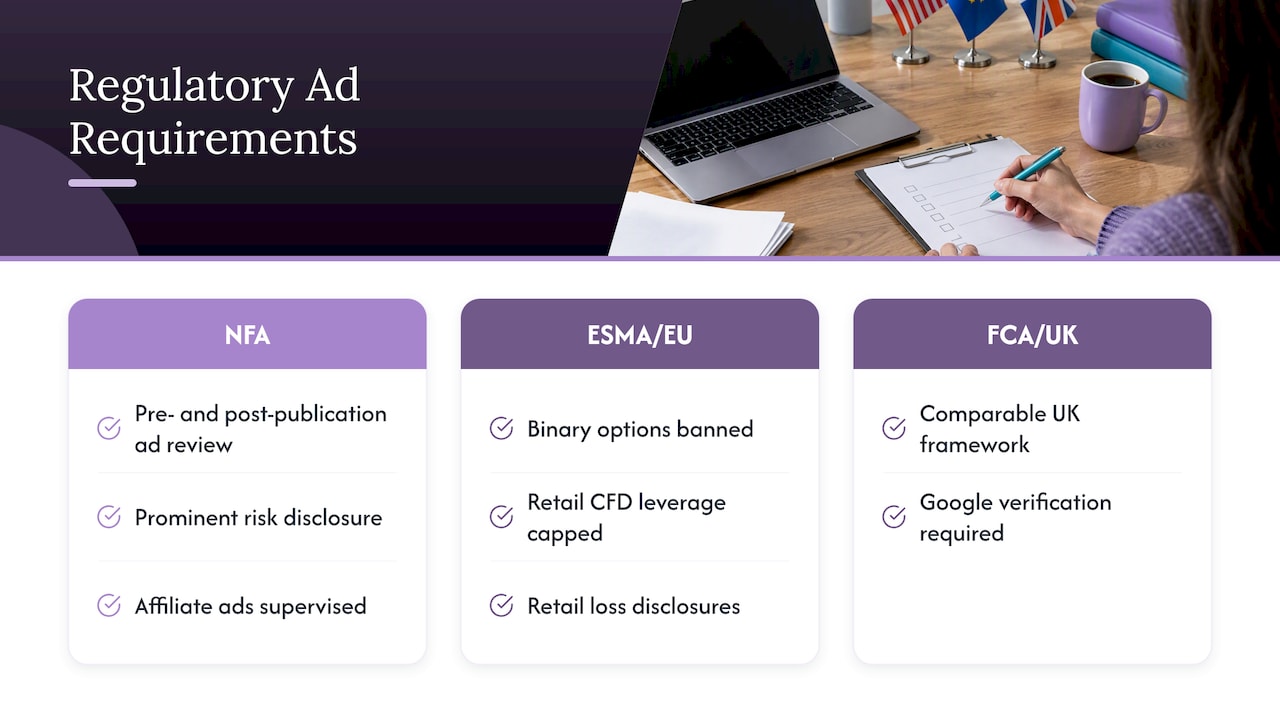
In the United States, NFA Compliance Rule 2-29 requires that promotional material for forex dealers not be misleading, mandates prominent risk disclosure, and holds the firm responsible for reviewing audio, video, and written ad content before and after publication. The rule’s interpretive notices specifically call out supervisory responsibility for affiliate-generated material, meaning a firm cannot outsource its marketing and treat the resulting compliance risk as someone else’s problem.
In the EU and UK, restrictions tracing back to ESMA’s product intervention measures shape what Google allows regionally: binary options are banned outright, CFD leverage is capped well below levels common in less-regulated markets, and standardized retail loss disclosures are expected in both ad creative and landing pages. The FCA enforces a comparable framework for the UK specifically, and Google requires FCA verification for in-scope financial ads targeting British audiences.
Satisfying both Google and your regulator at once comes down to treating Google’s certification as a floor, not a ceiling. Build your compliance pack around the stricter of the two standards, keep your risk disclosures aligned with the regulator’s exact wording requirements rather than a generic version, and extend your supervisory review to every affiliate and partner publishing ads on your behalf. A campaign that passes Google’s review but violates your regulator’s advertising rule is still a liability, certification or not.
Keeping Your Account Compliant After Approval
Certification is a starting point, not a one-time task. Google updates its financial services policies periodically, and regulators issue bulletins that can change disclosure requirements or leverage limits with little notice, so ongoing monitoring has to be built into your operating routine rather than treated as an occasional check.
A practical cadence looks like this: review Google’s Advertising Policies Help pages weekly for changes to the Complex speculative financial products policy, check your primary regulator’s public notices monthly, and run a full landing-page and creative audit against your current compliance pack at least quarterly. Partner and affiliate marketing guidelines across the industry consistently warn that in-scope categories and eligible locations shift without much lead time, which is exactly why a fixed review schedule matters more than reacting after a disapproval.
Keep documented evidence of your license, your Google certification approval, and every version of your landing page and ad creative on file, since regulators and Google can both request historical proof during a review. Retaining this material also speeds up re-certification if Google asks you to reapply after a policy update.
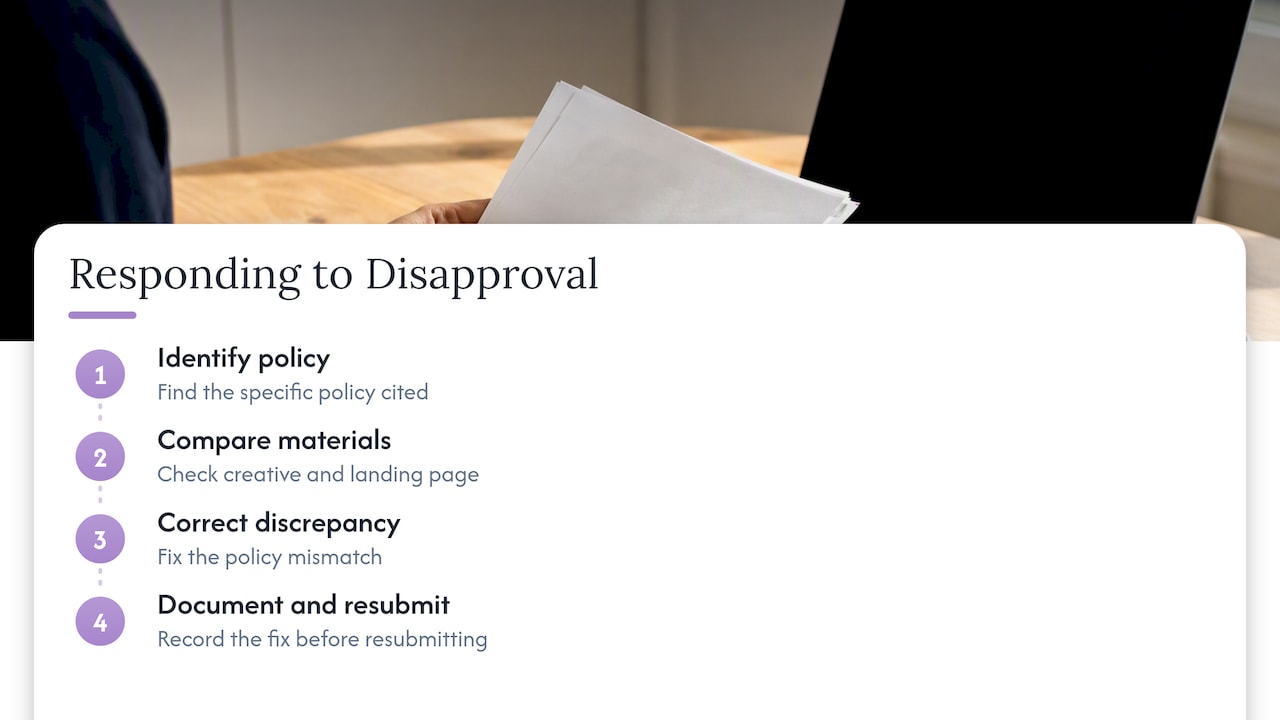
When a disapproval or account review happens, move fast: identify the specific policy cited, compare it against your current creative and landing page, correct the discrepancy, and document the fix before resubmitting. If the review escalates to a broader account suspension, our guide on recovering from an ad account suspension walks through the evidence and appeal steps in detail.
Pro Tip: Pair automated policy-page monitoring tools with a manual quarterly compliance review, since automated alerts catch wording changes but miss the practical landing-page inconsistencies a human reviewer will spot.
How Agencies Prepare Forex Advertisers for Certification
Agencies that specialize in this category typically build a compliance pack first: licensing proof, approved risk disclosure language, and a landing page template that mirrors the regulator’s exact requirements before any certification request goes in. They also run technical checks that reduce rejection risk, confirming click-tracker certification, verifying tracking template consistency, and auditing server and landing-page hygiene so nothing conflicts with the submitted license details.
A test submission in a single market before expanding to others is standard practice, since it surfaces documentation gaps cheaply. Our forex ad approval service covers this preparation work for advertisers who want it handled end to end.
What I’d Prioritize as an Advertiser Right Now
If you are running or planning forex campaigns on Google, start with the eligibility check before anything else: confirm your target country is actually on the approved list, because no amount of creative polish fixes a market-level disqualification. From there, align your license documentation with your landing page word for word, not approximately, since entity name mismatches are one of the most common and most avoidable rejection causes I see.
Write your risk disclosures before you touch ad copy, not after, so the compliance requirement shapes the campaign instead of getting bolted on at the end. If affiliates or partners touch any part of your creative, supervise their output as closely as your own; a regulator will not distinguish between your ad and theirs when assessing liability.
For advertisers managing multiple markets, build a calendar now for separate certification submissions and ongoing monitoring, one track per country, rather than treating compliance as a single global task. The advertisers who struggle most are usually the ones who treated one market’s approval as proof the next one would be easy.
— Umar
Getting Hands-On Help With Forex Ad Approvals
Certification paperwork, licensing alignment, and ongoing creative review take real time, and getting one detail wrong can mean starting the review cycle over. We built our services around removing that friction for advertisers in forex and other high-scrutiny categories.
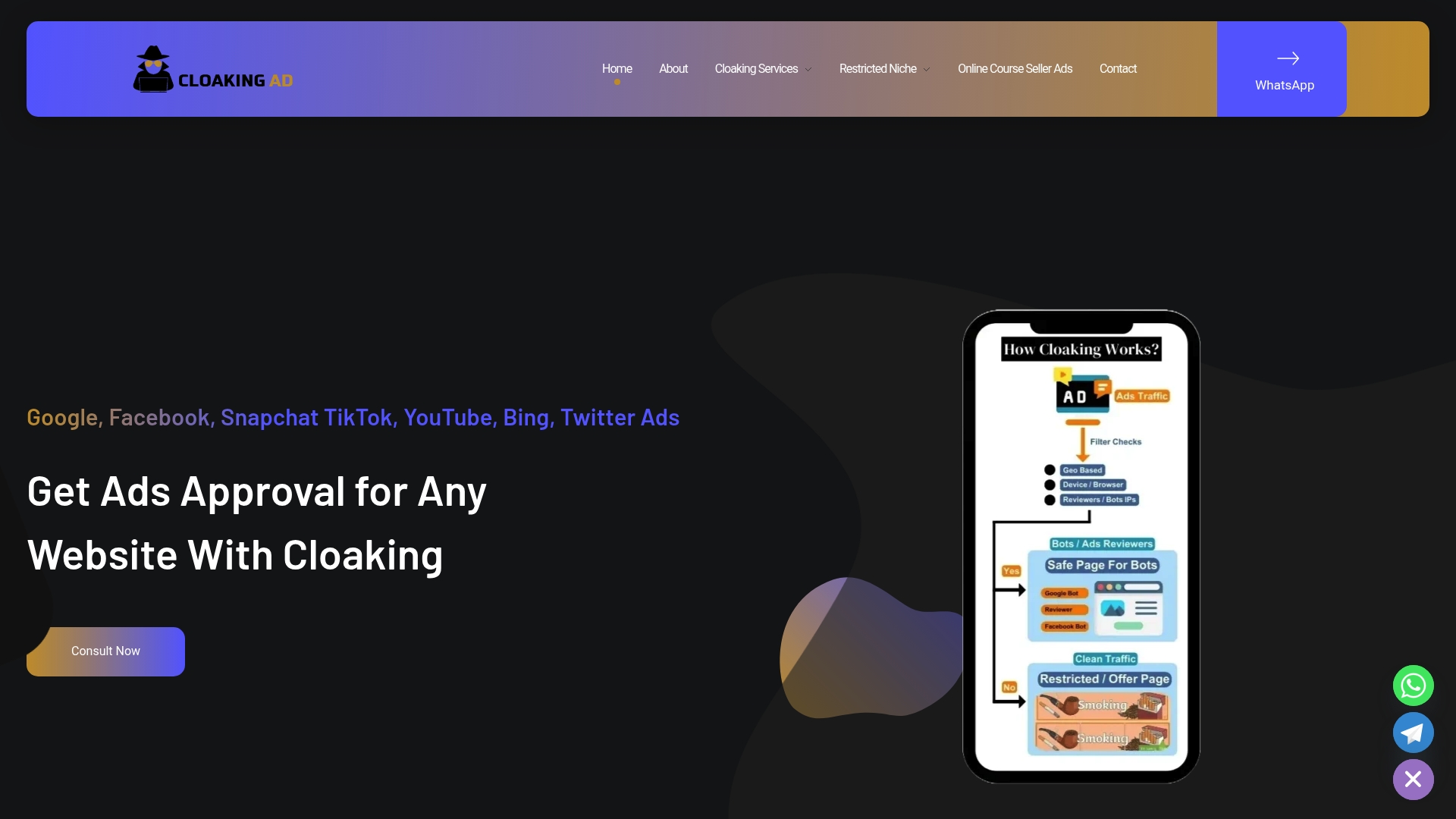
Our consultation call walks through your current account setup and flags gaps before you submit anything to Google. For advertisers who want the technical side handled directly, our cloaking system setup is a one-off engagement priced at $1,599, and our fully managed Done-For-You service, priced at $3,599 one-off, covers compliance pack creation, landing-page alignment, and ongoing account management so your campaigns keep running while regulations shift under you. If forex is one of several restricted categories you manage, our Google Ads cloaking and approval service extends the same approach across other high-risk verticals. Book a consultation to see which setup fits your current account.
This article is general information, not a substitute for advice from a qualified financial advisor. Consult a qualified financial professional about your own circumstances before acting on anything here.
FAQ
Can you advertise forex on Google Ads at all?
Yes, but only in locations Google has designated as eligible for Complex speculative financial products, and only when the advertiser is licensed in that market, compliant with local law, and certified by Google for that specific location. Binary options remain banned everywhere regardless of licensing.
Do I need a separate Google certification for each country?
Yes, Google’s Financial services verification process treats each targeted location as a separate application, so being certified in one market does not extend to another. You need distinct licensing proof and a distinct submission per country you plan to target.
What documents does Google ask for during certification?
Google typically requests your regulator-issued license number, proof of current registration with that regulator, and evidence that your advertised product falls within your license’s scope. Mismatches between your license entity and your landing page’s named entity are a frequent cause of delay.
Are testimonials or past performance claims allowed in forex ads?
Past performance figures are not banned outright, but they must be paired with a clear statement that past results do not guarantee future outcomes. Claims implying guaranteed profit, “risk-free” trading, or “no slippage” are explicitly flagged and will likely cause disapproval.
Where do I apply for certification now that the process has changed?
As of June 2026, applications for Complex speculative financial products certification are submitted directly through your Google Ads account rather than the Help Center. Existing approved certifications from before the change are not affected.
Sources
- Financial products and services: Complex speculative financial products – Advertising Policies Help
- Rules | NFA