
Yes, but only if your business fits a specific Meta category and your ads and landing pages consistently hold that compliant framing. Peptide brands generally fall into one of three buckets: topical or supplement sellers, research-use suppliers, or certified telehealth clinics. Get that bucket wrong, or let one page element contradict it, and you risk more than a rejected ad. This guide walks through the checklist, the creative rewrites, and the account moves that keep peptide campaigns alive.
TL;DR:
- Only businesses in specific categories, like research suppliers or certified telehealth clinics, are more likely to successfully run peptide ads on Meta, provided they maintain consistent framing.
- Automated and manual reviews scrutinize ad copy and landing pages, flagging any medical claims, human benefits, or inconsistent messaging that could imply human use or treatment.
- Campaigns should focus on technical or laboratory language, exclude consumer intent keywords, and keep product promotion aligned with research or supplement claims to avoid rejection.
- Building a clean infrastructure with documented compliance, slow budget scaling, and consistent messaging reduces the risk of ad account suspension or rejection.
- Managed compliance services are recommended for scaled or high-risk peptide accounts, with solutions like cloaking systems offering reviewer-safe infrastructure and campaign separation.
Table of Contents
- How Meta treats peptides: three business buckets and enforcement mechanics
- Compliance checklist: funnel, copy, keywords, and account hygiene to fix before you launch
- Craft compliant creatives and landing pages: rewrite patterns and side-by-side examples
- Campaign setup and targeting best practices to reduce enforcement risk
- Monitoring, appeals, and mitigation: steps for when ads or accounts are flagged
- CloakingAd operational safeguards and real-world edge cases (what our setup covers)
- When to DIY vs hire a managed compliance provider
- How CloakingAd helps peptide brands
- Primary sources and official references
- Sources
- FAQ
How Meta treats peptides: three business buckets and enforcement mechanics
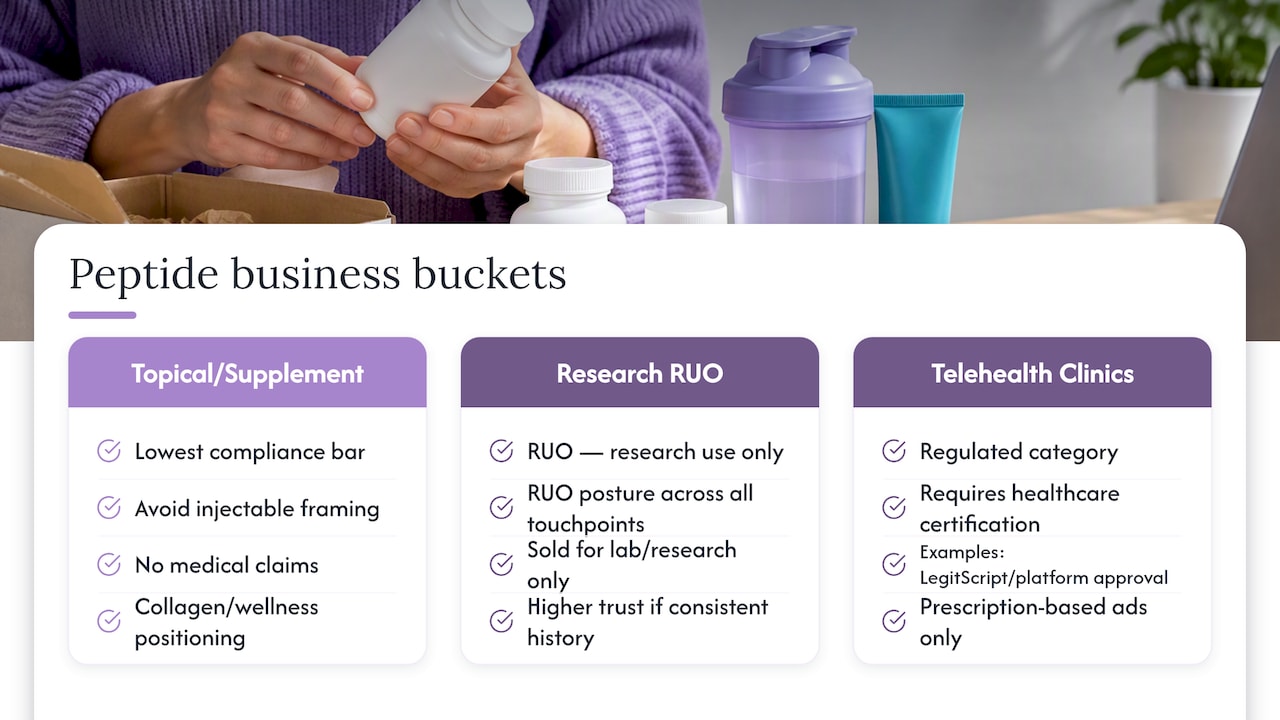
Meta does not have one rule for “peptides.” It has different tolerance levels depending on what you are actually selling and how you present it.
Topical and supplement peptide products, think collagen-adjacent skincare or oral blends marketed for general wellness, carry the lowest compliance bar because they avoid injectable framing and medical claims. Research-use suppliers sell peptides for laboratory or research purposes only, and that RUO (research use only) posture has to hold across every touchpoint, not just the disclaimer at the bottom of a page. Telehealth clinics that prescribe peptides need certification such as LegitScript or platform-specific healthcare approval before running ads in many countries, since regulated telehealth categories often require merchant certification separate from standard ad approval.
Enforcement runs on two tracks. Automated systems scan ad copy, keywords, and destination URLs first, and anything that reads as a medical claim or consumer-use signal gets flagged before a human ever sees it. Manual review kicks in when an ad gets reported, when an account has prior strikes, or when a domain has a thin or inconsistent history. Reviewers weigh account age, prior violations, and whether the landing page matches the ad’s claimed framing, so a brand-new domain running aggressive peptide copy draws more scrutiny than an established research supplier with a clean track record.
Behind all of this sits the FDA’s approach to unapproved drugs, which looks at the totality of circumstances rather than a single claim in isolation. A vague ad might pass on its own, but combined with a landing page that sells bacteriostatic water and a dosing calculator, regulators and platforms both read that as intended human use. That combined-evidence lens is exactly why Meta’s reviewers cross-check ad creative against destination content instead of judging the ad text alone.
Compliance checklist: funnel, copy, keywords, and account hygiene to fix before you launch
Before spending a dollar on ads, audit the whole funnel with fresh eyes. A single weak link undoes an otherwise clean campaign.
On the landing page, keep RUO wording visible above the fold when it applies to your product line, strip out any dosing or injection instructions, and remove testimonials that describe a human benefit or outcome. In ad copy, avoid medical claims, avoid phrases that imply treatment or recovery, and skip compound names like BPC-157 or TB-500 in consumer-facing contexts since platform policy analysis flags these as common red-flag terms. Topical and supplement products should lean on appearance or structure-function language rather than anything that sounds like a medical outcome.
Keyword and targeting choices matter just as much as copy. Avoid consumer-intent phrases such as “buy BPC-157” or “peptide injections,” and where your business fits the research bucket, target professional or research audiences instead of general health seekers.
- Landing page: RUO statement visible, no dosing or injection instructions, no human-benefit testimonials
- Ad copy: no medical claims, no treatment language, no compound names in consumer contexts
- Keywords: avoid consumer-intent phrases like “buy BPC-157” or “peptide injections”
- Account hygiene: consistent tone across the funnel, an established domain history, and documentation ready if you’re asked to prove compliance
Account hygiene closes the loop. Keep your funnel tone consistent from ad to landing page to checkout, build domain history before scaling spend, and remove any mixing supplies or accessories from public pages that imply human administration. If you can document your compliance posture on request, you are already ahead of most sellers in this category.
Craft compliant creatives and landing pages: rewrite patterns and side-by-side examples
The fastest way to fail review is inconsistency: one page says “research use only” while another sells a peptide calculator. Three micro-templates cover most peptide advertisers.
A research-use B2B headline might read “High-purity peptides for laboratory research, bulk pricing for verified institutions,” paired with body copy that never mentions administration or outcomes and links to a spec sheet instead of a dosing guide. A topical or supplement consumer creative can describe texture, appearance, or how the product feels to use, without claiming it treats, cures, or repairs anything. A telehealth creative, only usable once certification is in place, can reference a consultation process and link to a licensed provider intake form rather than a direct purchase button.
- “BPC-157 for faster tendon repair” fails because it names a compound and claims a medical outcome. “Research-grade peptide compounds for laboratory study” passes because it stays in RUO territory with no outcome claim.
- “Inject daily for best results” fails because it gives human dosing instructions. “See our technical specification sheet for handling and storage” passes because it redirects to lab-relevant information.
- “Customers report incredible recovery” fails because it is a human-benefit testimonial. “Trusted by research labs for consistent purity” passes because it speaks to product quality, not personal outcomes.
On the landing page itself, put your RUO statement above the fold, remove dosing content entirely, keep a controlled technical specification section for verified lab buyers, and close with a “contact for inquiry” call to action rather than an instant “buy now” button for anything resembling an injectable.
Campaign setup and targeting best practices to reduce enforcement risk
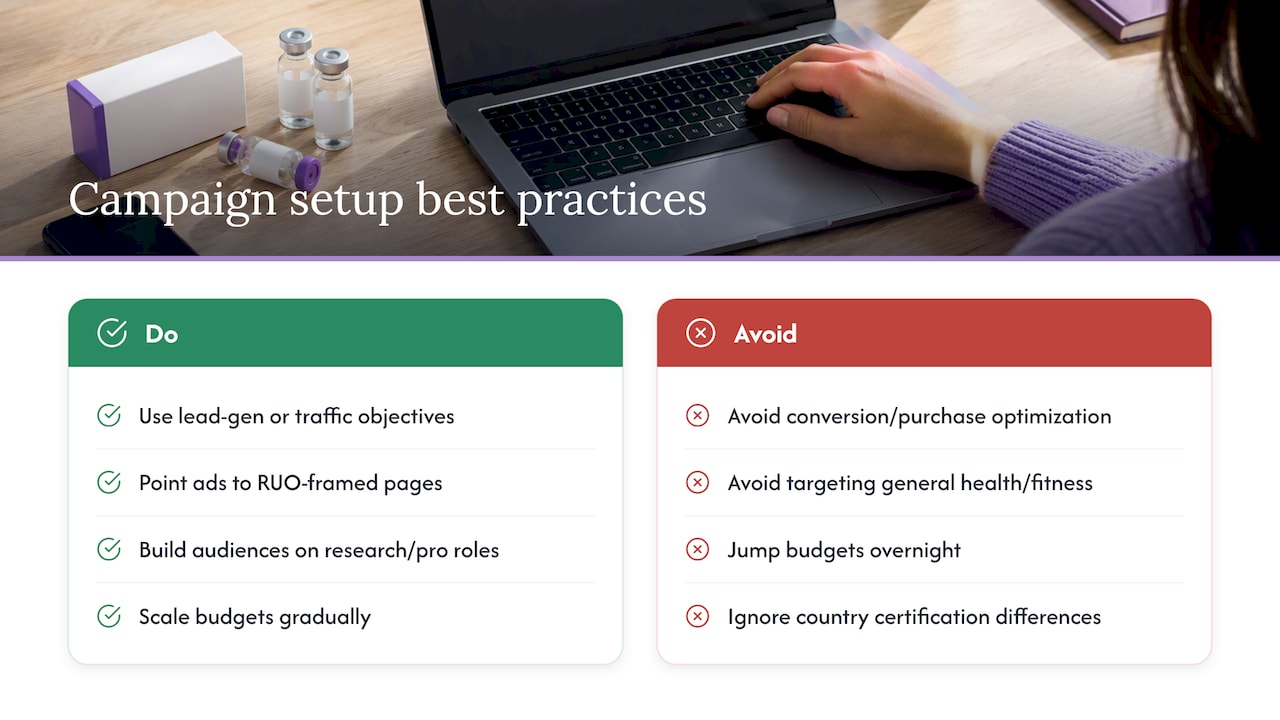
Campaign objectives should match your bucket. Research-use suppliers generally do better with lead generation or traffic campaigns pointed at RUO-framed pages rather than conversion campaigns optimized around purchase events, which can signal consumer buying intent to Meta’s systems. Topical and supplement sellers have more room to run awareness or traffic campaigns since the consumer framing is already compliant by design.
Audience building matters as much as objective choice. Research suppliers should build audiences around professional and research interests, exclude general health and fitness audiences that skew toward personal-use intent, and think carefully about which countries they target given that certification requirements and enforcement intensity vary by market.
Budgeting also plays into risk. Scale spend in small increments rather than jumping from a $50 daily budget to a $2,000 one overnight, since sudden spend spikes are a known trigger for manual review in platform enforcement patterns. Slow, steady scaling gives your account time to build the history that makes future campaigns easier to approve.
Monitoring, appeals, and mitigation: steps for when ads or accounts are flagged
A single flagged ad does not have to become a suspended account if you move fast and document everything.
- Isolate the flagged ad immediately and pause it rather than the whole account, then check whether the issue is copy, landing page, or both
- Screenshot the ad, the landing page, and the rejection reason before making any changes, since edited pages lose their evidentiary value
- Gather supporting documents such as certification PDFs, domain history, or business registration before filing an appeal
- Escalate to a specialist if the same account draws a second flag within a short window, since repeat strikes often precede a full suspension
Pro Tip: Never edit a flagged landing page before you’ve screenshotted it. Reviewers and appeals teams often compare the version that triggered the flag against what’s live now.
CloakingAd operational safeguards and real-world edge cases (what our setup covers)
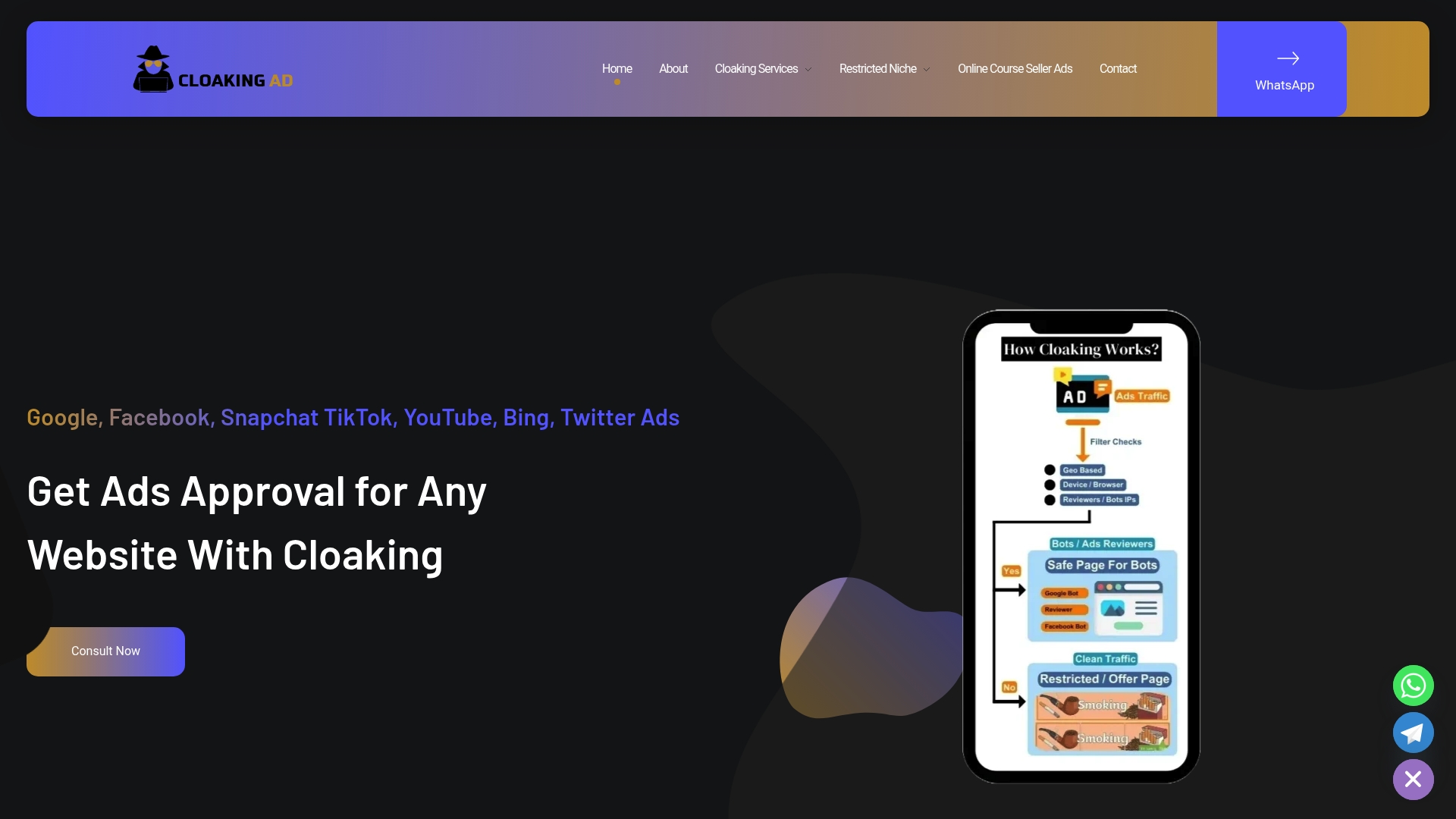
Technical infrastructure matters most at the edges, where one page element can undo months of clean campaign history. Consultation, cloaking setup, and managed campaign services can help separate reviewer traffic from genuine prospect traffic so a compliant RUO version renders for platform checks while targeted professional funnels still convert. Our pharma and medication ad approval work applies the same reviewer-detection logic to peptide accounts.
The edge cases are instructive. FDA warning letters have cited bundled supplies like bacteriostatic water and peptide calculators as evidence of intended human use, and a nearly identical pattern shows up in another 2026 warning letter where selling bacteriostatic water alongside peptides supported the same inference. A single product bundle, when combined with ad copy, triggered both platform and regulatory attention.
Compliant infrastructure means the reviewer sees a clean RUO page while your verified buyer sees the technical detail they actually need.
When to DIY vs hire a managed compliance provider
DIY compliance works for low-risk topical products, a small budget, and an in-house resource who already understands ad policy. A managed provider makes more sense for research-use suppliers, anyone with a past enforcement history, or accounts scaling past a few thousand dollars a month, where one mistake costs more than the service fee.
How CloakingAd helps peptide brands
Running peptide ads without technical infrastructure means gambling your account on every landing-page edit. Specialized services exist for restricted verticals like peptides, CBD, and pharma, building reviewer-safe architecture that keeps RUO and consumer funnels separate.
- CONSULTATION CALL: a direct conversation to map your current funnel against platform risk
- SETUP CLOAKING SYSTEM: a one-off $1,599 engagement covering cloaking and server configuration, detailed on our services page
- Done-For-You: a full managed engagement at $3,599 one-off for brands that want ongoing account and campaign management
Book a consultation at CloakingAd to see which setup fits your peptide business before your next campaign launch.
Primary sources and official references
- FDA warning letter, NuScience Peptides LLC: bundled supplies cited as evidence of human use
- FDA warning letter, Tex Peptides: bacteriostatic water sold alongside peptides
- FDA Clinical Pharmacology Considerations guidance: regulatory definition of peptide drug products
- Google Ads for Peptide Brands guide: platform enforcement patterns and certification needs
This article is general information, not a substitute for advice from a qualified doctor. Consult a qualified healthcare professional about your own circumstances before acting on anything here.
Sources
- NuScience Peptides LLC – 733652 – 08/24/2026 | FDA
- TXP Innovations LLC dba Tex Peptides – 735067 – 08/24/2026 | FDA
- Clinical Pharmacology Considerations for Peptide Drug Products | Level 2 Guidance
- Google Ads for Peptide Brands: Avoid Bans (2026)
FAQ
Can you run Facebook ads for peptides?
Yes, if your business fits a permitted category such as topical or supplement products, research-use supply, or certified telehealth, and your ad copy and landing pages stay consistent with that framing throughout the funnel. Mixing consumer-use signals with research claims is the most common cause of rejection.
Are you allowed to sell peptides on Facebook Marketplace?
Facebook Marketplace is built for consumer-to-consumer sales and does not accommodate the RUO or research-use framing that most legitimate peptide sellers rely on. Running a proper ad campaign through Meta’s advertising platform, under the correct business category, is the more viable path.
Is it legal to advertise peptides?
Legality depends on your market, your product’s regulatory classification, and how you present it, since many peptides meet the FDA’s definition of a drug and require specific handling under FDA’s clinical pharmacology guidance. Check the rules that apply to your country and product before advertising, and consult a qualified professional when your classification is unclear.
Why am I all of a sudden getting ads on Facebook?
Meta’s ad delivery system matches ads to users based on interests, browsing behavior, and account signals, so a sudden shift in the ads you see usually reflects a change in your activity or a new advertiser targeting your demographic. It has no connection to how peptide brands get their own ads approved.
What does CloakingAd charge for peptide ad compliance help?
CloakingAd’s cloaking system setup is a one-off $1,599 engagement, while the fully managed Done-For-You service is a one-off $3,599, both detailed on the CloakingAd site. A consultation call is available to determine which option fits a given account.
— Umar