
Yes, Meta allows forex ads, but only with proper authorization, consistent funnel messaging, visible risk disclosures, and server-side value tracking routed to the Conversions API. Miss any one of those four pieces and the ad gets rejected or the account gets flagged. The policy section below covers country-specific checks you need to confirm before you spend a dollar.
TL;DR:
- Forex ads require proper licensing, clear funnel consistency, and visible risk disclosures to avoid rejection or account restrictions.
- Rejections often stem from mismatched landing pages, unsubstantiated profit claims, or unauthorized use of logos, all fixable through landing page alignment and disclaimer placement.
- Implementing server-side deposit event tracking via Conversions API alongside Pixel significantly enhances Meta’s optimization for funded traders.
- Scaling campaigns in new countries demands separate authorization processes and regular account compliance checks to prevent re-verification issues.
- Professional services can streamline compliance, tracking, and funnel setup, ensuring adherence to Meta policies and improving campaign approval rates.
Table of Contents
- Meta’s authorization and policy requirements for forex ads
- Common ad rejection reasons and how to fix them
- Technical setup: Pixel, Conversions API, and FTD routing
- Creative and landing-page best practices for compliant ads
- Optimization and scaling tactics for forex advertisers on Meta
- How CloakingAd turns compliance and tracking into a working setup
- Why treating the funnel as one unit protects your growth
- Get your forex campaigns approved and tracked correctly
- Sources
- FAQ
Meta’s authorization and policy requirements for forex ads
Meta treats forex and other financial products as a restricted category rather than a flatly banned one. That distinction matters because restricted categories can run, provided the advertiser proves it is licensed to operate where the ad will show. Meta’s prohibited financial products policy requires local regulatory licensing and pre-approval before financial ads go live in several countries, including the United Kingdom, Singapore, Australia, and Canada. Running ads without that pre-authorization, or submitting misleading claims, leads to rejection and can trigger broader account restrictions.
The pre-approval workflow lives in Meta Business Suite, under the Authorizations and Verifications tab. You declare the countries you intend to target, then submit documentation tied to that market’s regulator.
Typical documents Meta requests during verification include:
- A valid regulatory license number from the relevant financial authority in the target country.
- Proof of business registration matching the name on the ad account.
- A compliance contact or legal entity confirmation for the advertiser.
- Evidence that landing pages carry required risk disclosures for that jurisdiction.
Expanding into a new country later means repeating this process for that market specifically. Our guide on Meta ads compliance and license approval walks through the documentation workflow in more detail if you are preparing a submission for the first time.
Common ad rejection reasons and how to fix them
Most forex ad rejections trace back to one of three patterns, and all three are fixable without rebuilding the campaign from scratch.
- Funnel inconsistency. The ad promises educational content, but the landing page pitches guaranteed returns. Meta’s compliance and verification guidance treats this mismatch as one of the top causes of both ad rejection and account suspension, since reviewers evaluate the entire funnel, not just the creative.
- Income or guarantee claims. Phrases implying certain profit, fixed returns, or “risk-free” trading get flagged almost immediately. Replace them with educational framing and add a visible risk disclaimer near the claim, not buried in a footer.
- Missing or unauthorized elements. Logos from regulators or partner brokers used without permission, or financial PII fields embedded directly in the ad, are quick rejection triggers.
The fix for all three starts with the landing page, not the ad copy. Align the message so the page delivers exactly what the ad promises, add the disclaimer in the same visual block as any performance language, and strip out logos you cannot document rights to use.
Pro Tip: Before resubmitting, read your ad and landing page back to back as a reviewer would. If the tone shifts from “learn how” to “earn guaranteed,” that shift is what gets you rejected.
Technical setup: Pixel, Conversions API, and FTD routing
Tracking is where most forex campaigns lose optimization power long before policy becomes the issue. Running the Meta Pixel alone misses deposits that happen off-site or after a delay, which starves the algorithm of the signal that actually matters: who became a funded trader.

The fix is routing First-Time Deposit (FTD) events through the Conversions API, Meta’s server-side tracking channel, alongside the browser-based Pixel. Sending deposit signals instead of just registrations lets Meta’s algorithm learn the profile of a trader who actually funds an account, not just someone who clicks.
Three checkpoints keep this reliable:
- Generate the event_id on your backend and reuse that exact value for both the Pixel and CAPI calls for the same event, which prevents Meta from counting one conversion twice.
- Match event_name and event_id consistently within a 48-hour window so deduplication actually triggers.
- Monitor event match quality in Meta’s Events Manager weekly, since a drop usually means a tracking parameter broke after a site update.
Shifting from registration events to deposit events passed via the Conversions API materially improves Meta’s ability to optimize toward valuable customers, according to Meta’s own CAPI documentation. That shift is the single highest-leverage technical change most forex advertisers can make.
Creative and landing-page best practices for compliant ads
Compliant creative and high-converting creative are not in tension, they are the same creative once you frame it correctly. Educational, specific language performs well and survives review, while vague promotional language does neither.
- Write in an educational register. Explain what forex trading is or how a platform’s tools work rather than promising outcomes.
- Drop guaranteed-return language entirely. Phrases like “guaranteed profit” or “risk-free” violate the Transparency Center’s financial services policy, which also requires financial ads to target people 18 and older only.
- Add a risk disclaimer near any performance claim, not in a separate terms page three clicks away.
- Never request financial information inside the ad itself. Meta’s policy explicitly forbids collecting PII or account details through ad units.
- Use only logos you have rights to, including regulator badges and partner broker marks.
For landing pages, keep the call to action consistent with what the ad promised, whether that is “download the guide” or “open a demo account,” and avoid a late pivot to a funded-account pitch. A/B testing different messaging angles tends to reveal which type of content holds attention without triggering policy flags.
Optimization and scaling tactics for forex advertisers on Meta
Interest-based targeting for “forex trading” or “currency trading” audiences tends to plateau fast because it is broad and heavily competed. A sharper approach is seeding lookalike audiences from hashed depositor data, first-time funded accounts rather than leads or registrations, so Meta builds similarity models around people who actually convert financially.
Scaling from there works best in increments rather than jumps:
- Maintain a sufficient volume of optimization events per ad set before increasing budget, as low event volumes can cause unstable ad delivery.
- Duplicate winning ad sets instead of editing them directly, which preserves the learning phase.
- Expand into new countries only after securing that country’s specific Meta authorization, never before.
Pro Tip: Treat every new geography as a separate compliance project. The authorization that got you approved in one market does not carry over to the next.
Account health deserves a recurring check, not a one-time setup. Meta can re-verify a previously approved advertiser at any point, so keeping licensing documents current per country avoids a sudden disable. Our breakdown of forex ad strategies that work covers audience seeding in more depth for advertisers scaling past the initial approval stage.
How CloakingAd turns compliance and tracking into a working setup
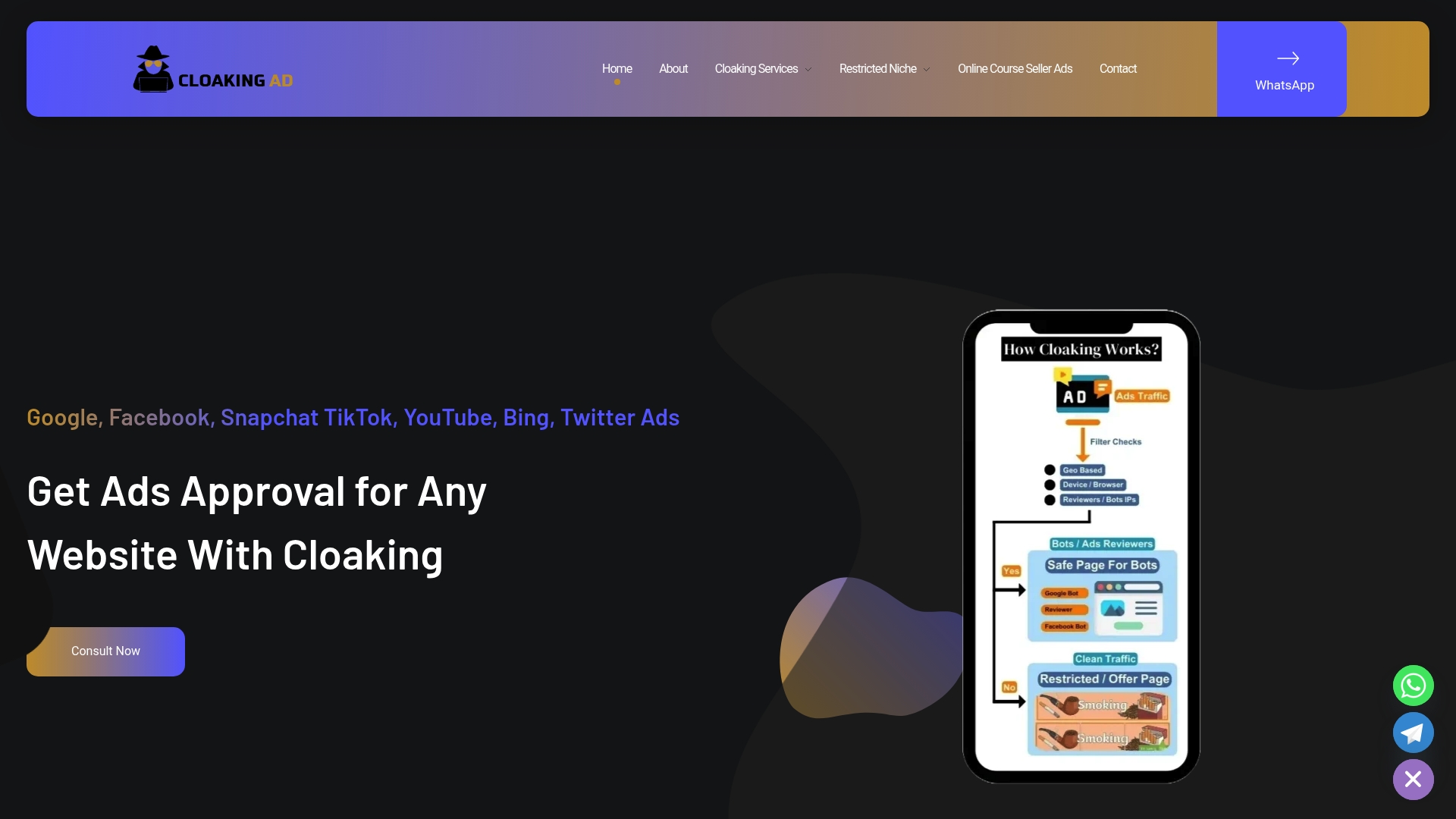
Every gap covered above (authorization documentation, funnel alignment, event deduplication, safe landing pages) is a separate technical job, and most forex advertisers do not have the bandwidth to manage all of them while also running media. Services exist to address account, funnel, and tracking setup according to Meta’s policy requirements, including cloaking and server setup, safe landing pages with risk disclosures, server-side event routing to address deduplication, and ad-account management to handle re-verification requests.
Readers who want a forex-specific walkthrough can start with the forex ads approval service page.
Why treating the funnel as one unit protects your growth
The ad, the landing page, and the tracking setup are not three separate projects, they are one compliance unit, and Meta reviews them that way. Specialist help earns its cost when an account has already been flagged or when a launch into a new country needs documentation fast.
— Umar
Get your forex campaigns approved and tracked correctly
CloakingAd offers a consultation call to review your current funnel, authorization status, and tracking setup, followed by a done-for-you build if gaps need fixing.
- A consultation call maps your account against Meta’s policy and technical requirements before you spend another dollar on ads.
- A managed setup through Done-For-You services covers cloaking, server configuration, and safe landing pages in one engagement.
- The cloaking system setup option fits advertisers who want the technical build handled directly.
Book a consultation at Cloakingad to get a compliance review started.
Sources
- Updates to Our Prohibited Financial Products and Services Policy
- Financial and Insurance Products and Services | Transparency Center
FAQ
How much do 1,000 clicks cost on Facebook?
Facebook ad costs vary widely by niche, audience, and country, and forex is a competitive vertical with higher-than-average costs per click due to restricted targeting options. There is no fixed industry rate, so the most reliable approach is testing a small budget against your own funnel and tracking cost per deposit rather than cost per click alone.
What is the 90% rule in forex?
The term refers to a widely cited trading adage that a large share of new traders lose money within a short window, but it is an informal rule of thumb rather than a figure from a named regulator or study. Advertisers should avoid repeating it as a statistic in ad copy, since financial ad policy restricts performance claims regardless of their source.
Who are the top five forex traders?
There is no single official or regulator-published ranking of the top forex traders, and claims of this kind vary by source and criteria. Advertisers should avoid naming specific “top trader” figures in forex ad creative, since unverifiable performance claims are a common rejection trigger.
Is $500 enough for Facebook ads?
A small budget can run a test campaign, but forex advertising typically needs enough spend to reach stable event volume before Meta’s algorithm optimizes reliably. Treating a small budget as a test of funnel and tracking setup, rather than a scaling budget, is the more realistic approach.
Do forex ads need special approval on Facebook?
Yes, forex and other financial product ads fall under Meta’s restricted categories and may require country-specific licensing and pre-authorization through the Authorizations and Verifications workflow before they can run in certain markets. Advertisers should confirm requirements for each target country before launching rather than assuming one approval covers every region.