
Google Ads does not allow vape advertising. Its tobacco policy prohibits ads for tobacco and for products designed to simulate smoking, including e-cigarettes, and there is no certification route that changes that for vape products. If you run a vape brand, the practical work is knowing exactly where the line sits, protecting the Google account you already have, and building a channel mix that does not depend on Google paid search.
TL;DR
- Google Ads prohibits ads for e-cigarettes and vapes, plus component parts and services that promote tobacco consumption.
- E-juice is also blocked in Shopping ads and free Shopping listings under the dangerous products policy.
- A violation does not mean instant suspension: Google warns at least 7 days before suspending an account for dangerous products or services.
- Disapproved ads can be edited or appealed, and edited ads are usually re-reviewed within 24 to 48 hours.
- Local law applies on top of Google’s rules, and YouTube has its own restrictions on nicotine content.
Table of Contents
- What Google’s policy says about vapes
- Where the policy bites in practice
- What happens when you break the rule
- Do not confuse this with circumventing systems
- Local laws and other platforms
- Compliant ways to market a vape business
- Our perspective
- Get your account and catalog reviewed
- Pre-launch checklist for vape-adjacent advertisers
- FAQ
- Sources
What Google’s policy says about vapes
The rule sits in Google’s Tobacco policy. It prohibits advertising tobacco or products containing tobacco, and products designed to simulate tobacco smoking, including electronic cigarettes and e-cigarettes. That one sentence covers the vape devices, pods and disposables most stores sell.
The prohibition goes wider than the device itself. The same policy covers products that are a component part of a tobacco product, and services that directly facilitate or promote tobacco consumption, such as rolling papers, pipes and hookah lounges. A shop that sells coils, tanks or batteries is therefore not safe just because the ad never says “vape.”
Liquids are covered too. Google’s dangerous products policy prohibits e-juice in Shopping ads and free Shopping listings, so a product feed full of e-liquids will be flagged even if your text ads are clean.
Teens and age-based limits
Even where tobacco-related content is allowed to exist, Google limits who sees it. It restricts ads for tobacco, including e-cigarettes, on Google Accounts for users under 18 globally. That is a floor, not a loophole: it does not make vape ads eligible for adults.
Where the policy bites in practice
Most disapprovals come from a handful of places. Check each before you assume the problem is a single ad.
| Area | What gets flagged | What to do |
|---|---|---|
| Ad text and keywords | Device names, brand names, “vape,” “e-cig,” “disposable” | Stop running them; Google will not approve them |
| Shopping feed | E-liquids, devices, coils and pods | Remove vape SKUs from the feed entirely |
| Landing page | Vape products reachable from an ad’s destination | Keep ad destinations free of restricted products |
| Accessories | Component parts, pipes, papers | Treat as restricted, not as a safe workaround |
| Display and YouTube | Video or banners promoting nicotine products | Review YouTube rules separately |
A mixed store is the common trap. If you sell vapes alongside mainstream items such as batteries, gift cards or general accessories, the ad can be disapproved because of the destination, not the creative. Splitting what you promote from what you sell is a policy question, so read the rules for your exact catalog before you launch anything.
What happens when you break the rule
The good news for existing advertisers is that enforcement is staged. Google says violations of the dangerous products or services policy do not lead to immediate account suspension, and it issues a warning at least 7 days before suspending an account. Use that window. Remove the offending ads, feed items and destinations, then confirm nothing restricted is still live.
If an ad is disapproved, you have two options per Google: edit the ad to comply, or appeal in your Google Ads account if you believe the decision was an error. Edited ads or assets are typically re-reviewed automatically within 24 to 48 hours.
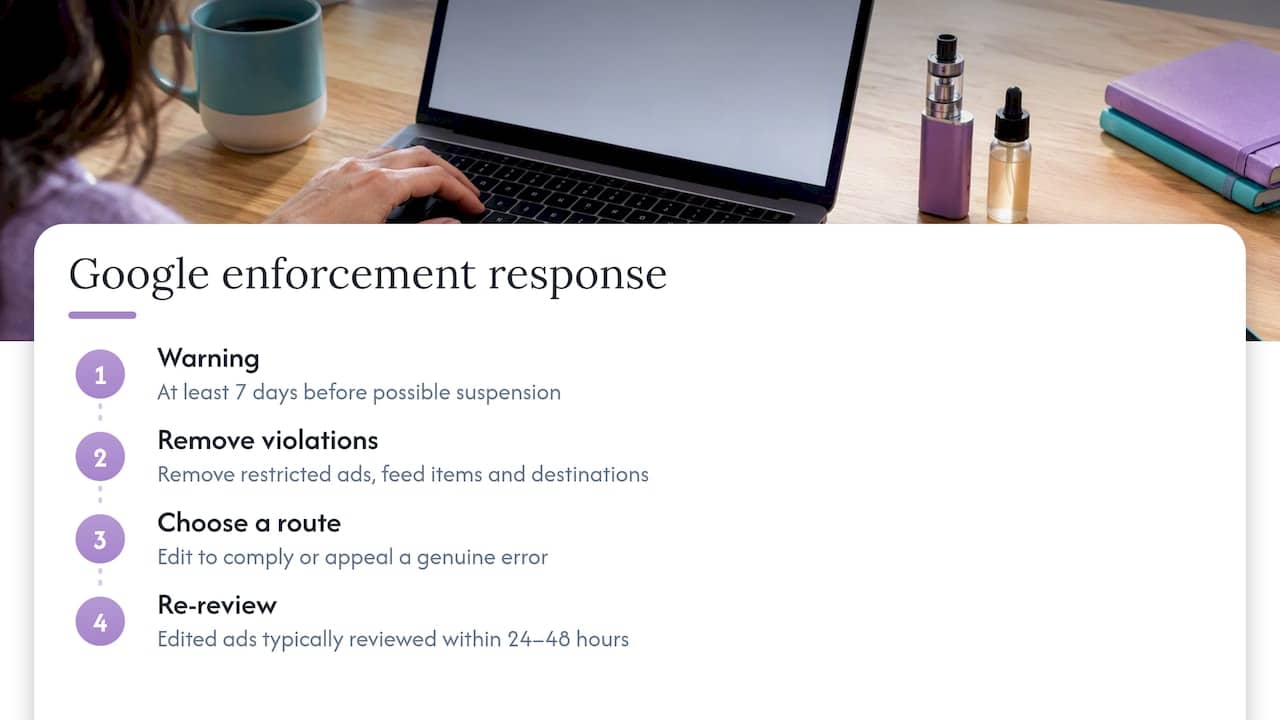
Be honest with yourself on which route applies. If the ad promotes e-cigarettes, an edit will not fix it, because the product category itself is prohibited. An appeal makes sense only when the ad or page was genuinely misread, for example a hemp or accessories page with no nicotine product on it.
If your account is already restricted, our guides on ad account recovery and reinstatement walk through documenting your fixes and structuring an appeal.
Do not confuse this with circumventing systems
Vape advertisers hear a lot of advice about workarounds. Google addresses this directly: its circumventing systems policy says cloaking, meaning showing different content to people or to Google to hide things that break the rules, is not allowed. Accounts caught doing it can be suspended, and a suspension can follow you to every account tied to the same business. Our 7-step audit for circumventing systems suspensions lays out what reviewers look for and how to check your own setup.
That is why we treat vapes differently from restricted-but-certifiable categories. Where a category has a legitimate approval path, the question is how to get through it cleanly. Where Google flatly prohibits the product, the question is where else your budget works harder.
Local laws and other platforms
Google’s policy is one layer. Advertisers must comply with the local laws and regulations of every area their ads target, in addition to Google Ads policies. Local rules can be stricter than Google’s, and they differ widely.
YouTube
YouTube’s policy prohibits content that directly sells, links to or facilitates access to nicotine or vaping products, including promotional links or provider contact details. It also prohibits content showing minors using vaporizers or e-cigarettes, and reviews of nicotine e-liquid brands are age-restricted. If your plan was to pivot from search to creator videos, read the policy first.
United Kingdom
The UK shows how much the legal picture varies. The ASA says nicotine-containing e-cigarettes not licensed as medicines cannot be advertised in newspapers, magazines or most online media. Some formats remain open: the ASA notes cinema, posters and public transport are among the media where such products may be advertised, but not TV, radio or print.
Own-property content has more room. CAP rule 22.12 permits factual, non-promotional product claims on a marketer’s own website. Ads in permitted media must be socially responsible, must not appeal to children and must not make medicinal claims without MHRA authorization. And the Tobacco and Vapes Act 2026, in force in the UK since 29 October 2026, prohibits free distribution and substantial discounting of vaping products, which affects promotions as well as ads.
Australia
Regulators enforce directly. Australia’s TGA directed one company to cease advertising vaping goods without an authorisation in force, across its websites, social accounts and other platforms. Whatever Google allows or blocks, the legal exposure is yours.
United States
If you sell in the US, check federal and state rules on age verification, flavor restrictions and marketing, and confirm your product’s FDA status with a regulatory attorney before you spend on any paid channel. Ad platform approval is never a substitute for legal clearance.
Compliant ways to market a vape business
With Google paid search closed, the realistic options are the ones that do not need Google’s approval. None of them is a magic replacement, so mix them.
- Your own website and SEO. Educational content, product pages with factual information and local store pages are organic and are not ads. Where local law limits promotional claims, keep the copy factual. Build pages around what customers actually ask: device compatibility, battery care, how to read a product label.
- Local presence. If you operate physical stores, a complete business profile with accurate hours, address and category helps people nearby find you. Check that your category and listing content follow the platform’s own rules.
- Email and SMS to existing customers. A first-party list, with age verification at sign-up and clear consent, is the most dependable asset a vape brand can own. Comply with the consent rules in each market you email.
- Retail and wholesale partnerships. Distributors, convenience stores and specialty shops reach buyers without any ad platform in between.
- In-store and event marketing. Where local law allows, loyalty programs, signage and age-gated events work. In the UK, for example, the permitted media list above includes posters and cinema, subject to the ASA’s content rules.
- Sponsored content in age-appropriate trade media. Industry publications and B2B directories often have their own advertiser rules, so ask each outlet before you plan around it.
For adjacent products that do have approval paths, such as hemp-derived or CBD goods, the rules are different and more workable. We cover them in our guide to CBD, kratom, hemp and vape ads approval.
Our perspective
Vape is one of the clearest lines in Google’s rulebook, and we say so up front because it saves our clients money. When a category is prohibited outright, no amount of creative polish gets it approved.
What we do see, every week, is vape-adjacent businesses caught in the crossfire: a hemp store flagged because a product page looks like a vape page, a multi-brand shop whose feed pulled in a restricted SKU, an account sitting on a warning with seven days to act. These cases are fixable, and speed matters.
Our work is built around high-risk verticals: custom setup, safe landing pages, real-time bot and reviewer detection, and ongoing account management across Google, Facebook, TikTok and other platforms. For restricted categories with a route to approval, that is where we help clients scale. For anything on a platform’s prohibited list, we start with a straight assessment of what can and cannot run.
If you are unsure which side of the line you are on, talk to us before you spend. A short review of your catalog, destinations and account history is cheaper than a suspension.
Umar
Get your account and catalog reviewed
If your Google account holds a warning, or you sell a mix of products and are not sure what is exposed, a consultation call with our team is the place to start. We go through your catalog, landing pages and account history, and tell you what can run on which platform.

For businesses in restricted niches that have a route to approval, we offer a cloaking system setup at 1599 one-off, and a Done-For-You engagement at 3599 one-off. You can see what each includes on our services page.
Pre-launch checklist for vape-adjacent advertisers
Run this before any Google spend, even if you believe your products are outside the policy.
- Catalog audit. List every SKU and mark which ones are devices, liquids, components or genuinely unrelated goods.
- Feed hygiene. Make sure nothing restricted is in a Merchant Center feed that feeds Shopping ads.
- Destination check. Click every ad destination and look at what a reviewer sees in the first scroll, in the navigation and in the footer.
- Account history. Note any existing warnings or disapprovals and the dates. The 7-day warning window is only useful if you see the notice in time, so make sure account notifications reach someone who reads them.
- Local law check. Confirm what each target country allows, since Google requires you to follow it.
- Plan B channels. Decide your organic, email and retail plan before the account is at risk, not after.
FAQ
Can I run Google Ads for a vape store?
No, not for vape products. Google’s tobacco policy prohibits advertising e-cigarettes and products designed to simulate smoking. The same applies to component parts, and e-juice is blocked in Shopping ads and listings.
Will Google suspend my account right away for a vape ad?
Not for a dangerous products violation. Google says it issues a warning at least 7 days before it suspends an account. Use that time to remove the ads, feed items and destinations that break the policy.
How do I appeal a disapproved ad?
You can appeal inside your Google Ads account if you believe the decision was a mistake, or edit the ad to comply. Edited ads are usually re-reviewed automatically within 24 to 48 hours. An appeal works best when the ad did not actually promote a prohibited product.
Does YouTube allow vape content?
Not content that sells or links to nicotine or vaping products, and not promotional links or contact details for providers. Content showing minors using vaporizers is also prohibited, and e-liquid brand reviews are age-restricted.
Do local laws matter if Google already blocks vape ads?
Yes. Google requires advertisers to follow the local laws of every area they target, and regulators such as the UK’s ASA and Australia’s TGA enforce their own advertising rules regardless of platform policy.
Sources
- Tobacco – Advertising Policies Help
- Ad-serving protections for teens – Advertising Policies Help
- Google Disallows E-juice Products In Ads & Shopping Listings
- Dangerous products or services – Advertising Policies Help
- Circumventing systems – Advertising Policies Help
- Legal requirements – Advertising Policies Help
- Illegal or regulated goods or services policies – YouTube
- ASA: Electronic cigarettes, media prohibitions
- ASA: Electronic cigarettes, general
- ASA briefing note on vape advertising
- TGA: Direction about advertisements, Iquality Group Pty Ltd