
Ad account recovery comes down to three things: find out exactly why the account was suspended, fix the cause on your side, then file one clear, honest appeal through the platform’s own channel. Everything else, including opening replacement accounts, usually makes things worse. This guide walks through that process for Google Ads and Meta, with extra detail for high-risk verticals such as CBD, peptides, kratom, crypto and supplements, where suspensions are most common.
TL;DR
- Recovery runs through the platform’s official appeal, not through a new account. Google says creating new accounts after a suspension counts as circumventing systems.
- Google gives advertisers at least six months to appeal, and a review usually takes 3 to 5 business days. Meta’s route runs through Account Quality.
- Fix the real problem first (landing page, claims, verification, unpaid balance, linked accounts), then appeal once, with specifics.
- In restricted niches, an account that keeps getting suspended usually has a structural compliance problem. That is where an outside audit pays for itself.
Table of Contents
- First, work out which kind of problem you have
- What a suspension actually means on Google Ads
- The recovery process, step by step
- Why a new account is the wrong move
- Meta ad accounts: the Account Quality route
- Reactivating a canceled account
- Special case: restricted verticals
- Perspective: what we see in high-risk accounts
- When outside help is worth paying for
- What to do while the account is down
- Mistakes that turn a suspension into a permanent loss
- FAQ
- Sources
First, work out which kind of problem you have
“Ad account recovery” covers several different situations, and the fix for each is different. Before you write a word of appeal, sort yours into one of these:
| Situation | What it looks like | Where to start |
|---|---|---|
| Policy suspension | Account blocked, ads stopped, a policy category named in the notice | Official appeal form after fixing the issue |
| Payment or verification hold | Account paused, billing or identity prompts | Clear the balance, complete verification |
| Canceled for inactivity | Account closed after a long idle period | Reactivation flow in account settings |
| Lost access | Former employee or agency owns the login, admin disabled | Ownership and admin recovery, not an appeal |
| Hacked account | Unknown changes, billing altered, security controls removed | Platform account recovery tools, immediately |
Most searchers land on the first row. The rest of this guide focuses on it, then covers the others briefly.
What a suspension actually means on Google Ads
Google describes suspensions as the result of advertiser actions that put users, Google or its partners at risk. The notice usually names a category, such as unacceptable business practices or circumventing systems, and little else. According to Google’s suspension overview, Google generally does not spell out how to fix a violation, so the burden of working out the cause falls on you.
Three details are worth knowing:
- Strikes come first for many policies. Google issues a maximum of three strikes per policy before an account is suspended, according to the same help page.
- A suspended account is typically read-only. You can usually still open reports and billing, but you cannot run ads. Use that access: export your campaign history, ad copy and landing page URLs before you do anything else.
- Reinstatement is the exception. Google’s guidance says reinstatements happen in compelling circumstances, such as proof of a clear error. A vague request rarely qualifies.
Use the access you still have
Pull every disapproved ad, every landing page the account used, and the policy names listed in your notices. Compare them against the policy text, not against what competitors run. Competitors who appear to get away with it may simply not have been reviewed yet.
The recovery process, step by step
- Read the notice and name the policy. Write down the exact category. If you have several notices, list them by date.
- Audit everything the account touched. That means ads, keywords, landing pages, checkout, the domain’s footer and policy pages, and any redirects. Check mobile and desktop, and check from different locations if your site serves different content by geography.
- Clear the housekeeping. Google’s community guide on fixing a suspended account recommends completing advertiser verification and clearing any unpaid balance before you contact support.
- Check linked and associated accounts. For CBD, crypto and other sensitive niches, success often hinges on every associated account being compliant. A non-compliant sibling account can block reinstatement of the main one, and a Google Ads Community thread shows associated accounts can block a Merchant Center account even without a formal link.
- Fix, then document. Take screenshots of the corrected pages, keep dates, and keep copies of licenses or partner agreements if they apply.
- File the appeal once. Use the official suspension appeal form linked from your notice email. Submit it when the work is finished, not while you are still editing the site.
- Wait for the answer. Google says the response typically takes 3 to 5 business days. Do not resubmit during that window.
Writing the appeal itself
An appeal is a request for human review, not a negotiation. A few principles hold up across platforms:
- Be specific. State which policy the notice cites, what you found, and what you changed. Google’s own help content on suspensions for complex violations suggests advertisers supply context up front, such as partnership documentation when brand impersonation is alleged, instead of just asking for a review.
- Be honest. If you ran a non-compliant page, say so and say it is fixed. Speculation and blame get nowhere.
- Be brief. Excess or irrelevant material can hurt the evaluation rather than help it, as experienced Google Ads community contributors point out.
- Do not spam the form. Google may stop processing repeated appeals for the same suspension, and misuse of the appeals function can lead to a 7-day pause on further appeals.
Google also notes that you have at least six months from the suspension date to appeal, so there is time to do the audit properly. Rushing a weak appeal is worse than waiting a few days.
Why a new account is the wrong move
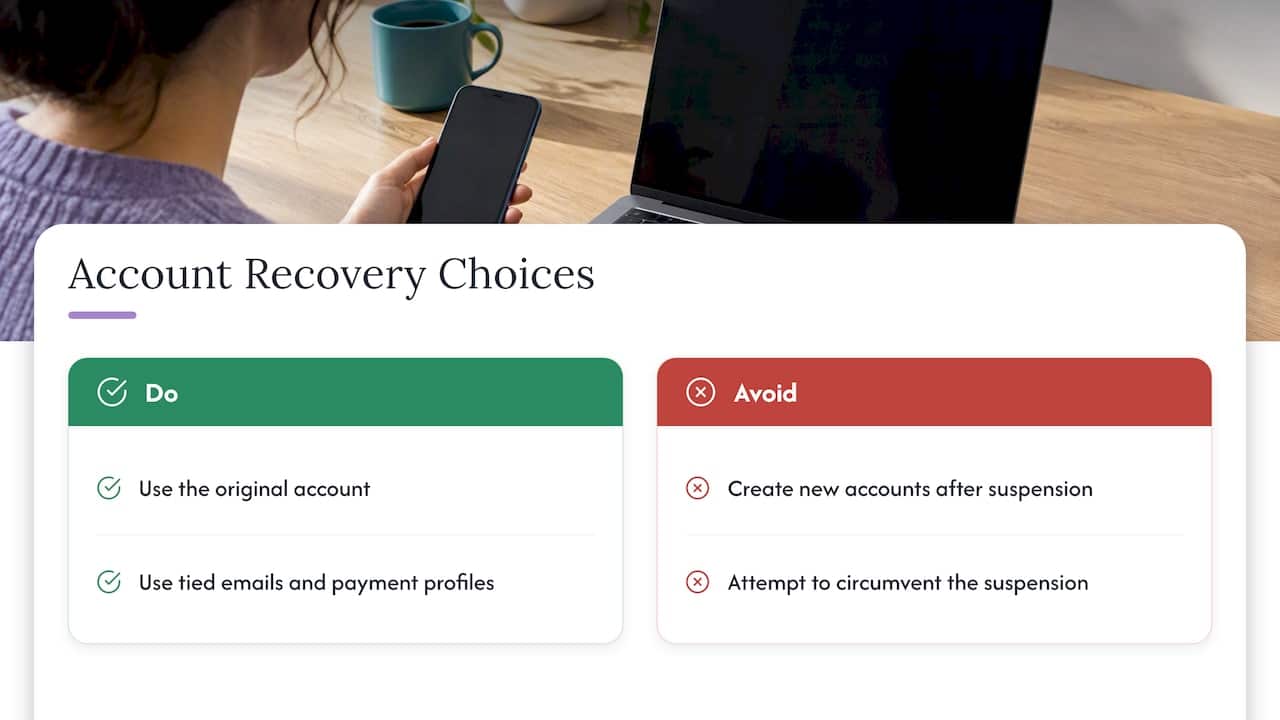
When revenue stops, opening a fresh account feels logical. On Google it is explicitly listed in the circumventing systems policy: attempting to use the system again after a suspension by creating new accounts is not allowed. Google support experts also advise using the original account, emails and payment profiles tied to the suspension to resolve the problem, and warn that circumvention can lead to a permanent ban.
If you are unsure whether anything in your setup could read as circumvention, our 7-step audit for circumventing systems suspensions goes through the common patterns: duplicate domains, shared payment methods, repeated creative variations and mismatched landing pages.
Meta ad accounts: the Account Quality route
Meta handles restrictions through Account Quality in Business settings, which shows the status of ad accounts, Pages and business portfolios and, where available, a restriction reason and a request-review option. The recovery path is the same in spirit as Google’s:
- Open Account Quality and read the stated reason.
- Fix the specific cause (ad content, landing page, business verification, payment issue).
- Submit the review request where the option is offered, with supporting documents.
- Do not create replacement ad accounts or profiles to keep spending while the review is pending.
Two practical Meta notes. First, if an admin’s personal profile was disabled, the ad account can become inaccessible even though the account itself is fine, so the personal profile is where recovery starts. Second, if the account was hacked, use Meta’s account recovery tools right away and document any billing or role changes. For businesses that need to advertise in categories Meta restricts, our Meta ads approval license guide explains the process of qualifying before you spend.
Reactivating a canceled account
A canceled account is a different case and a much easier one. Google Ads automatically cancels accounts that have been inactive for more than 15 months. Reactivating a canceled account is free, and you follow a few steps in your account preferences. Expect payment and document verification, which can involve a specialist review of about 48 hours. If your account was canceled for inactivity and not for a policy violation, you do not need an appeal.
Special case: restricted verticals
CBD, hemp, kratom, peptides, supplements, crypto and forex advertisers are suspended more often than average, for a simple reason: platforms either ban the product outright, or allow it only after certification, licensing or a country-by-country application. Google, for example, requires some industries to apply before advertising, and an ad disapproved for missing certification shows that status in your account.
In these niches, repeat suspensions usually trace back to one of these:
- Claims on the page. Disease or cure language on supplement and peptide pages, income promises on trading offers.
- Product category mismatch. The ad says one thing, the checkout sells another.
- Missing licensing. The product category needs a certification or an approval you have not obtained.
- Account history. Prior disapprovals, associated accounts and shared payment profiles accumulate.
Our Google Ads license service guide covers the licensing side, and the CBD, hemp, kratom and vape approvals page and the peptides and pills page cover vertical specifics.
Perspective: what we see in high-risk accounts
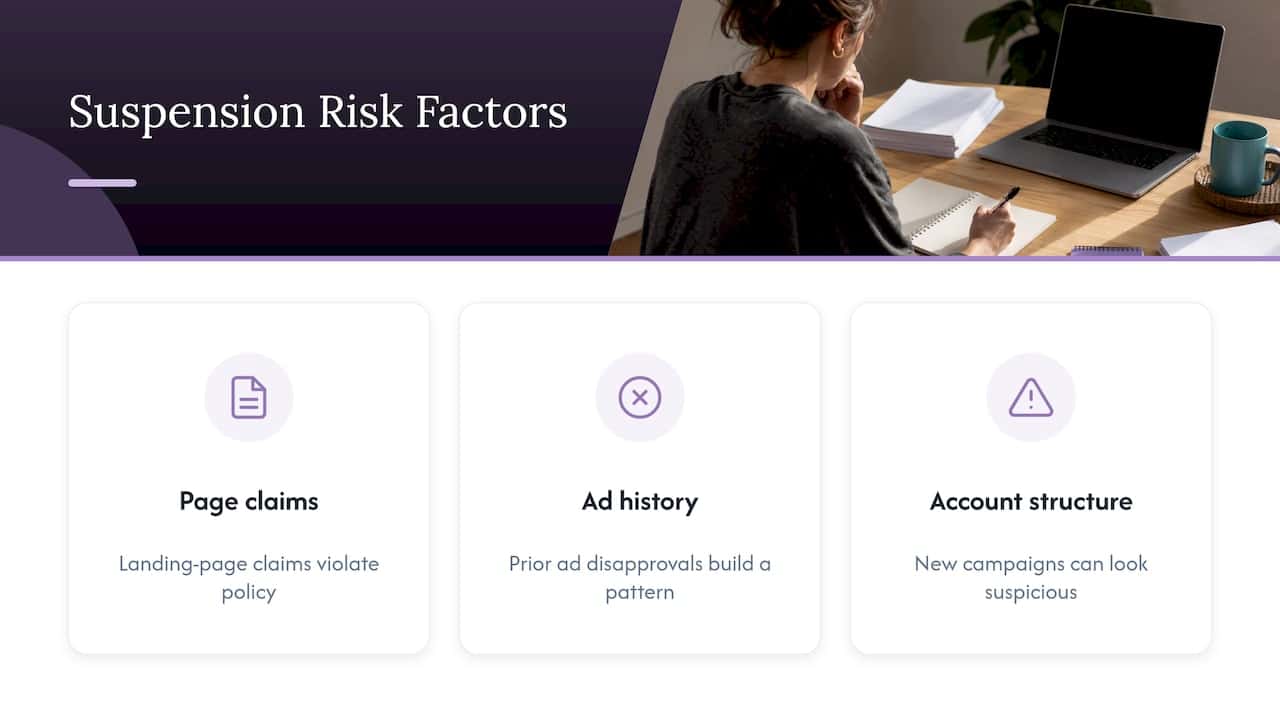
We work with advertisers in restricted verticals every day, and the pattern behind a suspended account is rarely a single bad ad. It is usually a stack: a landing page with claims the policy does not allow, a prior disapproval history, and an account structure that makes every new campaign look suspicious.
That is why we tell clients to resist the quick fix. Our own write-up on why audits beat bypassing ad review in restricted industries says it plainly: fix the page before you reach for anything more aggressive. Cloaking itself carries real platform-ban risk and legal scrutiny, which we lay out openly in our ad cloaking legal risk article. Anyone who tells you there is no downside is selling you something.
What we do offer is structure. We review the account, the pages and the history, tell you what is likely to pass and what is not, and then, depending on the niche and your risk tolerance, set up the right approach. Often that means a clean, compliant landing page and a documented appeal. For some verticals it involves more, and we explain the trade-offs before you commit.
— Umar
When outside help is worth paying for
You can recover most accounts yourself if the cause is a fixable page or a verification gap. Outside help makes sense when:
- You have been suspended more than once and cannot see the pattern.
- Your niche requires licensing or certification you are unsure how to get.
- You manage several accounts and suspect an association is blocking reinstatement.
- Each day offline costs more than the cost of an expert review.
Our suspension recovery guide covers securing documents and writing the appeal in more detail. If you want a second pair of eyes on your situation, a consultation call is the lowest-commitment way to start. We also offer a cloaking system setup and a done-for-you engagement; current prices are published on those pages. Whichever route you choose, we will tell you honestly if an appeal and a page fix are all you need.
What to do while the account is down
The waiting period is not dead time. Use it for:
- Revenue continuity. Shift budget to channels you control: email, organic search, affiliates and marketplaces that allow your products.
- Page cleanup. Run a claims audit on every page the ads pointed to.
- Access hygiene. Make sure the business owns its ad account, the login is not tied to one employee’s personal email, and at least two admins exist. A former marketer’s personal login is one of the most common causes of lost-access cases.
- Records. Keep invoices, licenses, supplier documents and the dates of every notice in one folder.
Mistakes that turn a suspension into a permanent loss
- Opening new accounts or profiles to keep spending.
- Appealing repeatedly with the same text.
- Editing the landing page after you have appealed, so the reviewer sees something different from what you described.
- Ignoring associated accounts that are still non-compliant.
- Sending a long, emotional or speculative message instead of facts.
- Buying a “guaranteed reinstatement” from anyone. Google states that reinstatement happens only in compelling circumstances, and the appeal process does not guarantee recovery.
FAQ
How long does ad account recovery take?
On Google Ads, a submitted appeal typically gets a response in 3 to 5 business days. The preparation (audit, page fixes, verification) is what takes the time, and it varies by case. Meta timelines depend on the restriction type and are shown in Account Quality.
Can I recover an ad account without an appeal?
Only if the account was not suspended for policy reasons. Canceled-for-inactivity accounts can be reactivated through account settings, and payment holds clear once the balance is paid. A policy suspension needs the official appeal.
Should I create a new ad account while I wait?
No. Google lists creating new accounts after a suspension under its circumventing systems policy, which can lead to a permanent ban. Wait for the review and resolve the original account.
What if my appeal is denied?
Read the response, re-audit for anything you missed, and check associated accounts. Google may stop processing repeated appeals for the same suspension, so only appeal again when something material has changed. This is the point where an independent audit is most useful.
Do restricted niches like CBD or peptides have lower odds?
They face more scrutiny because of category rules and licensing requirements, so the audit has to be more thorough. Documented compliance and the right approvals matter more than the wording of the appeal.
Sources
- Google Ads account suspensions overview
- Circumventing systems, Advertising Policies Help
- Fixing a suspended Google Ads account, Community guide
- Old unlinked ad account is blocking Merchant Center, Google Ads Community
- Phishing suspensions under unacceptable business practices, Google Ads Help
- Reactivate a canceled Google Ads account
- Apply to advertise certain products and services, Advertising Policies Help