
A policy-friendly creative is an ad whose claims, images, targeting and landing page all say the same honest thing, in terms the platform’s rules allow for your category. Reviewers, human or automated, judge the whole path from impression to checkout, so the creative and the funnel behind it have to pass together. This guide shows what that means in practice for CBD, hemp, kratom, smoking products, peptides, supplements and crypto advertisers.
TL;DR
- Every ad, asset and landing page is reviewed as one unit. A clean ad that points to a page making different claims will still fail.
- Write verifiable, qualified claims. Drop cures, guarantees and sensational language, and put disclaimers where a visitor can actually see them.
- Know the category rule before you build: some products are barred outright, and others run only in specific locations or with platform certification.
- After a rejection, read the stated reason, fix the real cause or appeal. Repeated violations lead to strikes and suspension.
- Cloaking-style shortcuts carry account risk. An audit-first approach is the more durable route.
Table of Contents
- What platforms actually check
- Start with the category rule, not the headline
- Writing claims that survive review
- Building a policy-compliant funnel
- Why restricted ads get disapproved and accounts get suspended
- What to do after a rejection
- Our perspective
- Keeping up as policies change
- Getting help with your creatives and funnel
- FAQ
- Sources
What platforms actually check
The major platforms publish their principles, and they overlap more than most advertisers expect.
Meta asks that ads clearly identify the company, product, service or brand, keep components relevant, and match the promoted offer to the landing page. Google allows only ads, assets and destinations that are clear, easy to interact with and relevant to users. Amazon’s quick-reference guidance asks for action-oriented calls to action, necessary disclosures, uncluttered creative and clear brand identification.
Read those together and you get a working definition. A policy-friendly creative is:
- Identifiable. The viewer can tell who is advertising and what is being sold.
- Relevant. The text, image and offer belong together.
- Consistent. The promise in the ad is the promise on the page.
- Disclosed. Terms, risks and qualifications appear where they are seen, not buried.
- Lawful for the place and category. The product is allowed where the ad will run.
The last point is where restricted verticals usually fail, so it comes first in your planning, before any copywriting.
Start with the category rule, not the headline
The same product can be fine on one platform, conditional on another and banned on a third. Check the rule for your category and country before you spend time on creative.
| Category | What the published policy says | What it means for your creative |
|---|---|---|
| CBD and hemp | Google permits certain topical, hemp-derived CBD products with THC of 0.3% or less only in California, Colorado and Puerto Rico, with Google certification | Outside those conditions, no wording will make the ad eligible. Check certification first. |
| Supplements and unapproved substances | Google disallows products with dangerous pharmaceutical ingredients and products marketed as preventing, curing or treating disease without government approval | Disease claims are the fastest route to rejection. Describe the product, not a medical outcome. |
| Drugs and unsafe substances | Meta prohibits ads for illicit or recreational drugs and other unsafe substances or supplements, and sets specific requirements for prescription, over-the-counter and cannabis-derived products | Read the restricted-goods page for your exact product type before you brief a designer. |
| Dangerous products generally | Google bars products or services that cause damage, harm or injury, with some restricted items eligible only under conditions | Smoking-related and kratom-type products often sit in this area. Assume a conditional or closed door and verify. |
| Forex and speculative financial products | Google allows CFD and rolling-spot forex products only for eligible licensed providers in eligible locations, with certification | Licensing and certification come before copy. Your ad cannot substitute for them. |
If the policy for your product and location says no, the honest answer is that paid ads on that platform are not available to you right now. Put the budget into owned channels, search on platforms with different rules, or a licensed or certified route where one exists. We would rather tell you that on a call than sell you a setup that fails in a month.
Writing claims that survive review
Search Engine Land’s practitioner guidance treats policy-friendly creative as a messaging discipline: verifiable features and terms, no sensational claims, disclaimers that are actually visible. That matches what we see in rejected accounts. The copy, not the technology, is usually the first problem.
Swap promises for qualified statements
The same guide shows examples that replace unsupported medical or financial promises with potential-benefit wording, stated APR terms and applicable disclaimers. Here is how that logic applies to our verticals, as illustrations of the approach:
| Risky pattern | Safer pattern |
|---|---|
| “Cures anxiety in days” | “Hemp-derived topical. Not intended to diagnose, treat, cure or prevent any disease.” |
| “Guaranteed 10x returns” | “Trading involves risk, including loss of capital. See risk disclosure.” |
| “Lose 20 lbs fast, doctors hate it” | “Daily supplement with listed ingredients. Results vary.” |
| “Before and after” body imagery | Product shot with ingredient and usage information |
Note what changes: the safer lines describe the product and state limits. They do not try to imply the forbidden claim through a hint, an emoji or a wink. Reviewers read implication, and so do regulators.
Our guide to medical claims policy goes deeper on which phrases trigger review in health-adjacent niches.
Images and audience targeting
Meta requires text and images to be relevant and says targeting must not discriminate, harass, provoke, disparage or engage in predatory practices. Practical consequences:
- Avoid imagery that implies a personal condition (“Are you overweight?” over a body shot).
- Do not show the product in use in ways the category forbids, such as smoking imagery for a category where that is restricted.
- Keep audience selections broad enough that they do not read as targeting a vulnerable group.
- Show the real product. Stock images that do not match what the customer receives create a mismatch problem later.
Building a policy-compliant funnel
The second keyword readers type is about funnels, and rightly so. Platforms follow the click.
Google uses a combination of AI and human evaluation, and complex, nuanced or severe cases may receive specialist review. Snap reviews both the creative and the associated landing page, rejecting pages that are low quality, disruptive, irrelevant, unsafe or poorly formatted for mobile. Native networks are just as particular: Revcontent requires landing pages that lead to the promoted offer without unnecessary barriers, broken links, looping redirects, excessive interstitials or forced redirects.
A funnel checklist
- Match the offer. Price, product name and promise on the page are the same as in the ad.
- Show who you are. Business name, contact details, return and shipping terms, privacy policy.
- Keep the path clean. No redirect loops, surprise pop-ups, auto-playing audio or forced extra steps.
- Make mobile work. Most review and most traffic is on phones. Load speed and layout matter.
- Disclose in plain view. Risk statements, age restrictions, and “results vary” language near the claim they qualify.
- Label advertorials. Revcontent asks for a clear, prominent notice above the fold that the page is an advertisement rather than a news article. Fake news-site pages with invented bylines are a policy problem on every major platform.
- Check every step. Quiz steps, upsells and checkout pages are part of the destination.
For affiliate offers, where you do not control the final page, see our notes on affiliate ads compliance and the fixes that help affiliate ads pass approval.
Why restricted ads get disapproved and accounts get suspended
Knowing the enforcement ladder helps you decide how much risk a given creative is worth.
Google may disapprove ads that violate policy and suspend accounts for policy or terms violations. Egregious violations can cause immediate suspension, while repeat violations lead to suspension through a strike system, with a maximum of three strikes per policy. Meta states that advertisers are responsible for applicable laws and that violations can lead to ad cancellation or account termination.
Two things follow:
- A disapproved ad is a cheap lesson. A suspended account is expensive, because related and newly created accounts can be caught too.
- Testing the limits of a policy with live ads is a bad strategy. Test copy against the written policy before launch, and change one variable at a time.
The highest-risk behavior is misrepresentation: showing the reviewer one thing and the customer another. Platforms have a policy specifically about circumventing their systems. If you have ever used redirects or page-swapping, our seven-step audit on circumventing systems suspensions shows what to check and clean up.
What to do after a rejection
- Read the stated reason. The disapproval notice names the policy. Do not guess.
- Find the real trigger. It may be in the headline, an image, an extension, the landing page, or a page two steps into the funnel.
- Fix and resubmit, or appeal. A disapproved ad cannot run until the violation is fixed and the ad is reviewed. If you believe it was a mistake, appeal the decision. If Google suspends the account, appeal rather than opening a new one.
- Document what changed. A short record of the edit and the policy it addresses makes appeals cleaner.
- Do not open replacement accounts. Google notes that related and newly created accounts may also be suspended.
Platform-specific recovery guides: ad account recovery and appeals, documenting and appealing a suspension, TikTok account bans in restricted verticals, YouTube ads policy fixes, and what X allows and rejects.
Our perspective
We work with advertisers in categories where approval is hard: CBD, peptides, supplements, crypto, forex and affiliate offers. Here is what we have learned.
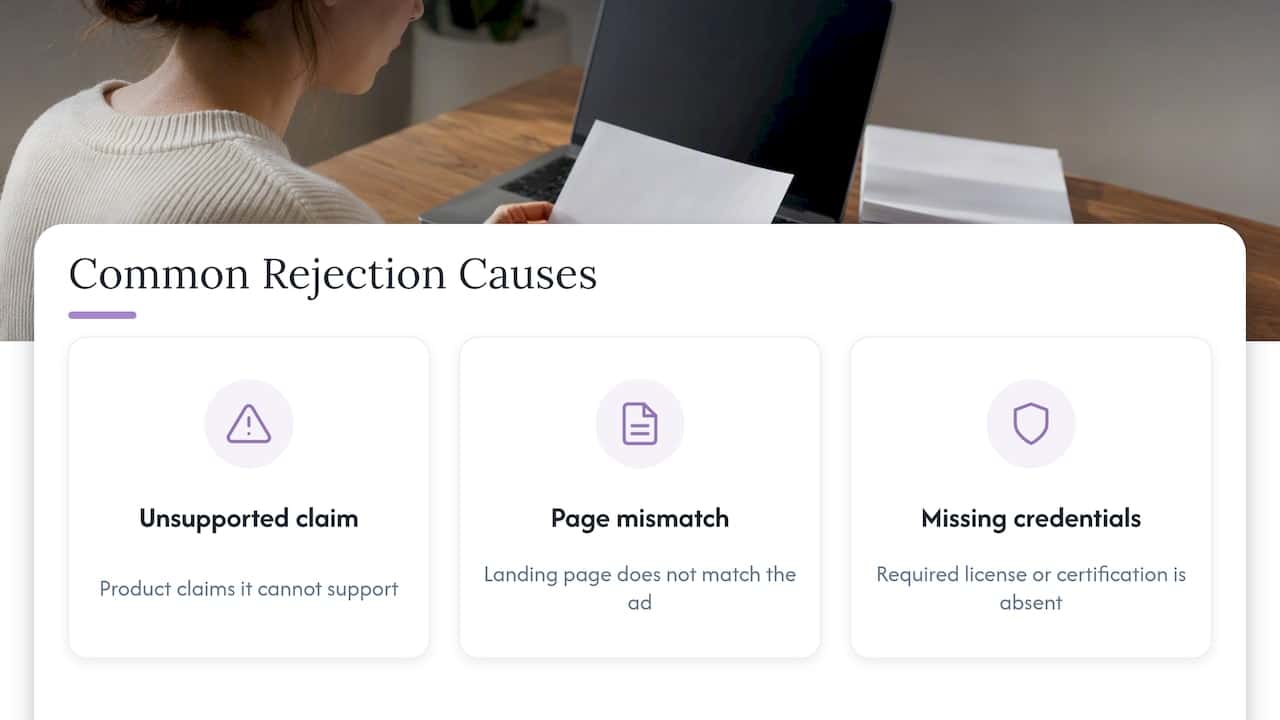
Most rejections are not mysterious. They come from a claim the product cannot support, a page that does not match the ad, or a category that needs a license or certification the advertiser does not have. Fixing those is the foundation of everything else, and no technical layer replaces it.
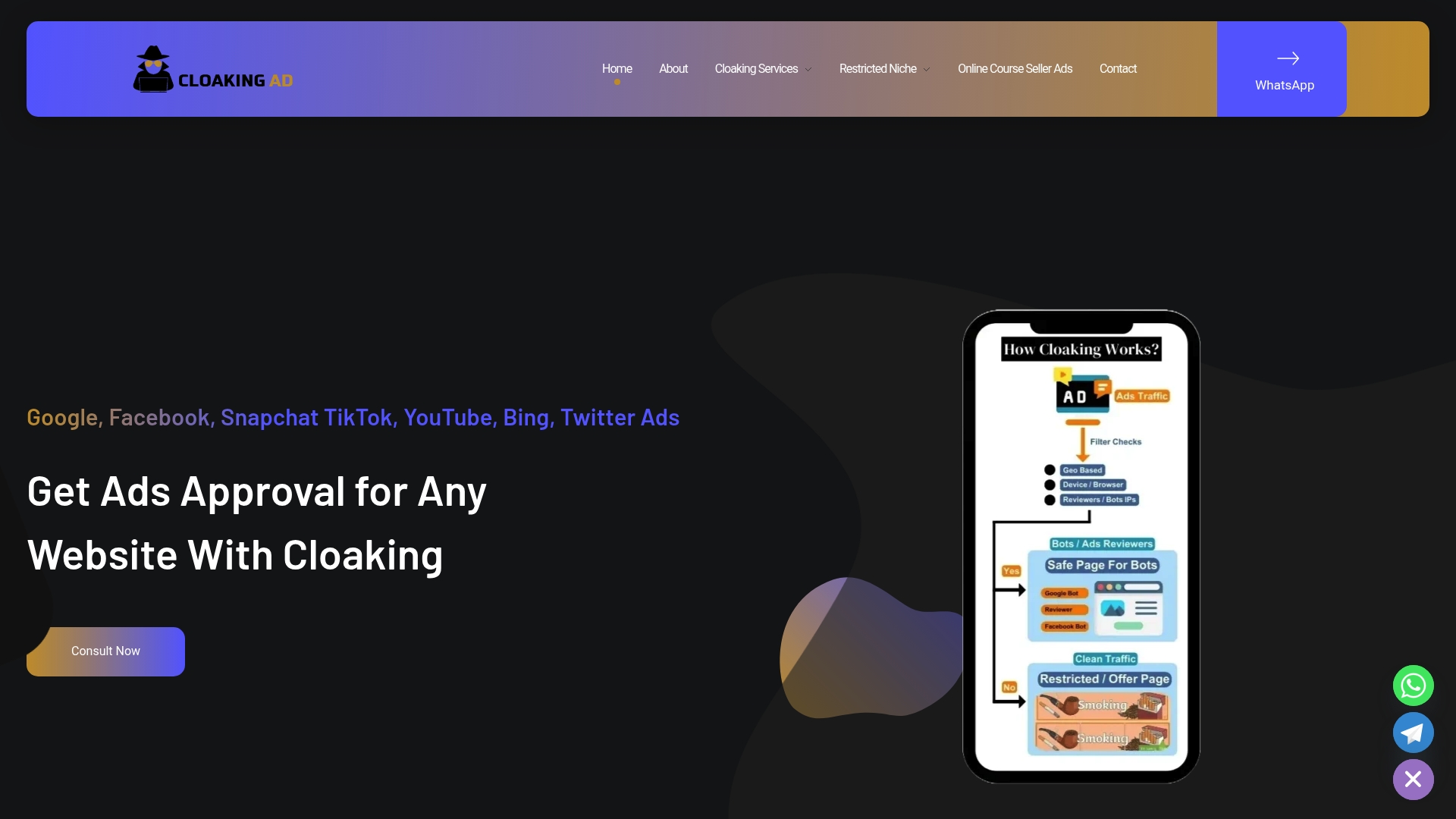
That is why we talk about cloaking carefully. Cloaking, meaning showing platform reviewers different content from what users see, is a method platforms prohibit, and the exposure falls on your account. We think every advertiser should understand what restricted advertisers risk with cloaking versus compliance before deciding anything, and our own view on why audits beat bypassing ad review is that a clean, well-documented funnel is what keeps accounts alive across Google, Meta, TikTok and others.
So our first step is a review of your creative, claims and funnel against the current written policy. Some clients leave that review with a rewrite plan and no further need of us. Others want hands-on help with setup and account management, and we discuss what fits their category and platform. Where a platform’s rules simply do not allow your product, we say so.
— Umar
Keeping up as policies change
Policies move. Meta says its policies can change at any time without notice, and that advertisers are responsible for understanding the rules that apply to them. Build a routine:
- Monthly: reread the policy page for your category on each platform you use.
- Before each new campaign: compare the creative and landing page with the current rule, not last quarter’s.
- After any rejection: log the reason, so patterns show up across campaigns.
- When you enter a new country or state: check local law first. CBD and financial products in particular differ by location.
We keep category guides current for restricted niches, and crypto advertisers can start with our piece on advertising crypto safely.
Getting help with your creatives and funnel
If you have rejected ads, a flagged account or a launch in a restricted category, the quickest start is a conversation about what you sell, where you want to advertise and what has already been rejected. Book a consultation call and we will go through your creative and funnel with you. We also offer a cloaking system setup and a done-for-you engagement, and we will tell you plainly which of them suits your situation and which platform rules apply.
For category detail, see our pages on CBD, hemp, kratom and vape ads approval and the Meta ads compliance process.
FAQ
What makes an ad creative policy friendly?
It identifies the advertiser and product, uses claims you can verify, includes visible disclaimers, and matches the landing page exactly. It also has to be for a product the platform permits in your location. Meeting the style rules does not help if the category itself is closed.
Can I run CBD ads on Google?
Only in narrow cases. Google permits certain topical, hemp-derived CBD products with THC at or below 0.3% in California, Colorado and Puerto Rico, and only with Google certification. Check the current policy page before you plan spend, since it can change.
How do I know if my landing page is the problem?
Compare it with the ad line by line. Look for mismatched claims, missing business information, redirect chains, intrusive pop-ups and unlabeled advertorial content. Platforms such as Snap and native networks review the page along with the creative, so a page problem can sink a clean ad.
What should I do if my account is suspended?
Read the stated reason, fix the underlying violation and file an appeal through the platform. Avoid creating new accounts to continue, because Google may suspend related and newly created accounts too. Our recovery guides walk through documenting the appeal.
Do fixed creatives stay approved forever?
No. Platforms update policies, sometimes without notice, and reviewers reassess ads. Recheck your category policies on a regular schedule and after any regional expansion.
Sources
- Introduction to the Advertising Standards, Meta Transparency Center
- Google Ads policies, Google Ads Help
- Ad policies quick reference guide, Amazon Ads
- A guide to Google Ads for regulated and sensitive categories, Search Engine Land
- What happens if you violate our policies, Google Ads Help
- Google Ads policies, Advertising Policies Help
- Snap advertising policies
- Landing Page Policies, Revcontent
- Dangerous products or services, Advertising Policies Help
- Dangerous products or services, United States conditions
- Unapproved substances, Advertising Policies Help
- Drugs and Pharmaceuticals, Meta Transparency Center
- Complex speculative financial products, Google Advertising Policies Help