
A website cloaker is a tool that changes what a visitor sees or where a link leads. The term covers two very different things. Link cloaking turns a long affiliate URL into a short branded link on your own domain, and it is routine. Ad or page cloaking shows an ad reviewer one page and a real visitor another, and the big ad platforms treat it as a serious violation. Which one you need decides your cost, your risk and your tools.
We run a cloaking service for restricted verticals, so we have a stake in this topic. We will say plainly what works, what does not and where the exposure sits.
TL;DR
- “Website cloaker” usually means link cloaking: a branded redirect such as yoursite.com/go/offer that hides a messy affiliate URL and lets you track clicks. It is widely used and low risk when disclosed.
- Ad cloaking is a different technique. It filters traffic so reviewers and real users see different pages, and Google treats it as a circumventing systems violation.
- Platforms have become better at spotting it, and a ban for circumventing systems is very hard to reverse.
- Advertising law applies whatever the filter does: the FTC looks at the overall impression an ad leaves on a reasonable consumer.
- If you sell CBD, peptides, kratom, crypto or similar products, start with an audit of your channel fit and compliance. Treat any cloaking as a high-risk layer, never as a shortcut.
Table of Contents
- What people mean by “website cloaker”
- Link cloaking: the harmless version
- Ad cloaking: what it is and why platforms ban it
- Who looks for ad cloaking, and why
- Our perspective
- How to choose: a decision guide
- What to look for in any cloaking provider
- Working with us
- Common mistakes
- FAQ
- Sources
What people mean by “website cloaker”
Search results for this phrase are dominated by affiliate-marketing plugin guides. That tells you the main intent: people want to hide or shorten a link. A second group, smaller and more sensitive, are advertisers in restricted categories who want to get ads approved.
Here is the split.
| Link cloaking (link masking) | Ad / page cloaking | |
|---|---|---|
| What it does | Replaces a long URL with a branded short link that redirects | Serves different pages to reviewers and real users |
| Typical method | 302 or 307 redirect on your own domain | Filtering by IP, device fingerprint, user agent and behavior |
| Main purpose | Clean links, click tracking, easier link management | Getting ads past platform review |
| Platform stance | Generally acceptable if not misleading | Prohibited under platform policies |
| Risk level | Low | High |
The AffTank guide to cloaking affiliate offers draws the same line. Branded redirects keep destination, tracking and commissions clean. Filtering that serves entirely different content to auditors is the risky kind.
Link cloaking: the harmless version
If you promote affiliate offers, link cloaking is a sensible hygiene step. A raw link such as a network URL with long parameter strings looks untrustworthy and is easy to strip. A branded link on your domain is shorter, memorable and lets you change the destination later without editing every page.
How it is done
- Pick a path on your own domain, for example /go/ or /recommends/.
- Create one redirect per offer, using a 302 or 307 so the destination can change. The AffTank guide notes that link masking relies on 302 or 307 redirects.
- Add tracking parameters on the redirect so you can see clicks by page and campaign.
- Disclose the affiliate relationship near the link.
- Test the link on mobile and desktop and check where it finally lands.
On WordPress, a plugin does the job in minutes. Outside WordPress, a server rule or a redirect tool does the same.
What to watch
- Disclosure. Hiding a link is fine; hiding that you earn a commission is not. The FTC’s .com Disclosures guidance covers how to make disclosures clear in digital advertising.
- Paid traffic. Sending paid clicks to a redirect is fine in itself, but the final page must match what the ad promised. Once the redirect shows a reviewer one thing and a user another, you have moved into ad cloaking.
- Regulated sectors. In niches such as iGaming, link cloaking carries extra policy risks, so read the program and platform rules first.
Ad cloaking: what it is and why platforms ban it
Ad cloaking is where most of the money and most of the danger sit. A cloaker in this sense is software on a server that inspects each visitor and decides which page to show. Meta describes the core technique as a page that displays one version to reviewers and another to users, as reported by Montana Labs on Meta’s February 2026 announcement about its cloaking lawsuits.
Platform rules are direct:
- Google’s help page says cloaking is not allowed under the circumventing systems policy: you cannot show different content to different people or to Google to hide things that might break the rules.
- Google’s circumventing systems policy also bars attempts to trick its ad review processes with ads, content or destinations.
- Meta’s Inauthentic Behavior policy prohibits deceiving Meta or its users about identity or the origin or purpose of content.
The consequence is not a simple ad disapproval. Google describes circumventing systems violations as ones that can lead to account suspension, and the usual outcome is a permanent ban, often without a prior warning. Appeals rarely succeed, and the domain, the account owner and the wider footprint can be flagged.
Detection keeps improving
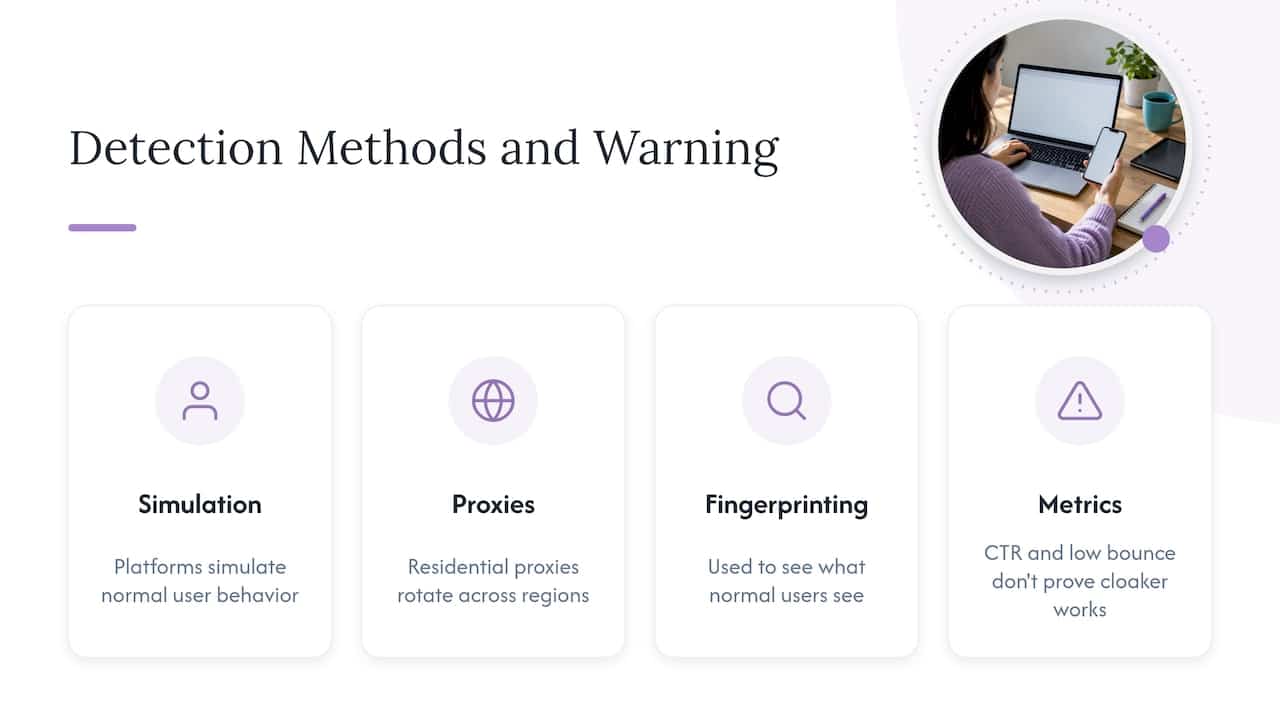
A cloaker that worked last year may be logged and ignored this year. Platforms now use behavioral simulation, rotating residential proxies from many regions and browser fingerprinting to see what a normal user sees, according to the Montana Labs analysis. One trap is worth remembering: strong click-through and low bounce rates in your dashboard do not prove the cloaker is working. The platform may simply be recording the pattern for later enforcement.
The legal layer
Even if a filter slipped past review, the ad still faces consumer protection law. The FTC’s enforcement policy statement on deceptively formatted advertisements centers on how an ad reads to consumers, not on how it got through review. A legal product does not make a misleading presentation legal. We go deeper on this in our piece on ad cloaking risks, platform bans and FTC scrutiny.
Who looks for ad cloaking, and why
The demand comes from categories that platforms restrict, not always ban outright:
- CBD, hemp, kratom and vape brands
- Peptide and supplement sellers
- Crypto and forex businesses
- Pharma, healthcare and telehealth offers
- Affiliate marketers in tightly policed offers
- Government service and travel visa sites
- Brand replica and IPTV offers
Many of these advertisers have real products and hit a wall of blanket category restrictions. That frustration is understandable. But the right first question is not “which cloaker?” It is “is there a permitted route for this product on this platform?”
Channel fit often beats workarounds
Industry practitioners point out that many CBD and supplement brands have a channel-fit problem, not a copy problem. For example, LegitScript certification is a prerequisite for Meta’s eligible CBD advertising pathway. A brand that cloaks instead of certifying skips the legitimate route and takes on the ban risk. If you are in that position, our walkthrough on running CBD Facebook ads with compliance steps that pass review shows what the permitted path looks like.

Our perspective
We build cloaking systems, server configuration, safe landing pages and bot and reviewer detection for restricted verticals. We would be doing you a disservice if we said it was risk-free. It is not, and anyone who promises otherwise is selling you something.
What we see in practice:
- Most failed accounts have a fixable problem. Mismatched landing pages, missing certifications, claims that cannot be supported and weak domain history cause more rejections than a lack of a cloaker.
- A cloaker is an infrastructure decision, not a fix. Detection, traffic filtering and tracking have to be set up correctly, including Google ad tracking integration and, for device-level filtering, an honest read of the device cloaking risk checklist.
- Audit first. Our own article on why audits beat cloaking in restricted industries argues this, and we stand by it. A seven-step audit to prevent circumventing systems suspensions costs you an afternoon and can save an account.
- Know what you are accepting. If you go forward with cloaking, you are accepting platform policy risk. We help you make that choice with open eyes and a setup built for stability, not a promise of immunity.
We would rather lose a sale to an advertiser who realizes they can run compliant ads than win one from someone who learns about the risk after a ban.
— Umar
How to choose: a decision guide
Use these questions in order.
1. Are you only hiding or shortening a link?
Use a link cloaking plugin or a redirect on your own domain, disclose affiliate relationships, and stop there. You do not need an ad cloaker.
2. Is your product allowed on the platform with certification or restrictions?
Get the certification or license first. Examples include LegitScript for Meta CBD ads, covered above, and licensing routes for crypto advertisers, which we explain in our guides to crypto advertising approval and Meta ads compliance and approval licenses.
3. Is your category banned or heavily limited on that platform?
Consider other channels, such as search on other engines, native, email, influencer partnerships or content, before taking on enforcement risk. Some categories, like kratom, face rules that differ by platform and change often.
4. Are you willing to accept the risk of a permanent ban?
If yes, use a separate structure: dedicated domains, accounts you can afford to lose, and a setup that does not tie back to your main brand or payment accounts. If the account is your whole business, do not put it on the line.
What to look for in any cloaking provider
Whether you buy from us or someone else, check these points before paying:
- Honesty about risk. A provider that guarantees you will never be banned is not telling the truth about how platforms enforce.
- Real detection, not static lists. IP lists age fast. Ask how bots and reviewers are identified and how often the logic updates.
- Landing page quality. The page shown to reviewers should still be accurate and policy-sound, not a thin shell.
- Tracking compatibility. Your conversion tracking, pixels and analytics have to keep working.
- Ownership. You should own the server, domains and configuration, so you can move if something goes wrong.
- Scope clarity. Know whether you are buying advice, setup only, or full management.
Working with us
We offer three levels of help, and you choose how much we do:
- A consultation call to review your product, platform and risk, and tell you whether cloaking is even the right tool. Book it from our main page.
- A cloaking system setup: custom server configuration, safe landing pages and reviewer and bot detection, described on our services page.
- A Done-For-You engagement, where we also handle ad account management. Start from the consultation and Done-For-You page.
If your niche is Google-specific, see our Google Ads cloaking and approval service. For CBD, hemp, kratom and vape brands, there is a dedicated page on ads approval for those categories. We will tell you on the call if we think a compliant route is better for you.
Common mistakes
- Mixing the two meanings. Buying an ad cloaker when a link plugin was enough, or the reverse, wastes money.
- Trusting the dashboard. Good numbers do not prove the cloaker is undetected.
- Using your main account. Testing cloaking on the account that holds your spend history is the costliest way to learn.
- Ignoring the landing page. If real visitors land on a page that misrepresents your offer, consumer law applies regardless of the filter.
- Skipping disclosure. Affiliate links need clear disclosure even when masked.
FAQ
What is a website cloaker?
It is a tool that masks or conditionally changes what visitors see. In affiliate marketing it usually means a branded redirect that hides a long link. In advertising it can mean software that shows different pages to ad reviewers and to real users, which platform policies prohibit.
Is link cloaking legal and safe?
Link cloaking with 302 or 307 redirects on your own domain is generally acceptable, as long as you do not mislead users and you disclose affiliate relationships as FTC guidance expects. It is a different practice from ad cloaking and carries far lower risk.
Does ad cloaking get accounts banned?
It can. Google and Meta both prohibit showing reviewers different content than users see, and violations of the circumventing systems policy can lead to permanent suspension. Recovery after such a ban is difficult.
How is cloaking done technically?
For link cloaking, a redirect rule or plugin maps a short path on your domain to the destination. For ad cloaking, a server script evaluates signals such as IP, device and user agent before choosing the page to serve. We do not recommend the second without a clear view of the platform risk.
Can I advertise CBD or peptides without a cloaker?
Often, in some form. Certification and category-specific programs exist on some platforms, and other channels remain open. A consultation can map the permitted options for your product before you spend on any infrastructure.
Sources
- Why is my account suspended for cloaking under the circumventing systems policy? (Google Ads Help)
- Circumventing systems (Google Advertising Policies Help)
- Inauthentic Behavior (Meta Transparency Center)
- How to Cloak Affiliate Offers: What’s Legal, What’s Not (AffTank)
- Meta’s cloaking lawsuits target the oldest trick in front-end deception (Montana Labs)
- Enforcement Policy Statement on Deceptively Formatted Advertisements (FTC)
- .com Disclosures: How to Make Effective Disclosures in Digital Advertising (FTC)
- Meta Ads Compliance for CBD (GoComply)
- Affiliate Link Cloaking in iGaming: Safe Practices and Policy Risks (Big Betty)