
A platform medical claims policy is the set of ad rules that prohibit unsubstantiated disease, prevention, or cure claims, and your ad will usually be rejected if it asserts a treatment effect without meeting platform certification and competent evidence standards. The immediate action: map every health claim in your ad and landing page to specific, relevant evidence, and confirm your destination content actually supports what the ad says.
TL;DR:
- Ensuring claims are backed by relevant, specific evidence and matching landing content to ad statements is crucial for avoiding rejection.
- Certification, platform-specific rules, and the exact wording of claims significantly affect ad approval for healthcare products.
- Avoid direct medical claims, implied clinical benefits, and visual cues that suggest medical outcomes to minimize review flags.
- Maintaining a claim inventory, verifying landing pages, and preparing strong appeal documentation streamline compliance processes.
- Consulting with compliance experts is advisable when facing repeated rejections or managing complex regulatory standards across multiple platforms.
Table of Contents
- A 30-second compliance checklist before you submit a health ad
- What Google, Meta, and other platforms actually restrict
- How substantiation and legal evidence requirements work
- What your landing page needs to show reviewers
- Ad copy that gets flagged, and how to rewrite it
- A practical workflow for preflight review and appeals
- When a specialist is worth bringing in
- Get your ads approved without the rejection cycle
- FAQ
- Sources
A 30-second compliance checklist before you submit a health ad
Before any health-related ad goes live, run it through a short filter. This catches the mistakes that trigger most rejections and account reviews in CBD, supplements, peptides, and pharma campaigns.
- Scan your copy for direct disease or treatment words (“cures,” “treats,” “reverses”) and remove or qualify them.
- Match each remaining claim to evidence that is relevant to your exact product, not just its category or main ingredient.
- Confirm your platform eligibility, including certification requirements for your product type and target countries.
- Check that your landing page mirrors the ad’s claims and contains no hidden content or deceptive redirects.
- Review testimonials and imagery for implied clinical claims, since a before-and-after photo can read as a treatment promise even without words.
Pro Tip: Keep a one-page claim inventory for every active ad. When a reviewer flags copy, you want to find the supporting evidence in seconds, not hours.
What Google, Meta, and other platforms actually restrict
Each major platform publishes its own healthcare rules, and they do not line up exactly, which is why multi-channel campaigns in restricted verticals need a platform-by-platform read before launch.
Google Ads applies a healthcare and medicines policy that blocks products marketed as safe or effective for preventing, curing, or treating disease unless they carry the right government approval. Google’s list of restricted substances is explicitly non-exhaustive, so passing a name check against that list does not guarantee approval. Certain categories, including some CBD products, require certification through programs like LegitScript or a direct Google application, and even certified advertisers may be limited to specific countries, states, or ad formats.
- Google: certification routes exist for select healthcare categories, but eligibility still depends on claimed effect, target location, and destination content.
- Meta: health and wellness ad standards restrict weight-loss and supplement advertising, apply age-targeting limits on health products, and prohibit certain promotional claims outright.
- Other formats: a placement like YouTube’s masthead can carry stricter exclusions than standard search or feed ads, so check format-specific rules separately from the general policy page.
The practical takeaway is that eligibility is never a single yes or no. It shifts with product type, the specific claim made, target location, ad format, and what the landing page actually shows.
How substantiation and legal evidence requirements work
The FTC’s health-related advertising guidance requires that health claims be truthful, not misleading, and backed by competent and reliable scientific evidence tied to the specific product and the specific claim being made, not just the category it belongs to. This standard sits behind most platform policies, even when a platform does not cite the FTC directly.
- Match evidence to the claim. A study on an isolated ingredient rarely substantiates a claim about your finished product.
- Favor human clinical data. Disease-related claims generally need randomized controlled trial evidence, not animal studies or lab results alone.
- Avoid cherry-picking. Pulling a favorable subset from a larger study that found mixed results is a common substantiation failure.
- Build a documented evidence pack. Keep study citations, a short design summary, the relevant clinical endpoints, and any regulatory approvals together for each claim.
The FTC’s enforcement history shows that disease-treatment claims draw action even from well-intentioned marketers. During Operation CBDeceit, the agency sent warning letters and pursued settlements against CBD sellers claiming their products treated serious diseases, which meant unsubstantiated claims carried real legal exposure, not just an ad rejection.
What your landing page needs to show reviewers
A compliant ad can still get rejected if the landing page it points to does not back up the same claims. Destination content is part of the review, not an afterthought.
- Keep the language on your landing page consistent with your ad; never let the destination overstate what the ad itself claimed.
- Avoid hidden text, cloaked content shown only to reviewers, or redirects that send real visitors somewhere different from what was reviewed.
- Place disclosures where visitors can actually see them, and link to primary evidence when a claim depends on a specific study.
- Seek third-party certification, such as LegitScript, or a regulatory approval reference when your category supports it.
Pro Tip: If your landing page needs a disclaimer to stay honest, put that disclaimer near the claim itself, not buried in a footer no one reads.
Ad copy that gets flagged, and how to rewrite it
Some phrases get flagged almost automatically because they cross directly into medical claim territory.
“Cures anxiety,” “prevents diabetes,” “replace your prescription,” and similar phrasing imply prescription-level efficacy that few consumer products can substantiate.
Implied claims cause just as much trouble as direct ones. A testimonial describing a dramatic recovery, a before-and-after photo pair, or the phrase “clinically proven” without a matching randomized trial can all read as disease-treatment claims to a reviewer, even without a single banned word in the copy.
- Swap “cures” or “treats” for “supports” or “may help,” and only when real evidence backs that softer claim.
- Pair any wellness claim with a clear qualifier instead of letting it stand alone as a medical promise.
- Review testimonials and influencer content for implied clinical benefit before publishing, since the FTC has warned CBD marketers that testimonials are not a substitute for clinical proof.
- Check product imagery for anything that visually implies a medical outcome, like lab coats, syringes, or clinical settings, unless that context is accurate and relevant.
A practical workflow for preflight review and appeals
Treat compliance as a repeatable process, not a one-time check, especially if you are running campaigns across several platforms at once.
- Claim inventory. One person owns a running document mapping every ad claim to its supporting evidence file.
- Landing page audit. Confirm there is no hidden content, cloaked reviewer view, or mismatched redirect before submission.
- Eligibility and certification check. Verify which target countries or ad formats require certification for your product category.
- Submit, monitor, and appeal. If an ad is disapproved, build an appeal packet with the exact claim, the supporting study, and a short note tying the two together.
Once an ad is approved, keep monitoring it. Policies change, and documentation retention matters if a reviewer or regulator asks questions later.
Pro Tip: Store your appeal packets even after a successful appeal. Reviewers often ask for the same evidence again when a policy update triggers a fresh sweep.

When a specialist is worth bringing in
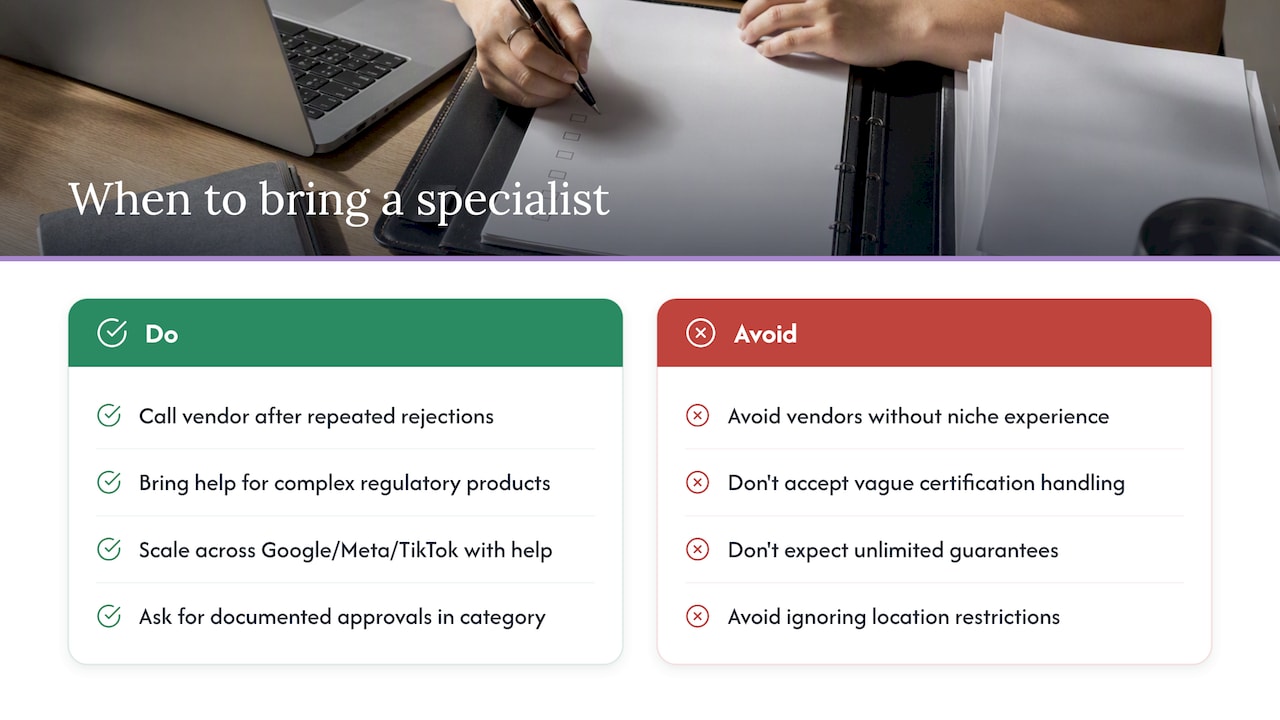
Repeated rejections across multiple platforms, a product with genuinely complex regulatory status, or a need to scale the same campaign across Google, Meta, and TikTok simultaneously are the signals that it is time to stop troubleshooting alone.
When you talk to a prospective vendor, ask for documented approvals in your specific category, a clear description of their compliance process, and honest limits on what any guarantee actually covers. A vendor who cannot explain how they handle certification and location restrictions for your exact product probably has not worked in your niche before.
— Umar
Get your ads approved without the rejection cycle
We built our service to help get health-related and other restricted ads through review more efficiently. We offer a CONSULTATION CALL to assess your account and claims, a one-off SETUP CLOAKING SYSTEM engagement for teams that want the technical work done once, and a fully managed Done-For-You option for ongoing campaign support.
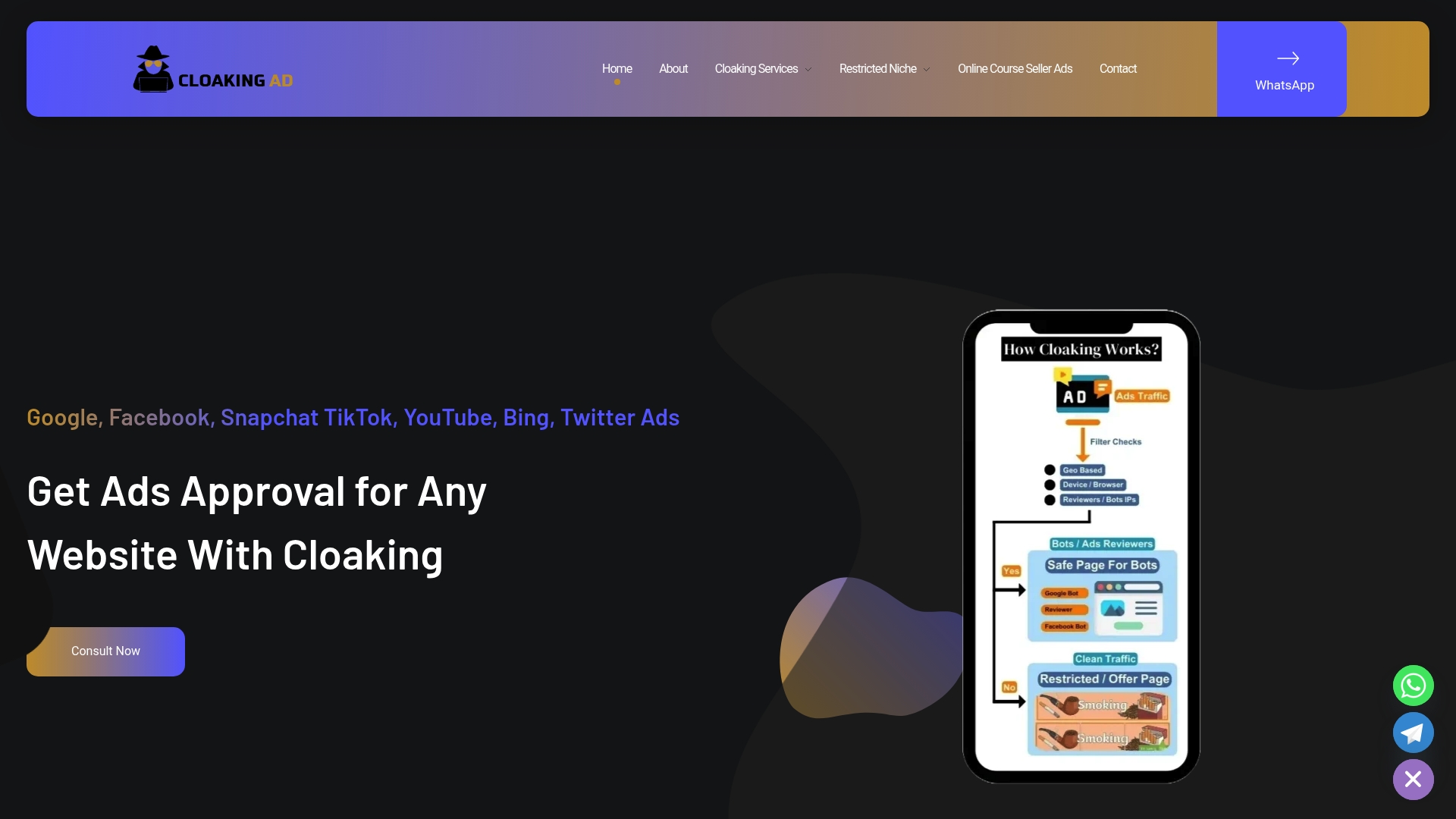
Before your consult, gather your current ad copy, landing pages, and any existing rejection notices. That lets us assess your healthcare or restricted-niche campaign quickly and tell you what changes will actually move the needle.
FAQ
What counts as a medical claim in ad policy terms?
A medical claim is any statement, image, or implication that a product prevents, treats, or cures a disease or medical condition. This includes indirect claims made through testimonials or before-and-after imagery, which reviewers evaluate the same way as direct wording.
Can supplement or CBD ads ever use health claims?
Only with evidence that matches the specific product and claim, and in some cases only after certification through a program like LegitScript or a direct platform application. Even then, Google restricts certain CBD advertising to approved locations and formats, so approval in one country does not guarantee approval elsewhere.
What happens if my ad gets disapproved for a medical claim?
Most platforms allow an appeal, and a strong appeal packet includes the exact claim, the evidence behind it, and a short explanation connecting the two. If the claim cannot be substantiated, the faster fix is usually to soften the language rather than keep appealing the same wording.
Are there legal risks beyond losing my ad account?
Yes. Regulators have sent warning letters and pursued enforcement over unsubstantiated health claims, including FDA and FTC action against disease-treatment claims that required corrective action on short deadlines. Account suspension is often the smaller consequence compared to regulatory exposure or reputational damage.
Can CloakingAd guarantee my health-related ad gets approved?
Our Done-For-You and managed engagements focus on assisting advertisers in restricted niches with ad approvals. Specifics on scope and turnaround are covered on a consultation call, since the right approach depends on your product, claims, and target markets.
Sources
- Unapproved substances – Advertising Policies Help (Google Ads)
- FTC Health-Related Advertising Guidance
- Meta transparency: Health and wellness ad standards