
Getting affiliate ads approved comes down to five things: a compliant, crawlable landing page that adds real value instead of redirecting straight to a merchant offer, a disclosure that’s impossible to miss, a working destination with no redirect chains, ad creative that follows platform-specific rules, and traffic sources you can explain if asked. Miss any one of these and reviewers, human or automated, will flag the campaign.
TL;DR:
- Ensuring your landing page is crawlable, adds genuine value, and has a clear, visible disclosure is crucial to pass affiliate approval processes.
- Traffic sources must be accurately disclosed and match your promotional methods; mismatches or evasive claims increase rejection risk.
- Destination URLs should be direct, functional, and free of redirect chains or broken links; crawler access must be verified before submission.
- Disclosures must be unavoidable and placed next to recommendations or links; hiding them in footers or requiring clicks violates FTC rules.
- Using a bridge page that reviews the offer and replaces raw affiliate links can significantly improve approval odds and account longevity.
Table of Contents
- What reviewers check when vetting affiliates and ad creatives
- Platform-specific approval rules and common failure modes
- Landing-page and destination requirements that pass review
- Affiliate disclosure and the FTC rule behind it
- Preparing your application and what timelines to expect
- Strategies that raise your approval odds without cutting corners
- When a specialized approval service makes sense
- Common pitfalls we’ve seen and quick wins
- How CloakingAd can help you get approved faster
- Sources
- FAQ
What reviewers check when vetting affiliates and ad creatives
Every merchant program and ad platform runs some version of the same audit. They want to know the site has something to say, that the traffic behind it is legitimate, and that the promotional methods match what was declared at signup.
Site content quality matters most. Reviewers look for original posts or pages that are publicly accessible, not gated behind a login, and that make a clear case for why a visitor should be there. Programs like Amazon Associates specifically look for robust original content, often citing a rule of thumb of at least ten substantive posts before an application looks credible.
Traffic source transparency is the second filter. If your traffic comes from paid social, search, or email, say so, because merchant affiliate reviews typically check traffic quality and categorization against what you disclosed, and mismatches read as evasive even when they’re accidental.
Promotional methods get scrutinized too. Some networks allow display ads but restrict search bidding on brand terms, others forbid direct affiliate links inside paid ads entirely. And account history follows you: a prior policy flag, even on an unrelated campaign, makes a human reviewer look harder at everything else you submit.
What tends to fail review:
- Thin sites with only a handful of pages and no original commentary.
- Traffic claims that don’t match the promotional methods declared on the application.
- Direct affiliate links used as the ad’s actual destination.
- Accounts with a history of policy strikes, even minor ones.
Platform-specific approval rules and common failure modes
Google and Meta run different review systems, but they converge on the same core demand: the destination has to work, and it has to be honest about what it is.
Google Ads runs an automated review on every new ad or edit that usually finishes within a few hours. The most common disapproval triggers aren’t creative wording, they’re technical: a destination that blocks AdsBot-Google, a broken link, or a redirect that doesn’t match the declared click-through URL. If a creative sits pending for more than half a day, Authorized Buyers guidance points to a destination problem rather than a policy one.
Meta takes a different stance on affiliate marketing itself. It doesn’t ban the practice, but it does prohibit sending ad traffic directly to a raw affiliate link. The landing page has to show its own value and disclose the affiliate relationship, and certain categories, crypto and supplements among them, get reviewed more aggressively than the rest.
Frequent failure modes across both platforms:
- Destination mismatch, where the click-through URL doesn’t lead where the ad claims.
- Long redirect chains that time out or that crawlers can’t follow.
- Unsupported third-party tracking calls that break during the review crawl.
- Claims in the ad copy that the landing page doesn’t actually support.
Landing-page and destination requirements that pass review
The page behind your ad gets crawled before a human ever sees it, and that crawl has to succeed cleanly.
Start by confirming your robots.txt and server rules don’t block AdsBot-Google or Meta’s review crawler. A page that looks fine in a browser can still fail review if the crawler itself gets a 403 or a timeout. Next, resist sending traffic straight to a merchant offer: a short bridge page that adds context, comparison, or original commentary satisfies both the reviewer and the visitor. Finally, audit every link and redirect on that page, because a chain of three or four hops, an invalid click macro, or a stale link is exactly what Authorized Buyers flags as a destination problem.
- Confirm crawler access with a fetch tool before submitting the ad.
- Load the page in an incognito window and on a mobile viewport to see what a fresh reviewer sees.
- Check that the disclosure is visible without scrolling or clicking anything extra.
- Remove or shorten any redirect chain longer than one hop.
Pro Tip: Test your landing page with a crawler simulator the same day you submit the ad, not after it gets rejected.
Affiliate disclosure and the FTC rule behind it
Disclosure isn’t optional decoration, it’s a legal requirement with a specific bar to clear. The FTC’s Consumer Reviews and Testimonials Rule requires that disclosures of material connections be clear and conspicuous, meaning unavoidable, and knowing violations can carry civil penalties.

The FTC’s standard for a compliant disclosure is that it must be unavoidable, not buried in a footer or a linked terms page, according to the FTC’s own guidance.
Practical placement that satisfies both the FTC and platform reviewers:
- Put the disclosure directly next to the recommendation or link, not in a separate section.
- Include a short disclosure line in the ad copy itself when space allows.
- In video content, place it in the description right beside the affiliate link, not just in an “about” tab.
Weak disclosures, the kind requiring a click or a scroll, are a common reason platforms flag a page as misleading even when the affiliate had no intent to deceive.
Preparing your application and what timelines to expect
Rushing an application almost always costs more time than it saves, because a rejection resets the clock and often adds scrutiny to your next submission.
- Confirm your site has public, original content and working contact information before applying to any program.
- Write an accurate description of your traffic sources, matching exactly what your promotional methods will be.
- Check every ad’s destination URL, disclosure placement, and display URL for accuracy before submission.
- Remove any raw affiliate redirect from the ad destination and replace it with your own content page.
- Expect automated ad review to resolve in a matter of hours, and manual affiliate program reviews to take 24 to 48 hours under normal circumstances, longer for sensitive verticals.
If a review stalls well past that window, request a manual re-review rather than resubmitting blind, since resubmitting an unfixed technical issue usually produces the same result.
Strategies that raise your approval odds without cutting corners
A short bridge page is the single highest-leverage fix available to most affiliates. Build one page that reviews the offer, adds context a raw affiliate link can’t provide, and captures a lead before sending the visitor onward. That page becomes your ad’s real destination, and it gives you an owned asset that doesn’t disappear if the merchant changes its program.
Strip every raw affiliate link out of your ad destinations and replace it with that content page, disclosure included. Don’t show reviewers a different page than what regular visitors see: content-flipping or cloaking your own landing page for review purposes is a fast route to a suspended account, not a saved one. For genuinely regulated categories, have your documentation, licenses, or certificates ready before you apply, since a manual reviewer will often ask.
- Build one bridge page per offer rather than reusing a generic template across every campaign.
- Track re-review outcomes and ad status logs to see which fixes actually moved a rejected ad to approved.
- Watch for a conversion lift after switching from raw links to a compliant landing page, since better context usually improves it anyway.
Pro Tip: Keep a changelog of what you fixed before each resubmission, so you’re not guessing which change actually worked.
When a specialized approval service makes sense
Some rejections are a one-line fix. Others are structural, tied to the vertical itself rather than any single ad, and that’s when a specialist earns its cost.
Consider outside help if you’re facing repeated manual rejections despite clean landing pages, if an account has already been suspended, or if you’re operating in a restricted category where platforms apply extra scrutiny by default, categories like CBD, crypto, or forex.
Services worth knowing about in this space include:
- Consultation calls to diagnose why a specific account keeps getting flagged.
- Cloaking and server setup that separates what reviewers see from what real visitors see, built transparently rather than as a bait-and-switch.
- Reviewer-detection logic and crawler whitelisting so legitimate review bots reach the intended page every time.
- Ongoing account management to keep a campaign active once it’s approved.
Common pitfalls we’ve seen and quick wins
The same three mistakes show up again and again: disclosures that require a click to find, ad destinations buried under redirect chains, and no one ever checking whether AdsBot or Meta’s crawler can actually reach the page. Fix those three first. They cost the least and resolve the most rejections.
— Umar
How CloakingAd can help you get approved faster
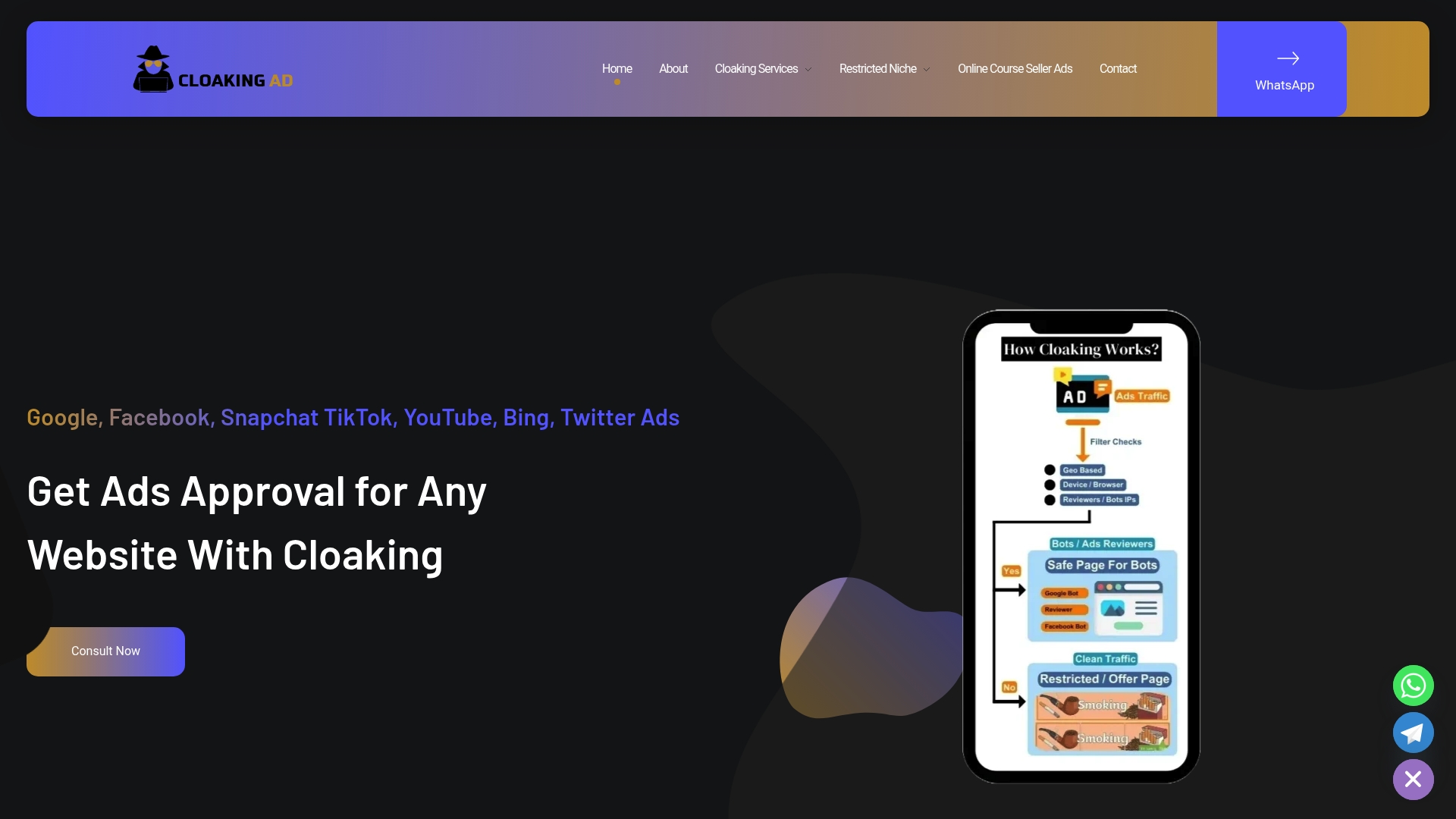
If your rejections keep coming back for the same reason, the fix is usually structural, not creative. CloakingAd builds the cloaking setup, crawler whitelisting, and reviewer-detection logic that let compliant campaigns in restricted verticals run without constant manual resubmission.
- Book a consultation call to diagnose a specific rejection pattern.
- Get a cloaking system set up for $1,599 one-off to separate reviewer traffic from real visitor traffic.
- Move to a fully managed, done-for-you engagement if you need ongoing account support across campaigns; current prices are available on the service site.
Start with a consultation to see which option fits your situation.
Sources
- The Consumer Reviews and Testimonials Rule: Questions and Answers | Federal Trade Commission
- How To Do Affiliate Marketing On Facebook (In 2026) – WeCanTrack
FAQ
How do you get approved for affiliate marketing?
Build a site with original, publicly accessible content, disclose your traffic sources honestly, and apply only with promotional methods you actually plan to use. Reviewers at programs like Amazon Associates look for substantive content before approving new affiliates.
How long does affiliate approval usually take?
Manual affiliate program reviews commonly take 24 to 48 hours, though sensitive verticals can take longer. Ad platform reviews are separate and usually faster, with Google Ads completing automated review within a few hours in most cases.
What is the 80/20 rule in affiliate marketing?
Definitions vary depending on who’s using the term, and it isn’t a rule defined by any platform or regulator covered here. Some affiliates use it loosely to describe the idea that a small share of content or offers drives most results, but treat it as a rough heuristic rather than a fixed standard.
Can I use ChatGPT for affiliate marketing content?
Yes, many affiliates use AI tools to draft or outline content, but platforms still expect the published page to offer genuine, original value rather than thin or duplicated text. Whatever tool you use, the landing page still needs to pass the same crawlability and disclosure checks described above.