

Circumventing systems means using cloaking, duplicate accounts, false verification, or feature misuse to get ads past Google’s review process. Google treats this as an egregious policy violation, which can trigger immediate suspension with no warning. If you suspect any of these practices touch your account, stop them today, audit your setup, and document everything before you file an appeal.
TL;DR:
- Using cloaking, multiple accounts, false verification, or feature misuse to hide policy violations can lead to immediate, no-warning suspensions.
- Automated detection flags cloaking scripts, redirect chains, and account patterns, but egregious violations trigger instant suspension without prior warning.
- Thorough audits should verify linked accounts, landing pages, redirect chains, and server scripts before appealing, since fixing the root cause is essential.
- Appeals must only be filed after full remediation with documented evidence, including updated verification, matching landing pages, and clear change logs.
- Professional services are recommended when multiple accounts are suspended or redirect setups are too complex to audit internally, especially for high-risk categories.
Table of Contents
- Policy breakdown: what Google means by circumventing systems
- Common violations and concrete examples
- How Google detects and enforces this policy
- Audit checklist: find circumvention risk in your account
- Fixing a suspension and appeal best practices
- Operational prevention: processes and safeguards to avoid future violations
- When to hire a specialist and what legitimate services should provide
- Publisher perspective: prioritized actions advertisers should take now
- CloakingAd services: consultation and managed remediation
- Sources
- FAQ
Policy breakdown: what Google means by circumventing systems
Google’s Circumventing systems policy bans any attempt to bypass, trick, or interfere with its ad review systems. The policy exists because these tactics let advertisers hide violations from reviewers while showing compliant content to Google’s crawlers and a different, often prohibited, experience to real users. That gap between what a reviewer sees and what a person clicks through to is exactly what the policy targets.
The rule covers several distinct behaviors:
- Cloaking: showing different content, URLs, or code to Google’s review systems than to actual visitors.
- Multiple-account abuse: creating new accounts to replace ones that were suspended, rather than fixing the underlying issue.
- False verification information: submitting inaccurate business identity, ownership, or billing details during advertiser verification.
- Feature misuse: exploiting ad extensions, dynamic keyword insertion, or other tools in ways that mislead reviewers about the ad’s true destination or intent.
There is a real line between allowed personalization and banned obfuscation. Showing a returning visitor a different offer than a first-time visitor is normal marketing. Showing Google’s reviewer a clean landing page while redirecting everyone else to a restricted product is the behavior this policy exists to catch. The distinction is intent and audience: personalization adapts content based on legitimate signals like location or past behavior, while circumvention hides the true nature of the ad from the one audience whose approval you need.
Common violations and concrete examples
Most circumventing systems suspensions trace back to a handful of recognizable patterns. Knowing what they look like in practice makes it much easier to spot the same setup in your own account before Google does.
- Cloaking through user-agent detection: a script identifies Googlebot or a reviewer’s IP range and serves a benign page, while regular visitors land on a page selling a restricted product.
- Cloaking through geographic redirects: the ad’s display URL resolves to a compliant page for reviewers in one region but redirects real traffic to a different, non-compliant offer.
- Multiple-account abuse after suspension: an advertiser opens a new account under a slightly different business name, using the same website, payment method, or physical address as a suspended account.
- Verification fraud: submitting a business registration document that does not match the actual advertiser, or listing an owner who has no real connection to the business.
- Tracker and redirect misuse: chaining multiple redirects through third-party trackers so the final destination differs from what the ad’s URL implies.
Not every unusual setup is a violation. Legitimate A/B testing, geotargeted landing pages that stay within the same product category, and standard analytics redirects are generally safe, provided the core offer and content stay consistent for every visitor including reviewers. Document these setups with screenshots and configuration notes so you have a ready explanation if a reviewer flags them by mistake.
Pro Tip: Before launching any redirect chain, load your final landing page from a clean browser with no cookies and confirm it matches what your ad promises. If it does not, a reviewer will notice the same gap.
How Google detects and enforces this policy
Google combines automated detection with human review to catch circumvention. Machine learning systems flag suspicious patterns first, cloaking scripts, redirect chains, mismatched landing pages, and account creation patterns that resemble known abuse. Human reviewers then confirm serious cases before action is taken, though egregious violations can trigger suspension immediately, without the warnings advertisers get for lesser infractions.
Several mechanics matter for advertisers trying to understand their exposure:
- Automated systems and human review work together, but egregious categories skip the usual grace period.
- Circumventing systems sits alongside coordinated deceptive practices, counterfeit goods, and malicious software as an egregious violation that can end an account without prior notice.
- Suspensions frequently spread across linked accounts that share a payment method, domain, business identity, or device fingerprint.
- Google rarely explains exactly which signal triggered enforcement, which makes a broad self-audit more useful than trying to guess the single cause.
Google uses automated detection combined with human review to catch policy violations, and egregious cases can result in immediate suspension without warning. That combination is why a single cloaked landing page can take down not just one campaign, but every account tied to the same business identity.
This is also why fixing the symptom, a flagged ad or a single landing page, rarely resolves the suspension on its own. Google’s enforcement targets the root cause: the account, the identity behind it, or the payment instrument connecting it to other suspended accounts.
Audit checklist: find circumvention risk in your account
Before you touch the appeal button, run a structured audit. Google’s own circumventing systems guidance recommends stopping the affected activity and correcting the underlying issue first, since an appeal without remediation rarely succeeds.
- Check linked accounts. Review every account that shares your payment method, business address, phone number, or website domain, and confirm none of them carry an active suspension.
- Verify your advertiser identity. Confirm the business name, registration documents, and billing details in your account match public records exactly.
- Audit payment instruments. Look for expired cards, mismatched billing names, or any payment activity that could read as suspicious, since billing issues carry their own suspension risk separate from circumvention.
- Test your landing pages as a reviewer would. Load every destination URL from a clean session, disable cookies, and confirm the content matches what the ad promises, with no geographic or device-based swap that changes the core offer.
- Trace every redirect and tracker. Map out each hop between the ad’s display URL and the final page, and remove any redirect that changes the offer, price, or product category along the way.
- Look for technical cloaking fingerprints. Check server logs and scripts for user-agent detection, IP-based branching, or conditional rendering tied to known crawler signatures. These are the clearest technical proof points Google’s systems look for.
- Log every fix with a timestamp. Keep screenshots, code diffs, and dated notes for each change, since this documentation becomes the backbone of your appeal.
Pro Tip: Run the landing page test from a mobile connection and a desktop connection separately. Cloaking scripts often target one device type and get missed if you only check from your usual laptop browser.
Fixing a suspension and appeal best practices
File an appeal only after you have completed a full remediation, not before. Google’s account suspension guidance treats an appeal as a request to re-review a specific, already-corrected account, and a premature appeal that repeats the original violation typically gets denied and can make future appeals harder to win.
Community reporting on suspension threads confirms that appeals for circumventing systems violations are rarely successful without clear remediation evidence, so treat the evidence stage as the real work and the appeal form as the last step.
Prepare these before you submit anything:
- A remediation report listing exactly what changed: removed scripts, corrected landing pages, closed duplicate accounts, updated verification documents.
- Business verification documents that match your account details precisely, including registration numbers and billing names.
- Screenshots or logs showing the corrected landing page matches the ad content for every visitor type.
- A short, factual statement describing what happened and what you fixed, written without excuses or vague promises to “do better.”
Avoid the two most common mistakes: appealing before the fix is complete, and writing a generic statement that does not reference the specific account or violation. If Google denies the appeal, most policies allow only one appeal per suspension, so treat a rejection as final unless the notice explicitly invites a resubmission with new information.
Operational prevention: processes and safeguards to avoid future violations
Preventing a circumventing systems violation is cheaper than recovering from one. A few structural habits keep most advertisers out of the danger zone entirely.
- Separate accounts by business unit, never by “backup” copies of the same offer, since duplicate accounts for the same product are themselves a red flag.
- Keep verification documents current and matched exactly to the business name and address used in billing.
- Review landing pages after every redirect or tracker change, not just at launch, since third-party tracking updates can introduce cloaking behavior without anyone intending it.
- Assign one person or team to own compliance checks before any new campaign goes live, so testing does not fall through the cracks between marketing and development.
| Safeguard | Frequency | What it catches |
|---|---|---|
| Landing page audit | Before every launch | Redirect drift, offer mismatch |
| Verification review | Quarterly | Outdated business documents |
| Linked account check | Monthly | Shared payment or domain risk |
| Tracker and script review | After any dev change | Accidental cloaking behavior |
Routine monitoring matters as much as the initial setup. A tracker vendor update, a new redirect rule, or a CMS plugin can introduce cloaking-like behavior weeks after launch with no one noticing until Google’s systems do. Building a monthly check into your workflow, rather than a one-time audit, is what keeps an account clean over time.
When to hire a specialist and what legitimate services should provide
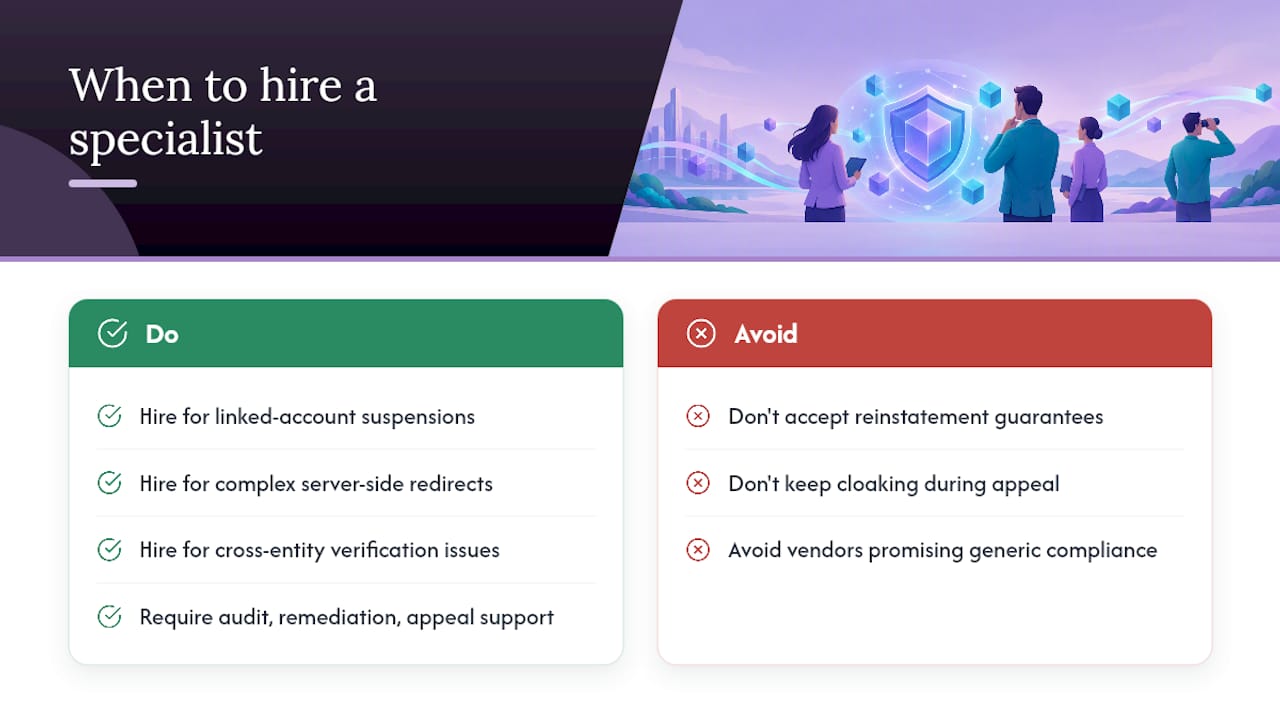
Professional help makes sense when a suspension spreads across a portfolio of linked accounts, when server-side redirect logic is too complex to audit internally, or when verification documentation needs to be reconciled across multiple business entities. These situations often require technical changes that go beyond what an in-house marketing team can safely execute.
A compliant vendor should provide a transparent audit of your current setup, a documented list of every remediation step taken, and support preparing verification materials for an appeal. Reputable help focuses on fixing the mismatch between what reviewers see and what users see, not on building a better version of that mismatch.
Watch for red flags: any vendor that guarantees reinstatement, or that instructs you to keep cloaking active while appealing, is setting you up for a repeat suspension. CloakingAd works with advertisers in high-risk categories such as CBD, crypto, forex, and health supplements, offering consultation calls, cloaking system setup, and fully managed campaign support built around platform-specific compliance knowledge rather than generic promises.
Publisher perspective: prioritized actions advertisers should take now
If you take nothing else from this, do three things today: stop any redirect or script that shows reviewers a different page than real users see, check every linked account for shared payment or domain exposure, and freeze new account creation until the root cause is fixed. Skipping straight to an appeal without this work is the single most common reason appeals fail.
The bigger operational shift is treating compliance as a recurring check, not a launch-day task. Trackers change, plugins update, and a clean setup today can drift into cloaking territory within weeks. Build that review into your monthly routine, not your incident response.
— Umar
CloakingAd services: consultation and managed remediation
If your account is already suspended across multiple linked properties, or your redirect logic is too complex to safely audit yourself, that is the point where paid help earns its cost. Specialized services exist for restricted verticals where standard compliance advice does not address specific review triggers these categories face.
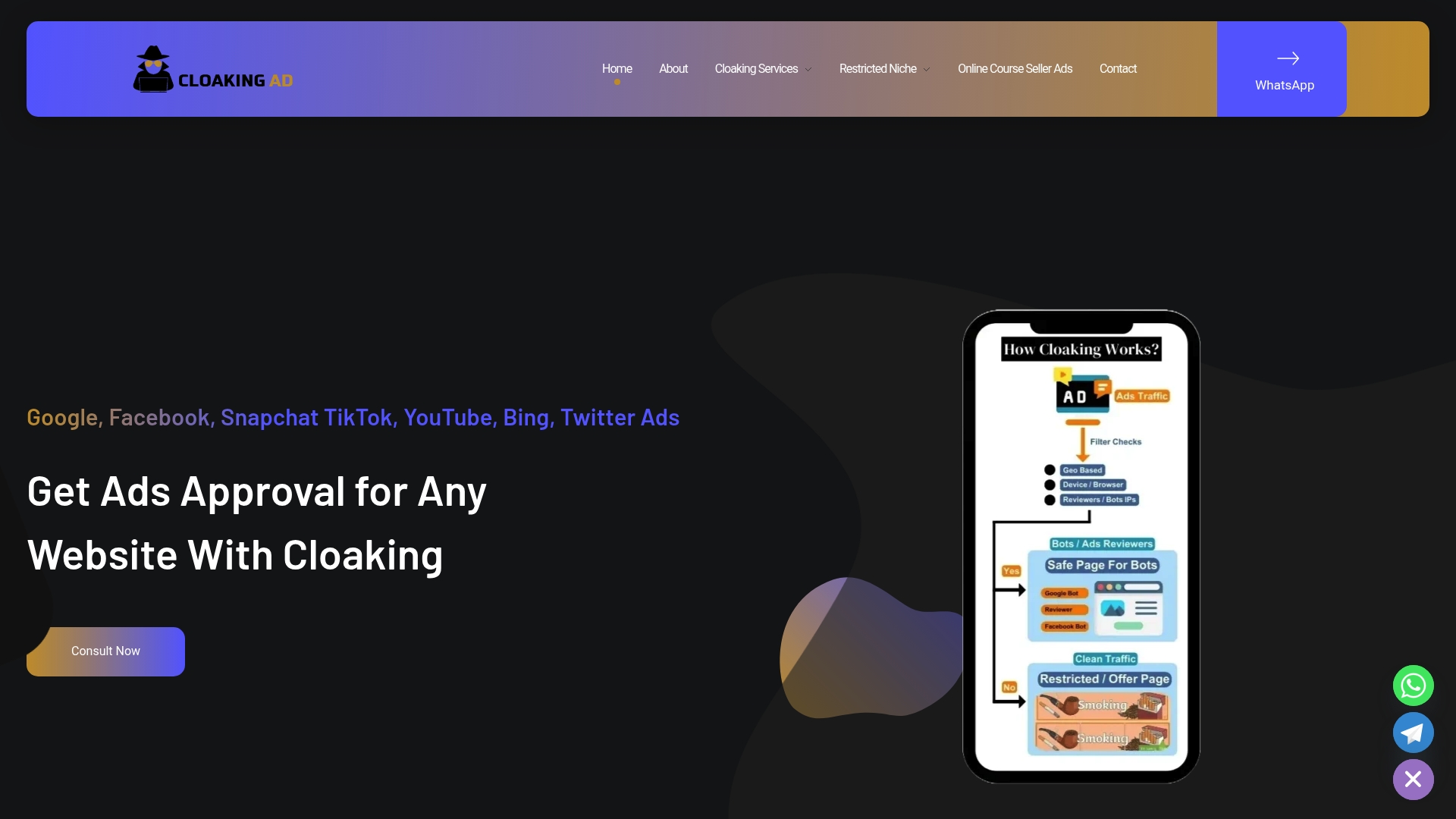
Services include:
- Consultation calls to review your current setup and identify exposure before you appeal.
- Cloaking system setup, a one-off engagement priced at $1,599, for advertisers who need server-side configuration built correctly from the start.
DIY audits work well for a single account with a straightforward landing page. Once you are managing multiple accounts across platforms like Google, Facebook, and TikTok in a restricted niche, a managed setup tends to catch issues an internal team misses. Book a consultation to see which path fits your situation.
FAQ
How to fix Google AdSense policy violation?
Stop the flagged behavior immediately, identify the specific policy cited in the notice, and correct the underlying issue, whether that is a landing page mismatch, a redirect, or missing verification. Document each fix before requesting a review, since Google’s own guidance treats unremediated appeals as likely to fail.
What happens if my Google Ads account is suspended for circumventing systems?
Circumventing systems is classified as an egregious violation, which can cause immediate suspension without prior warning and often affects linked accounts sharing the same payment method, domain, or business identity. Recovery requires fixing the root account before related suspensions clear.
What does “circumventing systems” mean in the context of advertising policies?
It refers to any attempt to bypass or interfere with Google’s ad review process, including cloaking, duplicate accounts, false verification, and feature misuse. The common thread is hiding a policy violation from reviewers while showing it to real users.
What is Google’s cloaking policy?
Google’s policy prohibits showing different content or URLs to its review systems than to actual users in order to hide a violation. This applies regardless of the method used, whether user-agent detection, geographic redirects, or conditional scripts.